How Mattress Materials Affect Temperature Regulation During Sleep
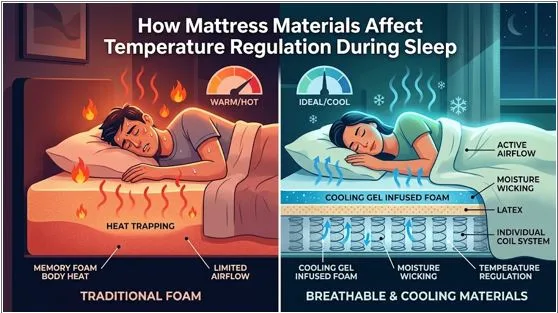
Most people who wake up sweaty at 3 a.m. blame the room. Turn down the thermostat, they think. Get lighter sheets. Maybe a fan. What they rarely consider is that the surface they’re sleeping on — specifically, the materials it’s built from — may be the primary reason heat is building up in the first place.
This isn’t a minor comfort issue. Core body temperature dropping by 1–2°C is one of the key physiological triggers for sleep onset and deep sleep maintenance. A 2024 study published in Neuroscience found that optimizing bed microenvironment temperature increased slow-wave sleep by an average of 7.5 minutes per night — and that was measuring the effect of temperature modulation alone, without any other variable changing. Seven and a half minutes of extra deep sleep sounds modest. Ask anyone with chronic insomnia how they feel about it.
The problem is that most mattress buyers have no practical way to evaluate how a mattress will behave thermally. Brands use the same vocabulary — “cooling gel,” “breathable cover,” “temperature-neutral” — for products that perform completely differently once a warm body spends eight hours on them. Understanding what’s actually happening at the material level changes how you shop.
Why Foam Traps Heat (And Why That’s Not the Whole Story)
Standard polyurethane foam has a closed-cell or semi-closed-cell structure. When compressed under body weight, those cells collapse, reducing air movement through the foam layer almost entirely. Heat generated by the body — typically between 60 and 80 watts during normal sleep — has nowhere to go except back toward the sleeper.
The industry’s first-generation response to this was gel infusion. Gel beads or swirls are incorporated into the foam matrix, and the marketing claim of “stays cool all night” followed. Here’s what the product pages don’t say: the heat-absorbing benefit of gel infusion is real — but finite. Gel beads work by absorbing latent heat as they transition from solid to semi-liquid state. Once that phase transition is complete, the material is thermally neutral. For most gel-infused foam layers, that window is roughly 20 to 45 minutes after body contact.
Copper-infused foam is slightly more defensible. Copper does have genuine thermal conductivity advantages — it conducts heat away from the surface rather than simply absorbing it temporarily. But the concentration of copper particles in typical foam formulations is less than 1% by weight. At that concentration, the bulk thermal conductivity of the foam changes only marginally. The antimicrobial benefit is real; the cooling claim is mostly marketing.
None of this is a conspiracy. It’s physics. Foam-only mattresses have structural limitations when it comes to sustained heat transfer, and no amount of infusion fully overcomes them.
Where Hybrid Mattresses Change the Equation
A hybrid mattress — by standard industry definition, a mattress combining an innerspring coil system with foam or latex comfort layers — solves the thermal problem through a mechanism that foam alone cannot replicate: airflow.
Individually pocketed coil systems, the dominant coil type in quality hybrids since roughly 2010, create a network of air channels throughout the support core. Body movement pumps air through these channels continuously. Heat and moisture that migrate downward through comfort layers are carried away rather than accumulating. This is passive ventilation — no technology required, no phase change involved — and it works consistently across the entire sleep period.
According to Furniture Today’s 2023 market analysis, hybrid mattresses now account for 62% of US mattress retail revenue above the $1,000 price point. That market shift wasn’t driven by marketing alone. Enough consumers experienced the thermal difference to make hybrids the dominant premium category.
But here’s where it gets more nuanced: the coil layer handles deep thermal management, but what a sleeper actually feels is largely determined by the comfort layers sitting above it. A hybrid with a dense, low-porosity foam comfort layer can still sleep hot, because the heat has to travel through that layer to reach the coils beneath. The comfort layer material matters enormously — and this is where material engineering in recent years has produced some genuinely interesting results.
What Advanced Materials Are Actually Doing
The most promising recent developments in mattress thermal management combine two distinct mechanisms: structural airflow and active thermal absorption.
Latex — particularly open-cell latex structures — has long been recognized for its natural breathability. The interconnected cell structure allows air movement through the material itself, not just around it. Natural latex also has higher thermal conductivity than standard polyurethane foam, meaning heat transfers through the layer rather than pooling at the surface.
Phase change materials (PCMs) add a second layer of thermal management. PCMs used in mattress applications are typically microencapsulated paraffins — compounds like n-hexadecane or n-octadecane — that undergo a solid-to-liquid transition at approximately 28–32°C, which is just below skin-adjacent temperature. During this transition, the material absorbs thermal energy from the sleeper without increasing in temperature itself.
The critical engineering challenge is duration. A PCM system that exhausts its absorption capacity in 30 minutes provides early-night comfort but doesn’t address the 3 a.m. heat buildup that affects sleep continuity. The solution — and what separates well-designed systems from marketing theater — is pairing PCM absorption with a structural substrate that continues to facilitate heat transfer after the phase change completes.
Sleepmax‘s Pulse™ Latex-Like Foam with Tempwave™ PCM is a practical example of this combined approach. The material is engineered to replicate the open-cell airflow characteristics of latex — allowing heat to move through the layer rather than accumulate at the surface — while integrating PCM microcapsules that handle the acute thermal load during the critical sleep-onset window. The result is a comfort layer that addresses both the first-hour temperature spike and the longer-term ventilation requirement, without relying on either mechanism alone.
This kind of dual-mechanism design reflects a more honest understanding of what temperature regulation actually requires across a full sleep cycle: not just a fast-responding absorber, but sustained thermal conductivity to support the body’s natural core temperature decline through the night.
The Sleep-Temperature Connection Is More Direct Than Most People Realize
Body temperature and sleep architecture are tightly coupled. Core temperature begins dropping about two hours before natural sleep onset — part of the circadian rhythm managed by the suprachiasmatic nucleus in the hypothalamus. This drop signals the brain to begin producing melatonin and shift toward sleep. If the sleeping surface reflects heat back and slows that drop, sleep onset latency increases. If the surface allows that temperature decline to proceed, sleep comes faster and stages more efficiently into slow-wave and REM cycles.
A 2024 clinical study examining temperature-controlled bed surfaces found that sleeping in a thermally optimized environment increased deep sleep duration by an average of 14.3 minutes in male participants and increased REM duration by 9.2 minutes in female participants — with 75.7% of male participants and 64.3% of female participants rating the temperature-optimized condition as meaningfully better than baseline. These numbers come from active thermal control systems, which represent the ceiling of what’s possible. Passive material design — good hybrids with well-engineered comfort layers — can move the needle meaningfully in the same direction without requiring electronics or a subscription.
What This Means When You’re Buying
Evaluating a mattress’s thermal performance from a product page is genuinely difficult, but there are signals worth checking.
The presence of pocketed coils in the support core is a positive baseline — it confirms the structural airflow advantage of a hybrid architecture. What matters next is the comfort layer specification. Look for open-cell structures, latex or latex-like foams, and any disclosure about PCM integration. The better brands will specify how the PCM is deployed — whether it’s in the cover fabric alone (effective for 20-30 minutes) or integrated into the comfort foam layer itself (more sustained).
Weight is a real variable here. The research on PCM thermal capacity suggests that heavier sleepers generate heat loads that exhaust phase-change absorption faster. For sleepers above roughly 200 lbs, the structural ventilation from a quality coil core matters proportionally more than PCM content.
One more thing: room temperature still matters. The most thermally sophisticated mattress in the world can’t fully compensate for a 30°C bedroom. Passive thermal management works within a range — it shifts the equilibrium point, it doesn’t eliminate it. A well-engineered hybrid with PCM comfort layers performs best when the ambient environment is already within a reasonable range of sleep-optimal temperature (roughly 65–68°F / 18–20°C).
The material engineering in this category has come a long way from the first-generation gel beads. For sleepers who’ve been waking hot and assuming it’s just how they sleep — it might not be the room. It might be what they’re sleeping on.