How Much Weight Does an Ebike Conversion Kit Add? Real Numbers, Where They Sit and What They Do to Handling
The short answer is 6 to 15 kg, and the longer answer is that the number matters less than where it sits. A 7 kg battery inside the frame triangle and a 7 kg battery on a rear rack weigh the same on a scale and ride nothing alike. This guide gives the real component weights for a current UK kit range, a method for measuring what your own bike gains, and a mass map that predicts how the finished bike will handle, brake and lift before you spend anything.
The numbers, by component
Weights below are published figures for KirbEbike’s current range, plus industry-typical figures for hub motor wheels where the exact variant decides the final number. Net added mass is lower than the sum, because the original wheel, tube and tyre come off.
| Component | Weight | Notes |
| EZ Rider 36V 250W front-hub system, complete | 6.0 kg | Motor wheel, both batteries (7Ah + 15Ah) and controls; the lightest complete system in the range |
| Entry XS 36V 15Ah down-tube battery | 2.5 kg | 540 Wh |
| Entry TS 48V 16Ah down-tube battery | 4.0 kg | 768 Wh |
| Entry DP 48V 20Ah down-tube battery | 4.5 kg | 960 Wh |
| Entry DP 52V 20Ah down-tube battery | 5.1 kg | 1,040 Wh |
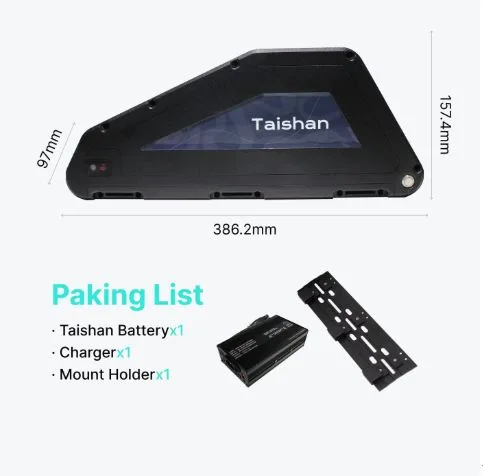
| Taishan 52V 25Ah / 60V 20Ah triangle battery | 6.2 kg | One case size for all voltages |
| Taishan 48V 30Ah triangle battery | 6.72 kg | 1,440 Wh, the range-focused option |
| Taishan 72V 20Ah triangle battery | 6.8 kg | Samsung 50S cells |
| HS-II 52V 30Ah triangle battery | 7.55 kg | 1,560 Wh, the largest pack in the range |
| TSDZ8 500W/750W mid-drive unit | 4.8 kg | Replaces the bottom bracket and crankset |
| Z16 48V 1000W mid-drive unit | about 6 kg | Replaces the bottom bracket and crankset |
| Direct-drive rear hub motor wheel, 1000W–2000W class | typically 6–9 kg built | Industry-typical; confirm the exact variant, and subtract the wheel it replaces |
| Controller, display, harness, sensors, torque arm | 1–1.5 kg combined | Spread around the frame |
Two things stand out. The battery is the biggest single decision: the spread from the lightest pack to the heaviest is over 5 kg. And a hub motor wheel’s net effect is smaller than its gross weight, because a conventional rear wheel with tyre and cassette already weighs 2.5–3 kg.
Three worked examples
| Build | Gross component weight | Minus replaced parts | Net added to the bike |
| EZ Rider 250W front hub with both batteries | 6.0 kg | Front wheel and tyre, about 1.8 kg | about 4 kg |
| 48V 1000W rear hub + Entry 48V 20Ah down-tube pack | 7.5 kg motor wheel + 4.5 kg battery + 1.2 kg electrics ≈ 13 kg | Rear wheel, tyre and cassette, about 2.8 kg | about 10 kg |
| 52V 2000W rear hub + HS-II 52V 30Ah triangle pack | 8.5 kg motor wheel + 7.55 kg battery + 1.5 kg electrics ≈ 17.5 kg | Rear wheel, tyre and cassette, about 2.8 kg | about 15 kg |
A 12 kg hybrid becomes a 16 kg bike in the first case and a 27 kg bike in the third. That is the honest range: 4 kg to 15 kg depending almost entirely on battery and motor class.
Energy per kilogram: the number that ranks batteries fairly
Comparing packs by weight alone punishes the ones that carry the most energy. Divide watt-hours by kilograms and the picture changes.
| Pack | Energy | Weight | Wh per kg |
| Entry XS 36V 15Ah | 540 Wh | 2.5 kg | 216 |
| Entry TS 48V 16Ah | 768 Wh | 4.0 kg | 192 |
| Entry DP 48V 20Ah | 960 Wh | 4.5 kg | 213 |
| Entry DP 52V 20Ah | 1,040 Wh | 5.1 kg | 204 |
| Taishan 52V 25Ah | 1,300 Wh | 6.2 kg | 210 |
| Taishan 48V 30Ah | 1,440 Wh | 6.72 kg | 214 |
| Taishan 72V 20Ah | 1,440 Wh | 6.8 kg | 212 |
| HS-II 52V 30Ah | 1,560 Wh | 7.55 kg | 207 |
Every pack in the range lands between about 190 and 216 Wh/kg, which is what you expect from 21700 lithium-ion cells in a sealed case with a BMS and a rail. The practical reading: a bigger pack does not cost you efficiency, it costs you absolute kilograms and frame space. Choose the energy you need for your route, then choose the lightest case shape that fits the position you can mount it in.
Taishan triangle battery with its case dimensions, 5A charger and mounting plate
The Mass Map: where the weight sits decides how the bike rides
Three positions, three very different bikes.
Front hub. Motor mass on the steering axis. Steering feels slightly heavier and slower to turn in; on steep wet climbs a loaded front wheel can spin. The rear of the bike, drivetrain and any rack are untouched, which is why front hubs suit commuters and folding bikes.
Rear hub. Motor mass behind the rider, on the wheel already carrying most of the load. Traction is excellent. The cost is unsprung mass on a suspension bike and a rearward bias that a rack bag makes worse.
Mid-drive. Motor at the cranks, low and central. The bike’s balance barely changes; it just gets heavier in the place it can best afford. Battery placement then decides everything.
The battery is the tie-breaker in all three. A triangle-mounted pack keeps the mass between the wheels and low; a down-tube pack does the same slightly higher; a rear-rack pack puts 5–7 kg high and behind the saddle, which is the single worst place on a bicycle for weight. When you compare ebike battery weights and case sizes, compare the mounting position in the same breath — a 6.2 kg Taishan in the triangle handles better than a 4.5 kg pack on a rack.
HS-II triangle ebike battery, the largest and heaviest pack in the KirbEbike range
How to measure your own net gain
Catalogue weights tell you what arrives in the box, not what the bike gains. This procedure takes twenty minutes and gives you a number you can plan around.
- Fit the tyres, pedals, rack and lock you normally ride with.
- Weigh the complete donor bike two or three times on the same scale; use the average.
- Weigh the wheel, tube, tyre and any cassette you are about to remove.
- Complete the installation, including torque arm, battery and every permanent accessory.
- Weigh the finished bike with the battery fitted, then once more with it removed.
- If handling is a concern, weigh the front and rear wheels separately on a bathroom scale with the other wheel on a block of the same height.
The battery-removed figure is the one that matters for stairs and car racks. The front/rear split is the one that matters for handling.
Braking must be judged at the finished mass — and speed
More mass means more energy for the brakes to turn into heat. Speed matters even more, because kinetic energy rises with the square of velocity: a 27 kg converted bike at 32 km/h carries more energy than the same bike at 20 km/h with an extra 15 kg on board. Riders upgrading a complete electric bike conversion kit to a higher power class should budget for brake pads at the same time, and check rotor size, caliper clearance and pad compound before the first fast descent.
A larger rotor helps leverage and heat capacity, but only where the fork or frame permits it and the correct adapter is used. It is an upgrade for many bikes and impossible on some.
Handling changes to test before normal riding
- Walk the bike in a tight space with the battery fitted.
- Start on a hill; check the motor does not surge while you balance.
- Ride slowly through a figure of eight.
- Roll over a small bump while braking lightly.
- Stand to pedal and check nothing contacts your legs.
- Lift the bike by the frame, not the battery.
- Load it onto the car rack, train hook or storage hanger you actually use.
Stairs, storage and car racks
A bike that rides well can still be impractical to own. Removing the battery takes 2.5–7.5 kg off the carry, but the motor wheel stays. Practise the real carry — a flight of stairs with a 16 kg bike is fine; with a 27 kg bike it is a different sport.
Car racks have per-bike limits, often around 18–20 kg for hanging racks and more for wheel-tray designs. Check the finished bike against the rack specification, and never clamp a battery case.
Where we stand
The best weight is the weight you can place well. A 15 kg addition in the frame triangle with a correctly built wheel will handle better than an 8 kg addition split between a heavy front wheel and a rack pack. Decide motor position and battery position together, measure the bike you actually end up with, and buy brake pads at the same time as the kit.
Frequently asked questions
How many kilograms does an ebike conversion kit add?
Between about 4 kg for a light 250W front-hub system with small batteries and about 15 kg for a 2000W rear hub with a 30Ah triangle pack, once the replaced wheel is subtracted. The battery is the biggest variable.
Does a larger battery always make handling worse?
No. Position matters more than mass. A larger pack mounted low in the frame triangle usually feels calmer than a smaller pack mounted high on a rear rack.
Which is lighter, a hub motor or a mid-drive?
A mid-drive unit such as the 4.8 kg TSDZ8 is lighter than most 1000W-class rear hub wheels, and it sits lower. A 250W front hub system like the 6.0 kg EZ Rider, including both batteries, is lighter than either as a complete package.
Can I remove the battery before lifting the bike?
Usually, if the pack is a removable rail-mounted design. Check that the rail and slide-off path remain clear after installation, and lift by the frame.
Will a converted bike exceed my car rack’s limit?
It can. Compare the measured weight of the finished bike — not the original frame specification — with the rack’s per-bike limit, and remove the battery before loading.