How Specialized Online Calculators Improve Accuracy in Everyday Decisions
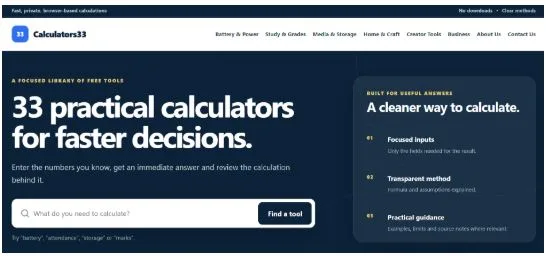
A basic calculator can perform arithmetic, but most real-world problems require more than arithmetic. People must choose the correct formula, match units, account for practical limitations, and decide how the result should be interpreted. Specialized platforms such as Calculators33 are designed around these complete questions, helping users move from raw inputs to results they can understand and apply.
This distinction matters whenever a calculation influences a grade, purchase, project, budget, recording plan, or equipment decision. A mathematically correct answer can still be unhelpful if it uses the wrong cost basis, ignores efficiency losses, mixes incompatible units, or rounds in the wrong direction.
Specialized online calculators reduce these problems by combining formulas with task-specific inputs, validation, unit handling, explanations, and practical output rules. They do not replace human judgment, but they can make that judgment better informed.
What Is a Specialized Online Calculator?
A specialized online calculator is a browser-based tool created for one defined calculation or decision.
Instead of presenting a keypad and expecting the user to construct an equation, it asks for the information relevant to the task. A battery-runtime calculator may request capacity, voltage, load, efficiency, and usable charge range. A weighted-grade calculator may request assessment scores and their assigned weights. A recording-storage calculator may use duration, video bitrate, audio bitrate, and file overhead.
This task-specific structure provides three important benefits:
- It identifies the variables needed for the calculation.
- It applies a formula suited to the user’s question.
- It presents the result with relevant units and context.
A basic calculator answers the equation entered by the user. A specialized calculator helps the user build the right equation before solving it.
Why Basic Calculators Are Often Not Enough
Many calculation mistakes happen before any arithmetic is performed.
A user may select the wrong formula, misunderstand a percentage, enter measurements in conflicting units, or leave out a factor that materially affects the result. The final number may appear reasonable even though the underlying model is incomplete.
Consider several common situations:
- A restaurant owner treats markup and gross margin as identical.
- A student averages grades without applying their different weights.
- A battery user assumes all advertised capacity is available to the load.
- A video creator estimates storage from resolution while ignoring bitrate.
- A craft buyer rounds a material requirement down to the nearest package.
- A homeowner measures a table but forgets the desired fabric drop.
None of these errors is caused by difficult multiplication or division. They occur because the real question has not been translated correctly into mathematics.
A specialized calculator can guide that translation by defining inputs, displaying units, identifying invalid combinations, and explaining what the result represents.
How Online Calculators Improve Calculation Accuracy
An online calculator is useful only when its design supports the method behind the result. Several features make the difference between a dependable tool and a decorative input form.
Task-specific inputs
Every input should have a clear purpose and label. If a calculation requires saleable recipe yield rather than theoretical yield, the tool should make that distinction visible. If runtime depends on usable battery capacity, users should not be left to assume that advertised capacity and usable capacity are always the same.
Good input labels reduce guesswork and help users recognize which information they need before beginning.
Consistent unit handling
Time can be expressed in seconds, minutes, or hours. Storage may use megabytes, gigabytes, or terabytes. Battery specifications may combine amp-hours, watt-hours, volts, watts, and amps. Project measurements may use inches, centimeters, feet, yards, or meters.
Applying the correct formula to incompatible units still produces the wrong answer.
Specialized calculation tools can require users to identify each unit and convert values into a consistent basis before completing the calculation. The result should also display its unit clearly so that a bare number is not copied or interpreted incorrectly.
Visible assumptions
Many practical calculations are estimates because real performance depends on conditions that cannot be predicted perfectly.
A battery estimate may depend on efficiency and reserve capacity. A storage estimate may include file overhead. A material estimate may require a waste allowance. A food-pricing calculation may include only selected direct costs rather than every operating expense.
When these assumptions remain hidden, users may mistake a planning estimate for a guaranteed result. A reliable calculator identifies the factors affecting the answer and allows important assumptions to be adjusted where appropriate.
Input validation
A field accepting a number does not mean every number is valid.
Zero recipe yield, negative recording duration, a percentage outside its meaningful range, or more attended classes than total classes should not generate an ordinary result. These inputs describe impossible or incomplete scenarios.
Useful calculators detect such conditions and explain what must be corrected. They should also identify genuine boundary outcomes, such as a required exam score exceeding the maximum available marks.
Appropriate rounding
Rounding should reflect the decision being made.
A requirement of 7.2 skeins normally means purchasing at least 8 whole skeins. A curtain plan requiring paired panels may need to increase to the next even quantity. A percentage may be shown to two decimal places while its underlying calculation retains additional precision.
Automatically rounding every answer to the nearest whole number can create shortages or change the intended target. Strong calculators distinguish between exact results, display precision, and practical purchase quantities.
Examples of Specialized Calculators in Everyday Use
Specialized online calculators serve users in many fields because each field applies numbers differently.
Education and academic planning
Students regularly work with percentages, but the correct method depends on the question.
A marks-percentage calculation compares obtained marks with the total available. A weighted-grade calculation applies the contribution assigned to each course component. A final-exam calculation determines the score needed on remaining work to reach a target grade.
Attendance planning creates another type of problem. A student may need to calculate current attendance, determine how many future classes must be attended, or estimate how many classes can be missed while maintaining a required percentage.
A tool designed for one of these questions should explain its specific method rather than treating every educational percentage as the same calculation.
Battery, charging, and power planning
Battery labels provide useful specifications, but they do not always describe the energy that will reach a connected device.
Runtime can depend on battery capacity, voltage, load, conversion efficiency, reserve level, condition, and discharge behavior. Charging time may depend on charger power, battery energy, input limits, and charging losses.
A simple capacity-divided-by-load calculation can provide a rough starting point, but a specialized calculator can make efficiency and usable charge range visible. This helps users understand why real-world runtime may differ from an ideal estimate.
Such results should still be treated as planning estimates. Temperature, equipment condition, battery age, changing loads, and manufacturer limits can affect actual performance.
Digital media and storage estimation
File size is not determined by resolution alone.
For compressed video, bitrate and recording duration are major factors. Audio bitrate and container overhead can add to the final requirement. Uncompressed audio instead depends on sample rate, bit depth, channel count, and duration.
A creator planning a long recording session needs more than a rough file-size number. The useful result may include total storage, storage per hour, recording time available on a selected device, and an optional planning allowance.
This allows the user to compare scenarios before purchasing storage or beginning a recording that cannot be interrupted.
Small-business pricing
Business calculations often use familiar words that describe different relationships.
Food cost percentage compares selected food cost with selling price. Gross margin compares gross profit with selling price. Markup compares gross profit with cost. Entering the same percentage under each method does not produce the same selling price.
A useful menu-pricing calculation should identify the selected cost basis and pricing method. It should also clarify that gross profit after food cost is not automatically net profit. Labor, rent, utilities, taxes, delivery fees, commissions, and other expenses may remain.
The calculator organizes the mathematics, while the business owner decides whether the result fits operating costs, customer demand, and local market conditions.
Home and craft projects
Project calculations frequently require practical allowances that are absent from the basic geometric formula.
Curtain planning may involve track width, desired fullness, panel width, hems, pattern repeats, and equal pairs. Tablecloth sizing depends on table shape, dimensions, desired drop, and sometimes floor-length clearance. Yarn estimates can use swatch consumption, project area, skein length, and a buffer. Cross-stitch fabric sizing depends on stitch count, fabric count, stitch-over value, and margins.
The exact mathematical size may not be the final shopping quantity. Fabric widths, whole skeins, matching pairs, finishing allowances, and pattern repeats can change what must be purchased.
Specialized Calculator vs Basic Calculator vs Spreadsheet
Each calculation method has a useful role.
Basic calculator
A basic calculator is suitable when the user already knows the correct equation and units. It is fast for direct arithmetic but provides little protection against a poorly constructed formula.
Spreadsheet
A spreadsheet is useful for recurring calculations, custom models, stored records, and large collections of data. However, the user must build, test, and maintain the formulas. A hidden reference error or overwritten cell can affect many results.
Specialized online calculator
A specialized calculator is useful when someone needs a focused answer without building the model from the beginning. It can define the inputs, apply the formula, validate entries, and explain the result within one interface.
The best choice depends on the task. A specialized calculator can be used for a quick estimate or as an independent check on a spreadsheet, while a spreadsheet may be more suitable for ongoing operational records.
A Practical Example: Planning Video Storage
Suppose a creator plans to record video at 12 megabits per second for two hours, with audio at 192 kilobits per second.
The video bitrate is:
12 megabits per second
The audio bitrate is:
0.192 megabits per second
The combined bitrate is:
12 + 0.192 = 12.192 megabits per second
Two hours contain:
2 × 60 × 60 = 7,200 seconds
The estimated data quantity in megabits is:
12.192 × 7,200 = 87,782.4 megabits
Because there are eight bits in one byte:
87,782.4 ÷ 8 = 10,972.8 megabytes
That is approximately 10.97 decimal gigabytes before adding container overhead or a safety allowance.
The arithmetic is straightforward once every value uses a compatible unit. The challenge is knowing that audio should be added, hours must be converted to seconds, bits must be converted to bytes, and real files may require additional space.
This is the type of multi-step process that a specialized storage calculator can organize automatically while still showing the method.
How to Check Whether an Online Calculator Is Reliable
Users should not trust a calculator solely because its interface looks professional. Before relying on an important result, check the following.
The formula is explained
The page should identify the main formula or calculation method. A visible method allows users to confirm that the tool addresses the intended question.
Every input is defined
Labels should state what each value represents. Supporting guidance should clarify terms that could be interpreted in more than one way.
Units are unambiguous
Both inputs and outputs should display units. If conversions occur, the page should make them understandable.
Assumptions are disclosed
Efficiency, overhead, waste, reserve capacity, and other adjustable factors should not be silently included.
Errors are handled clearly
The tool should reject missing, impossible, or contradictory inputs rather than producing meaningless results.
The result has context
A useful output explains whether the number is exact, estimated, minimum, required, or recommended.
A worked example is available
A simple example helps users understand the process and independently verify the tool’s behavior.
Limitations are acknowledged
Reliable tools do not claim to know factors that their inputs cannot measure. Estimates should be labeled as estimates.
Privacy and Accessibility Also Matter
Many everyday calculations do not require an account, email address, or permanent record.
A student testing grade scenarios, a creator estimating file size, or a homeowner planning materials should not need to provide unrelated personal information. Browser-based processing can allow inputs to remain within the current session, although users should still review the website’s privacy information.
Accessibility also affects usefulness. A calculator should work on mobile and desktop screens, use readable labels, support keyboard navigation where possible, and present validation messages near the relevant fields.
Speed is valuable, but a fast result is not enough if the user cannot understand the form or determine why an error occurred.
What Online Calculators Cannot Decide
Specialized calculators are decision-support tools, not decision-makers.
A battery calculator cannot fully predict temperature, battery aging, manufacturing variation, or changing equipment loads. A pricing calculator cannot know whether customers will accept a proposed price. A storage calculator cannot anticipate every encoder behavior. A craft calculator cannot measure differences in individual technique.
The quality of the output also depends on the quality of the inputs. Incorrect ingredient costs, outdated battery specifications, inaccurate measurements, or unrealistic efficiency assumptions will affect the result.
For safety-critical, contractual, medical, legal, tax, or major financial decisions, an online estimate should be checked against authoritative requirements or qualified professional advice.
Frequently Asked Questions
What is the main benefit of a specialized online calculator?
Its main benefit is context. It organizes the inputs, formula, units, assumptions, and output around one practical question instead of requiring the user to construct the entire calculation manually.
Are free online calculators accurate?
They can be accurate when they use the correct formula, handle units consistently, validate inputs, and explain their assumptions. Users should confirm that the calculator’s method matches their situation and independently check important results.
How is a specialized calculator different from a basic calculator?
A basic calculator performs the equation entered by the user. A specialized calculator helps determine which values and formula belong to a particular task before performing the arithmetic.
Can an online calculator replace a spreadsheet?
It can replace a spreadsheet for many quick or occasional calculations. Spreadsheets remain useful for stored data, repeated records, custom models, and calculations involving many rows or changing business information.
Why can two calculators produce different results?
They may use different formulas, default assumptions, units, rounding rules, or cost definitions. Comparing the displayed methods and inputs usually reveals the reason.
Should calculator results be rounded?
Rounding depends on the purpose. Percentages may use decimal precision, while physical items such as skeins, panels, or storage devices may require rounding upward to a usable quantity.
Do online calculators replace professional advice?
No. They can support planning and provide preliminary estimates, but they cannot account for every legal, financial, technical, medical, or safety-related circumstance.
Making Numbers More Useful
The real value of a specialized online calculator is not that it performs multiplication or division faster. Its value is that it organizes a real question into a clear and reviewable calculation.
A useful tool identifies the required inputs, keeps units consistent, exposes important assumptions, handles invalid scenarios, and explains what the result means. This helps users catch mistakes before those mistakes affect a purchase, project, grade, or operating decision.
As more everyday planning moves into digital workflows, demand will continue growing for calculation tools that are not only fast but also understandable. The most dependable tools will be those that show their reasoning, respect the limits of estimates, and help users turn numbers into practical decisions.