How Texas Megachurches Are Solving Their Acoustic Challenges
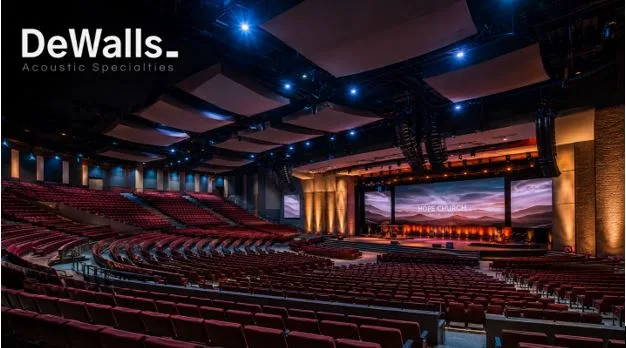
| Texas megachurches solve their acoustic challenges through a five-layer framework: controlling stage volume at the source, applying targeted wall absorption at primary reflection points, suspending acoustic clouds over seating areas, adding diffusion panels to preserve room energy, and implementing digitally steered line-array speaker systems with precision DSP tuning. No single solution works on its own. The combination of all five – completed in the right order – is what separates sanctuaries where every word lands clearly from ones where the sermon gets swallowed by the room. |
The Room That Has to Do Everything
Walk into a Texas megachurch on a Sunday morning and you are standing inside one of the most acoustically demanding environments in American architecture. The room has to carry a whispered prayer, sustain a full worship band at concert volume, and deliver sermon clarity to thousands of seats – all at the same time.
That is not a speaker problem. That is a physics problem.
Texas is home to approximately 210 megachurches, placing it second only to California nationally, according to the Hartford Institute for Religion Research. The average megachurch in the United States hosts over 4,000 people per service. When you place that many people inside a building designed to feel grand and architecturally impressive, you get reverberation times that stretch to three, four, and sometimes five seconds – far beyond what the human brain can decode as clear, intelligible speech.
Churches across Texas have spent years patching this problem with more speakers and more volume. That approach does not work. Turning up the volume in a reverberant room does not improve clarity – it makes the reverberation louder, too.
The megachurches getting this right are working with experienced acoustic and soundproofing specialists in Texas who understand the specific physical and environmental conditions that make Texas worship spaces uniquely challenging. This guide explains exactly what they are doing, in the order they are doing it, and why the sequence matters as much as the individual solutions.
Why Texas Megachurch Acoustics Present a Unique Challenge
Texas megachurches do not struggle with acoustics for the same reasons a 200-seat community church does. Three compounding factors make large Texas sanctuaries significantly harder to treat than equivalent rooms in other parts of the country.
1. The Arena-Style Building Problem
Texas megachurch design draws heavily from stadium and arena architecture. Wide, flat seating bowls with parallel side walls stretching 150 to 300 feet create slap echo paths with delay times of 80 to 150 milliseconds – well beyond the 50-millisecond threshold where the human brain stops fusing reflections into a single sound and starts hearing them as distinct, disorienting echoes. Multiply that by several simultaneous reflection paths, and the sermon becomes an unintelligible wash of overlapping sound.
2. The Metal Building Factor
A significant percentage of Texas megachurch satellite campuses occupy pre-engineered metal buildings or converted big-box retail spaces. Steel deck roofing creates flutter echo – a rapid, repeating high-frequency bounce between two hard parallel surfaces. Concrete slab floors and metal walls together provide almost zero natural absorption across all frequency ranges. That combination requires structural decoupling before any surface treatment can be effective.
3. The Rapid-Growth Retrofit Reality
Texas megachurch culture prioritises fast campus expansion. Gateway Church operates across 11 Texas locations. Fellowship Church draws over 24,000 weekly from its Grapevine campus. Many satellite locations launched inside warehouses, school gymnasiums, and former retail spaces – with acoustic consultants brought in only after the congregation had endured months or years of poor sound every Sunday.
These three factors – extreme room geometry, hard building materials, and retrofit constraints – make Texas megachurch acoustics genuinely harder to solve than almost anywhere else.
The Two Measurements That Define the Problem
Before spending a single dollar on acoustic treatment, a church needs two specific measurements. Vague complaints about “bad echo” or “muddy sound” cannot be fixed systematically. These two numbers tell you exactly how far the room is from where it needs to be.
RT60: How Long the Room Holds Sound
RT60 is the time, in seconds, for sound energy to decay by 60 decibels after a source stops. In plain terms, it is how long the room echoes after the pastor stops speaking.
- 8 to 1.5 seconds – target RT60 for clear spoken word (established acoustic design standard)
- 5 to 2.0 seconds – preferred RT60 for contemporary worship music
- 0 to 5.5 seconds – typical untreated Texas megachurch sanctuary
That gap between target and reality is where sermon clarity gets lost every Sunday.
STI: How Clearly Speech Reaches the Listener
STI (Speech Transmission Index), defined in IEC 60268-16, measures speech intelligibility on a scale of 0.0 to 1.0. Worship spaces should target a minimum score of 0.60 (Good):
- Above 0.75 – Excellent
- 60 to 0.75 – Good (minimum target for sermon clarity)
- 45 to 0.60 – Fair
- Below 0.45 – Poor
Research on large worship spaces with excessive reverberation consistently finds STI scores averaging around 0.48 (Poor range). Targeted acoustic treatment combined with proper loudspeaker optimisation can realistically achieve 0.70 to 0.72 – the Good-to-Excellent range where every word of the sermon arrives clearly at every seat.
Practical self-audit tip: Both RT60 and STI can be measured for free using Room EQ Wizard software paired with a calibrated measurement microphone (approximately $200). Any worship tech team can establish a baseline before making any purchasing decision.
The Five-Layer Acoustic Solution Framework for Texas Megachurches
Texas megachurches that successfully solve their acoustic problems do not rely on a single intervention. They work through a structured, five-layer framework – in order. Skipping a layer or completing them out of sequence consistently produces poor results and wasted budget.
Specialist contractors who focus on church acoustic treatment in Texas typically apply this layered framework as a diagnostic methodology – each layer revealing what the next layer needs to address.
Layer 1: Control Stage Volume at the Source
The single highest-return acoustic intervention available to a megachurch is eliminating unnecessary sound before it enters the room. Most worship teams use floor monitor wedges to let musicians hear themselves on stage. Each wedge points directly back toward the congregation and projects loud, undirected sound into the room – actively worsening the acoustic problem the rest of the framework is trying to solve.
The two changes that deliver the most immediate improvement:
- Switch to in-ear monitors (IEMs) – Systems such as the Shure PSM300 and Sennheiser EW-IEM G4 are widely used at the megachurch level. IEMs eliminate floor wedge bleed entirely, removing the single largest source of uncontrolled acoustic energy in the building.
- Add a drum enclosure – Full isolation cages reduce room drum SPL by 15 to 20 decibels. Acrylic shields reduce it by 6 to 10 decibels. Both remove high-energy transient sound from the room before it can excite reverberant reflections.
No acoustic panel absorbs sound that was never released into the room in the first place. This is why Layer 1 consistently delivers more improvement per dollar than any surface treatment.
Layer 2: Targeted Wall Absorption at Primary Reflection Points
Effective wall treatment is not about covering every surface – over-treatment makes a room feel acoustically dead and strips worship music of its energy and presence. The goal is to address primary reflection points: the rear wall, the underside of the balcony fascia, and the side walls at first-reflection zones.
How to find primary reflection points:
- Have someone sit in a representative seat in the congregation.
- Another person slides a flat mirror along the wall until the speaker cabinet is visible in the reflection – that position is the primary reflection point.
- Mark those positions before specifying any treatment product.
Material selection matched to frequency range:
- 2-inch fabric-wrapped fiberglass panels – controls high-to-mid frequency reflections (above 500 Hz)
- 4-inch fabric-wrapped panels – extends low-mid frequency control
- Bass traps at room corners – addresses 80–250 Hz low-frequency buildup that standard panels cannot reach
Target 25 to 40 percent coverage of the rear wall surface. Covering 100 percent removes too much energy. Rooms that are over-treated sound correct by measurement and wrong by ear – the congregation stops wanting to be there.
Layer 3: Ceiling Cloud Systems Over Congregation Seating
High, cavernous ceilings are the most common acoustic enemy in a Texas megachurch. Sound travels upward, hits the ceiling at 30 to 60 feet above the floor, and returns to the congregation 30 to 80 milliseconds later – delayed enough to smear the original signal into unintelligibility.
Acoustic clouds suspended at 18 to 25 feet above finished floor intercept those wave paths before they fully develop. Two cloud orientations serve different purposes:
- Flat clouds – absorb energy directly, reducing total reverberation time
- Angled clouds – redirect sound laterally, reducing buildup while preserving room acoustic energy
A secondary benefit that most acoustic articles miss: properly positioned ceiling clouds reduce the SPL level the mix engineer needs to run the speaker system. Better early sound coverage reaches rear seats at lower overall volume. Lower system volume means less energy bouncing off walls – a compounding benefit that surface panels alone cannot produce.
Important: Any suspended cloud system in a metal-frame building requires structural load verification by a licensed rigging engineer before installation.
Layer 4: Diffusion Elements to Preserve Acoustic Energy
Absorption treats the echo problem. Diffusion prevents the over-treatment problem.
Quadratic residue diffusers (QRDs) and barrel diffusers scatter sound waves in multiple directions instead of absorbing them. They preserve the sense of acoustic life in the room – the feeling that the sound has somewhere to go – while eliminating the coherent reflections that cause intelligibility problems.
Professional target for treated surfaces:
- 60 to 70 percent of treated surface area – absorption
- 30 to 40 percent of treated surface area – diffusion
Rooms treated with absorption alone feel acoustically claustrophobic – correct by the numbers, wrong by ear. Diffusion is what makes a treated megachurch feel like a worship space rather than a recording booth.
Layer 5: Speaker System Design and DSP Tuning
The speaker system either amplifies the benefit of the first four layers or wastes it. Modern digitally steered line arrays use precision vertical pattern control to direct audio into the seating zone while minimising energy hitting the floor, ceiling, and rear wall.
A properly steered line array can reduce rear-wall SPL by 8 to 12 decibels compared to a traditional point-source cabinet at equivalent coverage. That is the acoustic equivalent of treating hundreds of square feet of wall surface – at no materials cost.
DSP tuning is where the largest unrecognised improvements are available:
- Time alignment between speaker arrays – misaligned arrivals create a hollow, phasey quality that no surface treatment can fix
- Frequency equalisation tailored to the room’s specific response, measured post-installation
- EASE acoustic modelling completed before the system is installed to verify coverage before any equipment is purchased
Professional acoustic measurement using Smaart or a comparable tool typically costs $2,500 to $8,000. That investment routinely delivers more improvement than $30,000 in panels installed without tuning. In many Texas megachurches, uncorrected DSP is the primary reason a significant investment in physical treatment underperforms.
The HVAC Problem That Acoustic Panels Cannot Fix
Texas summers regularly exceed 100°F. The HVAC systems required to manage that heat inside a 4,000-seat sanctuary are industrial-scale operations. Older high-velocity duct systems generate background noise levels that bury quiet moments in worship – spoken prayer, moments of silence, acoustic musical passages – under continuous HVAC rumble.
Per ASHRAE standards (Handbook, Chapter 49), worship spaces should target a Noise Criterion rating of NC-25 or below. Older high-velocity HVAC systems in Texas megachurches commonly produce NC-40 to NC-50 – 15 to 25 points above the recommended maximum. At NC-45, the background noise level is clearly audible and distracting to seated listeners during quiet moments.
No acoustic panel can correct an NC-45 HVAC system. The solutions are mechanical:
- Low-velocity ductwork – larger duct cross-sections reduce air turbulence and the noise it generates
- Spring-mounted mechanical equipment rooms – isolates compressor vibration from the building structure
- Neoprene isolation pads – decouples equipment from floors and wall framing
- Interior duct lining – absorbs turbulence noise before it reaches the room
- Variable Air Volume (VAV) systems – reduces airflow during quiet service moments and ramps up for high-occupancy worship sets
New Texas megachurch builds completed after 2018 increasingly specify acoustic commissioning of the HVAC system as a separate contract line item alongside structural and AV work – still rare nationally but rapidly becoming standard practice in Texas.
What Church Acoustic Treatment in Texas Actually Costs
Professional church sound installation typically costs $70 to $125 per seat, including equipment and installation. For a 2,000-seat megachurch sanctuary, the full acoustic remediation cost breaks down roughly as follows:
| Acoustic Intervention | Approximate Cost (2,000-seat) | Priority |
| In-ear monitor system (replaces floor wedges) | $15,000 – $40,000 | 1st – Start here |
| Rear wall & balcony absorption treatment | $8,000 – $25,000 | 2nd |
| Ceiling cloud system over seating | $20,000 – $65,000 | 3rd |
| Diffusion elements (QRD / barrel diffusers) | $10,000 – $30,000 | 4th |
| Line array speaker system upgrade | $80,000 – $350,000 | Conditional |
| DSP tuning & acoustic consultation | $2,500 – $8,000 | Always – highest ROI |
| HVAC acoustic isolation (ductwork + isolation) | $35,000 – $200,000 | New builds / major reno |
Three things worth understanding before committing to any budget:
- DSP tuning and consultation is the highest ROI per dollar on the list. It is also the most commonly skipped.
- Stage volume control is the lowest barrier to entry and the most frequently skipped – churches consistently begin with panels instead.
- Completing the layers in priority order Starting with Layers 4 or 5 while skipping Layer 1 is the most expensive mistake a Texas megachurch makes.
The Streaming Congregation Acoustic Problem Most Churches Ignore
For many Texas megachurches, the online audience now exceeds the in-room attendance count. The acoustic experience that sounds full and rich inside a large sanctuary often sounds muddy and indistinct through a phone speaker or laptop – and that difference directly affects ministry reach.
Why the room sounds different on a live stream:
- In person, your ears use directional hearing and spatial cues to separate direct sound from reverberation – the brain processes them as a single, unified signal.
- A microphone feeding a live stream hears everything as a flat, undifferentiated mix. Excessive room reverb that feels warm in person becomes a blurred, indistinct wash in the recording.
- Viewers on laptops and phones hear this as low-quality audio, which reduces watch time and online engagement regardless of message quality.
How the largest Texas megachurches are addressing this:
- Dedicated broadcast mix positions with their own acoustic treatment zones, isolated from the front-of-house mix position
- Treatment around broadcast microphone pickup zones – not just the general seating area
- Tighter RT60 targets for broadcast zones – the broadcast signal benefits from more controlled reverberation than the in-room listener experiences
Some of the largest Texas megachurches have inverted the traditional priority entirely, designing acoustic treatment around the broadcast signal first and compensating for the in-room experience through speaker system design.
Frequently Asked Questions
How do you fix acoustics in a large church?
Fix acoustics in a large church by working through five layers in order: eliminate excess stage volume (in-ear monitors and drum enclosures first), apply targeted wall absorption at primary reflection points, suspend acoustic clouds over seating areas, add diffusion panels to preserve room energy, then professionally tune the speaker system with DSP measurement. Completing the layers out of order or skipping any single layer consistently underdelivers.
Why do megachurches have bad acoustics?
Megachurches typically combine large parallel hard surfaces, high ceilings, concrete floors, and in Texas, metal building structures – all of which reflect sound rather than absorbing it. The result is reverberation times of 3 to 5+ seconds, well above the 0.8 to 1.5-second target for clear speech. HVAC systems sized for Texas heat add a secondary background noise problem that panels alone cannot address.
How much does it cost to soundproof or acoustically treat a church?
Acoustic treatment for a 2,000-seat megachurch typically ranges from $60,000 to $350,000 depending on scope. A targeted rear-wall absorption treatment runs $8,000 to $25,000. A full digitally steered line array upgrade ranges from $80,000 to $350,000. DSP tuning – consistently the highest return per dollar – costs $2,500 to $8,000.
What is the best acoustic treatment for a church?
No single treatment is best in isolation. Fabric-wrapped fiberglass absorption panels at primary reflection points reduce echo. Acoustic cloud panels suspended over seating reduce reverberation from high ceilings. Bass traps at corners control low-frequency buildup. All three work together – and all three are secondary to eliminating excessive stage volume through in-ear monitors and drum enclosures first.
Does HVAC noise affect church acoustics?
Yes, significantly. Texas megachurch HVAC systems required for summer heat generate background noise levels of NC-40 to NC-50 in older installations – well above the NC-25 maximum recommended by ASHRAE for worship spaces. This background level masks quiet moments in sermons and worship music, and cannot be corrected by acoustic panels. Solutions require low-velocity ductwork, isolated mechanical rooms, and variable air volume systems.
What is a good RT60 for a church?
For spoken word clarity in a church, the target RT60 is 0.8 to 1.5 seconds. For contemporary worship music, 1.5 to 2.0 seconds is preferred. Most multipurpose worship spaces that serve both functions compromise around 1.2 to 1.6 seconds – a range that provides acceptable speech intelligibility while retaining enough reverberation for music to feel supported and full.
What is a good STI score for sermon intelligibility?
Per IEC 60268-16, an STI score of 0.60 or above is rated Good, and above 0.75 is Excellent. Most untreated megachurch sanctuaries score below 0.45 (Poor). Targeted acoustic treatment combined with speaker system optimisation can realistically achieve 0.70 to 0.72 in large rooms – the range where the congregation can follow every word without effort.
Conclusion
Texas megachurches are not solving their acoustic challenges with a single product or one well-placed panel. The ones getting it right work through a deliberate framework – starting with what goes into the room, treating the primary reflection surfaces next, intercepting ceiling reflections, preserving room energy with diffusion, and finally ensuring the speaker system delivers sound precisely where it needs to go.
The physics of a 5,000-seat arena-style sanctuary with five seconds of reverberation are not forgiving. However, churches that treat the problem systematically – beginning with stage volume control, addressing HVAC independently, and ending with professional DSP tuning – consistently reach a point where every seat in the building can follow every word of the sermon, and the worship band still sounds like it belongs in a room of that scale.
That is a solvable problem. It just requires understanding what you are actually solving before spending any money on it.