How to Build a Fixed Deposit Strategy for Short-Term and Long-Term Goals
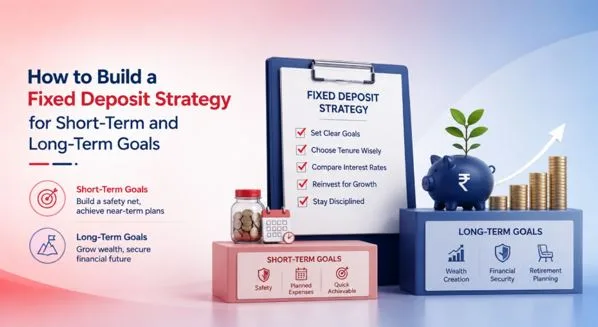
Building a fixed deposit strategy involves matching the product structure—tenure, payout type, rate, and compounding—to the actual timeline and purpose of each savings goal. Simply parking money in a single fixed deposit and calling it a plan often works until a goal-specific expense arrives before maturity, or the deposit renews automatically at a lower bank FD rate without the depositor noticing.
The Core Problem with a Single Fixed Deposit for Multiple Goals
Most depositors treat the fixed deposit as a single instrument for all purposes: emergency buffer, short-term travel fund, child’s education, retirement corpus. The fixed deposit interest rate, tenures, and liquidity requirements for each of these are entirely different. A 2-year FD for a home down payment and a five-year FD for retirement should not be structured identically, even if rates happen to be similar across those tenures.
The mismatch becomes visible at renewal time. An FD opened without a goal attached either gets rolled over at whatever rate is current or gets broken prematurely when the expense arrives, incurring a penalty that reduces the effective return. Mapping each fixed deposit to a specific goal eliminates this drift.
Short-Term Goals and the Rate Trade-Off
Short-term goals—typically those within one to two years—call for shorter FD tenures, even if those tenures attract a slightly lower rate than longer ones. The liquidity risk of locking funds for three years to chase a marginally better rate outweighs the return differential, particularly for salaried individuals managing household cash flow alongside saving.
For short-term accumulation where the corpus does not yet exist, a recurring deposit is a better starting structure. The recurring deposit interest rate at most banks is comparable to the fixed deposit rate for the same tenure. Monthly instalments build the corpus incrementally, and the locked rate protects against downward revisions mid-tenure. Once the RD matures, the proceeds can be moved into a fixed deposit timed to the actual goal—a fee payment, a travel expense, or a short-term business need.
Using a fixed deposit rate calculator at the planning stage clarifies the actual maturity amount for each short-term option. A six-month FD and a twelve-month FD will show different effective yields, and the calculator eliminates guesswork before booking.
Long-Term Goals and the Case for Rate Lock
Long-term goals—retirement corpus, children’s higher education, property purchase—benefit from locking in higher rates early, particularly during periods when rates are elevated. The compounding effect over three to five years on a cumulative FD is substantially more favourable than annual comparisons suggest.
The risk for long-term FDs is the renewal phase. A depositor who books a 3-year FD at a strong rate and lets it auto-renew at a lower rate loses meaningful return on the same principal without realising it. Long-term strategy requires active management at renewal—reviewing the prevailing rate, reassessing tenure, and deciding whether to reinvest or redirect the corpus.
Senior citizens building long-term income should note that the higher rate applicable to them compounds the benefit significantly over longer tenures. On a large deposit, the differential between a standard rate and a senior citizen rate, compounded over five years, can add a meaningful amount to the maturity value.
Laddering as a Structural Strategy
A laddering approach distributes the total investable amount across multiple fixed deposits with staggered tenures—one year, two years, and three years, for instance. As the shorter deposits mature, funds can be reinvested at prevailing rates or redirected to the relevant goal.
This structure serves both short-term and long-term goals simultaneously. The shorter-tenure FDs provide liquidity access at regular intervals; the longer-tenure FDs benefit from compounding and rate lock. No single deposit needs to serve every purpose, and premature withdrawal penalties are avoided because at least one FD is always near maturity.
A fixed deposit rate calculator helps model this across intended tenures before the first deposit is booked. Entering different principal amounts at different rates and tenures produces a projected maturity schedule—essentially a picture of when money will be available and in what amounts.
Aligning Renewal Decisions to the Rate Cycle
The single most impactful long-term decision in a fixed deposit strategy is not the initial booking—it is what happens at renewal. Depositors who pay attention to the rate cycle and choose to extend tenure when rates are high, or shift to shorter tenures when rates are expected to rise further, consistently produce better outcomes than those who simply roll over the same FD without review.
This does not require predicting markets. It requires checking the current rate, running the numbers on the fixed deposit rate calculator for the renewed amount and proposed tenure, and making a deliberate decision—rather than an automatic one.