How to Build a Strong User Feedback Loop With AI, Roadmaps, and Changelogs
A solid product is never constructed due to guesses. It is constructed on user response, good prioritisation, speedy implementation and open communication. But most teams fail to work due to too much feedback coming at them. There are users who post ideas in Discord. The rest of the people will send emails, support tickets, or comment on social media. In the long run, it generates fragmented user feedback, which is difficult to structure.
This problem can be overcome with an appropriate user feedback loop. It provides teams with a consistent approach to feedback, demand, and the creation of the appropriate features, and informs users about the changes.
What Does a User Feedback Loop Mean?
The process of converting user input to product improvement is known as a user feedback loop. It typically consists of five steps:
The first approach is to post feedback by users. Second, it is planned and revised by the team. Third, the team focuses on what is most important. Fourth, developers create and deliver new developments. Lastly, the team updates the team via a change log or roadmap.
The last step is not the most considered step. Several teams gather feedback and do not inform the users about the follow-up. This breaks trust and reduces future engagement.
Step 1: Centralise Feedback
The initial one is getting feedback into a single point. When ideas are spread across Discord, email, support tools, spreadsheets, and private chats, product teams lose visibility.
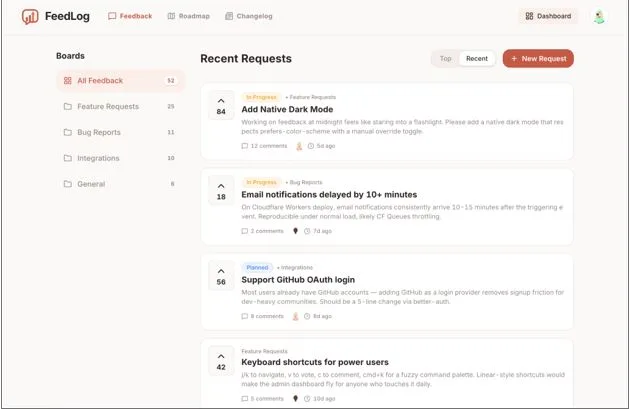
A feedback board provides the users with a special section where the feedback is given, and the existing ideas are voted on. FeedLog’s feedback boards support collecting, organising, voting on, and discussing feature requests. They are also in favour of threaded comments, markdown, and image uploads.
This aids teams in eliminating noise and establishing a single source of truth for product feedback.
Step 2: Use AI to Minimisee Repetitive Requests
Duplicate feedback is common. The same feature is usually requested by users using various words. In the absence of an intelligent system, teams can waste time going over repeated ideas.
This is where AI feedback management improves the workflow. FeedLog also has semantic merge capabilities that will propose similar posts in real time as the user enters. Administrators are also able to combine the same request and retain the votes and contexts.
This assists the product managers in knowing the actual demand behind their frequent requests rather than handling each post as a different idea.
Step 3: Prioritize With a Product Roadmap
When feedback is organised, the team must determine what to do next. The use of a roadmap assists in linking feedback on product planning. It also provides users with visibility into progress.
FeedLog also has an interactive roadmap which interacts with feedback boards and displays what is open, what is planned, and what is being done.
This renders the roadmap more helpful as it is tied to real user requests. In place of developing a fixed planning page, groups will be able to develop a dynamic roadmap that shows actual customer requirements.
Step 4: Communicate With a Changelog
Shipping features are not enough. Users should be aware of what has changed. A clear changelog helps teams announce improvements, explain fixes, and show momentum.
FeedLog also has a built-in changelog that teams can use to post updates to the product, assign shipped entries to first feedback, and inform voters.
This forms a complete circle. Users post feedback, vote on ideas, follow progress on the roadmap and get notified when something ships out.
Step 5: Avoid Vendor Lock-In
A feedback loop is of greater use as time goes by. It holds the user requests, comments, votes, roadmap decisions, and changelog history. Since this is valuable data, teams must consider the location of this data.
FeedLog is a self-hosted and open-source platform. According to its site, teams are allowed to bring their own Postgres database and retain the user emails, feedback materials and product roadmaps under their control.
This assists teams in preventing vendor lock-in and retention of product knowledge.
Why FeedLog Works for SaaS Startup Teams
FeedLog is a collection of the primary ingredients of an effective feedback process: feedback boards, AI-aided triage, a publicly viewable roadmap and a changelog. It has an active repository on GitHub that it describes as a tool on which its users post ideas, vote, and discuss, with teams then triaging the feedback into a roadmap and recording changelog entries once it has been shipped.
It is handy when building SaaS startups, indie hackers, open-source developers, product managers, and engineering teams desire a practical feedback system without fragmented tools.
Final Thoughts
An effective user feedback loop can assist teams in creating better products more confidently. It minimises guesswork, enhances prioritisation, and retains users to attend to them after providing feedback.
FeedLog facilitates this process through integration of an open-source feedback system, AI feedback management, a self-hosted product roadmap, and an explicit changelog strategy. For teams dealing with Discord feedback chaos, rising SaaS costs, scattered user feedback, or vendor lock-in, it offers a structured way to collect, organise, and close the loop with users.