How to Choose the Right Water Purifier for Your Hong Kong Home
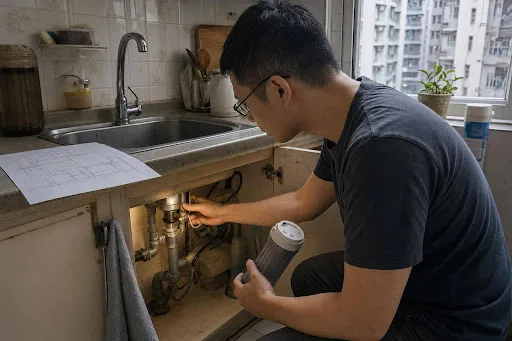
Most Hong Kong flats do not need a complicated water system. They need the right one, sized to a clear goal and the space available.
The Water Supplies Department (WSD) reports that Hong Kong’s treated water complies with the Hong Kong Drinking Water Standards. It also notes that tap quality can be affected by a building’s internal plumbing, including storage tanks, pipe materials, and stagnant water (WSD, My Drinking Water Quality). So the question is rarely: Is the water bad? It is more often: do you want better taste, extra reassurance, or more convenience at the tap, and which filter type supports that goal?
Key Takeaways
- Start with your building, not the gadget. WSD says treated water meets standards, but internal plumbing and tanks can influence what leaves your tap.
- Point-of-use (POU) suits most flats. A compact under-sink or countertop filter targets one tap and is usually easier to fit than a whole-home setup.
- Match technology to the goal. Use NSF/ANSI 42 for taste and odor claims, 53 for certain health-related contaminants, and 58 for RO dissolved-inorganics claims.
- Check recognized certifications. WSD accepts products certified to NSF/ANSI 42, 53, 58, 61, or 401, or to WaterMark, among other pathways.
- Softeners are rarely needed. WSD notes that Hong Kong’s water is generally soft.
Start With Your Water and Your Building
In a typical Hong Kong flat, water travels from the mains through building infrastructure before it reaches your kitchen. Roof tanks, older pipe materials, and long stagnation can affect appearance, taste, or trace content, even when supplied water meets standards.
Recent local incidents show why perception and standards can differ. In 2025, authorities said water at affected estates met standards while investigations linked complaints to particulates from pipe work or materials, followed by measures such as filters and tank cleaning (news.gov.hk; South China Morning Post).
Before spending on hardware, try a few free habits WSD recommends. Flush the tap briefly after long periods of no use, clean tap strainers, and avoid drawing hot tap water for drinking or cooking (WSD, Water Use Tips). WSD also notes that residual chlorine is maintained for safety and dissipates on boiling.
Point-of-Use vs Point-of-Entry for Hong Kong Homes
There are two broad ways to filter water at home.
Point-of-use (POU) treats water at a single tap, including faucet-mounted, countertop, and under-sink systems. Under WSD’s Voluntary Labelling Scheme, faucet-mounted and countertop filters sit at the extremity of the inside service. In-line under-counter and point-of-entry filters are excluded from that definition and typically require backflow prevention (WSD, Application Requirements).
Point-of-entry (POE) treats water for the whole flat at the main line. It covers every tap and can protect appliances, but it needs more space and professional installation.
For most apartments, POU is the simpler match. POE makes more sense when you want whole-home taste and odor improvement or reduced sediment reaching multiple appliances.
Match Your Goal to the Technology
No single system removes everything, so start with the outcome you want and look for third-party certification to the relevant standard.
- Better taste and odor: Activated carbon certified to NSF/ANSI 42 addresses aesthetic effects such as chlorine, taste, and odor (NSF).
- Health-related contaminant reduction: Carbon or other media certified to NSF/ANSI 53 covers contaminants such as lead, Cryptosporidium, and certain VOCs (NSF). WSD recognizes NSF/ANSI 53-certified filters among those capable of reducing lead and notes that not all filters reduce metals (WSD, Water Use Tips).
- Dissolved inorganics: Reverse osmosis (RO) certified to NSF/ANSI 58 requires TDS reduction and allows optional claims such as fluoride, nitrate, and lead reduction (NSF).
- Broader emerging contaminants: Filters certified to NSF/ANSI 401 cover up to 15 emerging contaminants (NSF).
A certification tells you a device was tested for specific claims, not that it removes everything. Read the exact reduction claims and check that they match your target. WSD reports that Hong Kong’s water is generally soft and has been fluoridated since 1961 on Department of Health advice, so U.S.-style water softeners are rarely necessary here.
The Hong Kong Checklist: What to Look For
Use this short list to separate genuine value from marketing.
- WSD Voluntary Labelling Scheme recognition. Products are deemed compliant if certified to NSF/ANSI 42, 53, 58, 61, or 401, or to WaterMark, among other pathways (WSD scheme document).
- Matching claims. Confirm specific reduction claims cover the contaminant you care about.
- Approved plumbing products. For under-sink and in-line units, check approved fittings and required backflow prevention.
- Replacement interval and service plan. Know how often filters change and whether local support is available.
- Space, power, and ventilation. Hot, chilled, or sparkling units need a socket and clearance.
- Appliance connections. If you want to feed an icemaker or coffee machine, confirm the under-sink unit supports it.
Examples of System Types Available Locally
Under-sink RO kits with a storage tank. These compact systems connect to a dedicated faucet or to appliances. They suit households that want dissolved-inorganics reduction and can spare cabinet space.
Whole-home pre-filtration housings. Sediment or activated-carbon housings on the main line can improve taste and odor across taps and reduce particulates reaching appliances.
Single-tap systems for boiling, chilled, and sparkling water. Convenience-focused units deliver several water options from one faucet. Life Solutions describes its Billi Sparkling Domestic product as dispensing boiling, chilled, and sparkling water with NSF/ANSI 42 and 53 certified 2-stage filtration. Still verify exact certification and performance claims.
If you want a quick way to compare common point-of-use under-sink filters, whole-home housings, and hot, cold, and sparkling dispensers available locally, browse this water purifier Hong Kong overview before you shortlist. A supplier directory can help you picture categories, but verify certifications, installation requirements, and replacement costs independently.
Installation and Maintenance in Hong Kong Flats
In-line under-counter and point-of-entry installations alter internal plumbing and should be carried out by suitably designated persons. Some estates may have by-laws or approval processes, so check with building management before committing.
Maintenance is where many systems quietly fail. WSD advises following manufacturer instructions and replacing filters on time, because a neglected cartridge can become a site for bacterial growth rather than a safeguard. Set reminders and keep a simple record.
RO systems produce some reject water and add a storage tank, while hot and sparkling dispensers use power and need ventilation. These trade-offs should match your space and habits.
How to Shortlist: A Six-Step Framework
Turn everything above into a short decision path. If you are still comparing home filtration options, use the same checklist for each candidate.
- Identify the goal. Better taste, a specific reduction need, or convenience such as hot and sparkling water.
- Check your building context. Tank hygiene, available space, a nearby power socket, and ventilation for hot or chilled units.
- Pick POU or POE. Most flats do well with a targeted POU unit; POE fits whole-home taste or appliance protection.
- Select technology matched to a standard. Carbon certified to 42, carbon rated to 53, RO certified to 58, or broader coverage certified to 401, based on your goal.
- Confirm service and filter availability. Check replacement supply and local support before you buy.
- Plan the maintenance calendar. Budget for replacement cartridges and set reminders.
A Calm Way to Decide
For most Hong Kong flats, the simplest path is a certified point-of-use filter sized to a clear need, paired with good building maintenance and WSD’s free habits. Point-of-entry systems suit homes that want whole-home taste and odor improvement or appliance protection.
Before buying, read certification labels closely and use WSD’s published resources. WSD posts half-yearly water-quality datasets; the microbiological dataset for October 2024 to September 2025 was last updated on February 5, 2026 (data.gov.hk). A device certified to a relevant standard gives you a claim you can check, which is more useful than a broad marketing promise.