Queen Garnet Plum Guide: Benefits, Research and Everyday Uses
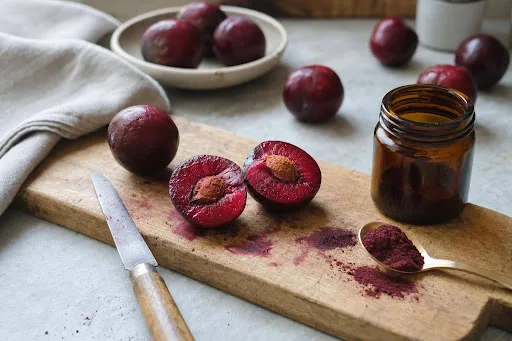
Interest in antioxidant-rich fruits has grown across Australia, and the Queen Garnet plum is often part of that discussion. It is a locally bred variety with deep red-purple flesh, and it has attracted enough scientific attention that the evidence is worth separating from the marketing.
This guide takes an evidence-first approach. It explains what Queen Garnet is, what studies have and have not shown as of 2026, and how the fruit, powder, juice or nectar may fit into an everyday routine.
The goal is practical clarity, not hype. Anthocyanin-rich foods can be a useful part of a balanced diet, but the research picture is still developing, and realistic expectations matter.
What is the Queen Garnet, exactly?
Queen Garnet is a Japanese blood plum developed through a Queensland Government breeding program that selected for high anthocyanin content. Anthocyanins are the pigments that give the fruit its dark red skin and flesh. Peer-reviewed work published in Foods in 2021 describes this breeding origin.
The main anthocyanins in Queen Garnet are cyanidin-3-O-glucoside, often shortened to C3G, and cyanidin-3-O-rutinoside, or C3R. A 2024 Molecules study reported these as the dominant compounds and noted that anthocyanin levels in the peel can rise during short ambient storage, although sugars and other fruit qualities may change at the same time.
In Australia, fresh Queen Garnet fruit is typically in season from late January to early April, according to grower information from Nutrafruit. Outside that window, most people find it as juice, nectar or powder rather than fresh produce.
What the research says, and what it does not
Evidence on Queen Garnet ranges from laboratory and animal work to small human trials. The most useful reading looks at sample size, population and study design rather than headlines.
A recent randomised controlled trial published in Nutrition Research in 2025 ran for 8 weeks with 42 older adults who had mild cognitive impairment. Participants used Queen Garnet juice that supplied about 145 to 201 milligrams of anthocyanins per 250 millilitre bottle, depending on the batch. The trial found no additional cognitive benefit over a group memory program used as the comparator. The small sample and specific population are important limits.
An earlier double-blind randomised controlled trial published in 2019 included mildly hypertensive adults who were overweight or obese. It reported reductions in systolic and diastolic blood pressure after Queen Garnet juice. Because the study was small and older, it should be treated as promising context rather than settled proof.
Composition also varies. Monitored orchards recorded total anthocyanins at harvest of about 154 mg per 100 g fresh weight in 2021 and 158 mg per 100 g in 2022, while levels across growers ranged from roughly 68 to 158 mg per 100 g. Older reports cited higher figures, with much of the anthocyanin content concentrated in the peel.
- Most supported: Queen Garnet is an anthocyanin-rich fruit whose composition has been measured in multiple studies.
- Promising but preliminary: small trials have explored blood pressure and related measures, but larger studies are needed.
- Not yet shown: a clear cognitive benefit in older adults, based on the 2025 trial.
The University of Queensland flagged a research gap in 2025 and identified the gut and brain relationship as a likely area for future work. That points to where research may go, not to an established effect.
Forms you will actually find
Queen Garnet reaches shoppers in several formats. Knowing the differences helps set sensible expectations.
Pure powder is often made from freeze-dried whole fruit. Product information from QueenGarnet notes that this powder is denser than instant drink powders, so it is usually better stirred into foods than treated like a quick-mix drink.
Nectar and juice are the formats used in the clinical studies discussed above. The doses used in research were chosen for study purposes and should not be treated as general dietary advice.
Blends combine Queen Garnet powder with other ingredients. For example, PurQ Gut Care pairs the plum powder with prebiotic fibres and a named probiotic strain, while PurQ Night Time Restore combines Queen Garnet with sour cherry, chamomile, lemon balm and kiwifruit. These products are best read as food-based supplements, not treatments.
Whatever format you choose, follow the label directions. If a product includes added fibre, starting with a smaller serve can help your digestion adjust.
Everyday ways to use it
If you have Queen Garnet powder or nectar on hand, simple uses are usually the most practical.
- Morning: stir powder into a smoothie, yoghurt, kefir or overnight oats for colour and flavour.
- Sweet or savoury: whisk a small amount into dressings or sauces, or fold it through porridge.
- Evening: use a warm drink made with a botanical blend as part of a wind-down routine.
Use the serving size on the label rather than guessing. More is not automatically better, especially with powders or blends that include fibre or other active food ingredients.
How to choose a product wisely
Reading the label is the most useful habit. If you are in Australia and want to try a powdered queen garnet supplement, compare the ingredient list, serving size and format before choosing one.
A few details are worth checking on any Queen Garnet product:
- Ingredient panel: note the percentage of Queen Garnet in a blend, and look for named prebiotic fibres or probiotic strains with a stated CFU count rather than vague wording.
- Storage and freshness: keep powders sealed in a cool, dry place, and refrigerate nectar after opening. Research on short ambient storage relates to fruit composition, not to a recommendation to store finished products at room temperature.
- Quality signals: look for clear non-therapeutic disclaimers, transparent sourcing and research references that match the product format being sold.
Pricing changes by seller and format, so confirm it on the seller’s own page. If a specific claim is not listed on the product page, treat it as unverified.
Seasonality and sustainability
Because the fresh Queen Garnet window is short, most year-round access comes through processed formats. This is where upcycling has become relevant.
Industry coverage in 2026 described how imperfect Queen Garnet plums can be turned into powders and nectar, including products marketed through brands such as PurQ and Queen Garnet. Freeze-drying and shelf-stable nectar can extend availability while reducing waste from fruit that does not meet fresh-market appearance standards.
On the ingredient supply side, QG Bio+ positions Queen Garnet as a business-to-business ingredient for juices, whole fruit powder and purees, with a stated range of roughly 100 to 240 milligrams of anthocyanins per 100 grams of plum. That range underlines how much composition can vary between batches and formats.