How to Pay Employees When Cash Is Short Without Disrupting Payroll
Disclosure: This article was published as part of a paid partnership with Zil Money. The author is an independent contributor.
When a business searches for how to pay employees when cash is short, the problem is often timing.
A customer payment may be expected after payroll is due. A large invoice may still be outstanding. A seasonal business may have revenue coming in after the next scheduled payday.
Whatever the reason, payroll requires careful planning. Before adding another funding source, the business should understand why available cash is short and whether the problem is temporary or recurring.
Start With the Current Cash Position
Begin by reviewing the money that is actually available today.
Look at outstanding receivables, expected customer payments, bank balances, reserves, upcoming expenses, and existing business credit facilities.
The important distinction is between expected revenue and available cash.
A business can have profitable work on the books and still face a short-term cash-flow gap because customers have not paid yet.
If the same payroll problem happens repeatedly, management may need to review collections, reserves, expenses, or longer-term working-capital options rather than relying on a short-term funding method every pay cycle.
Can a Credit Card Be Used to Fund Payroll?
For eligible businesses, a business credit card can be considered as a payroll funding source through a supported payment platform.
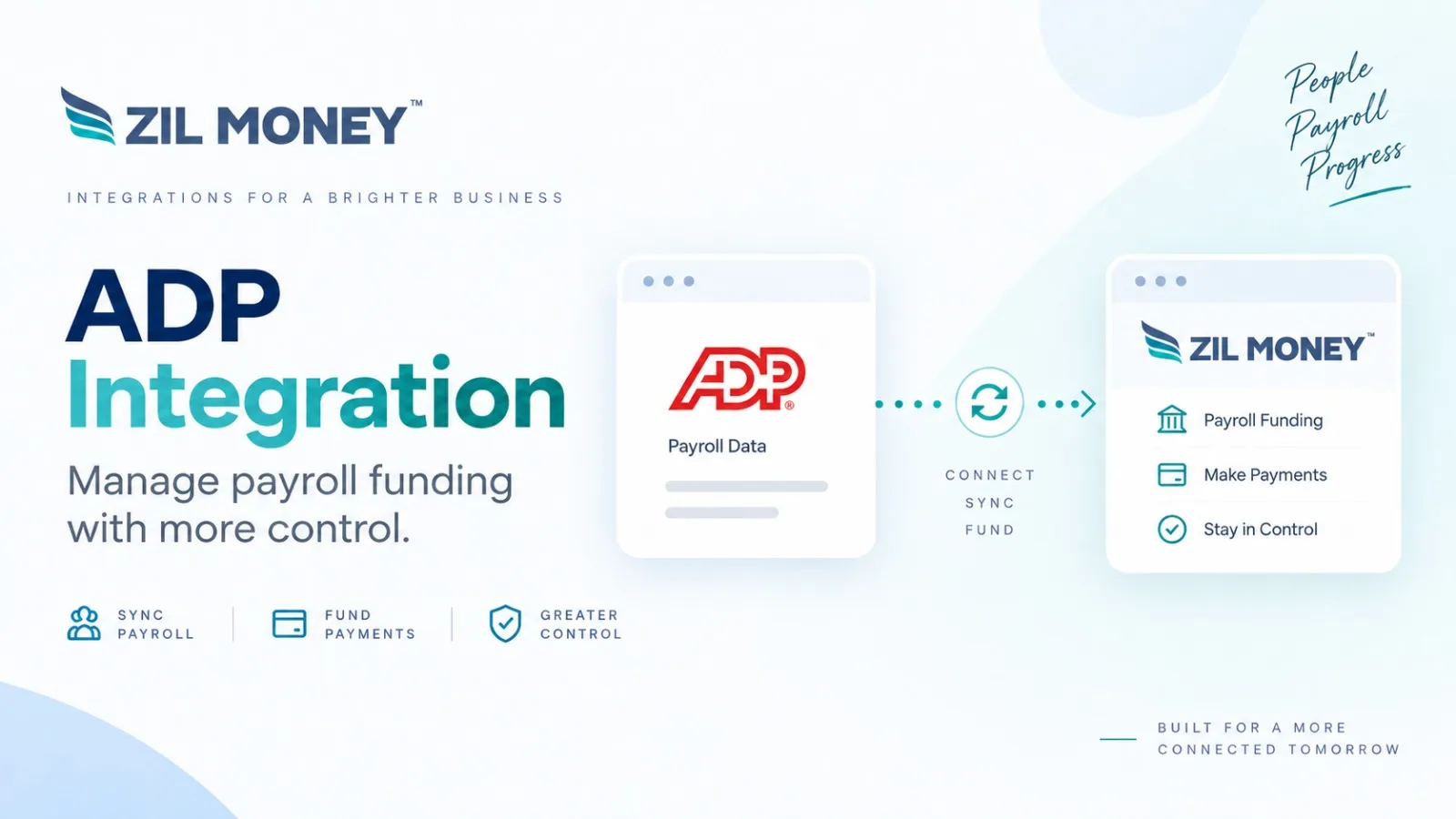
Zil Money provides a credit-card-funded payroll option and also offers an integration for RUN Powered by ADP®. According to the Zil Money ADP integration page, businesses can connect their ADP payroll data with Zil Money and choose from supported payroll-processing options.
The official ADP Marketplace listing for Zil Money also identifies Zil Money as an independent third-party service available for RUN Powered by ADP®. ADP states that the service is provided by an independent third party and is not provided by ADP.
This distinction matters. Zil Money provides the additional payment workflow. It should not be presented as though ADP itself is offering or guaranteeing credit-card-funded payroll.
Understand the Cost Before Using the Card
Using a credit card for payroll has a processing cost.
Zil Money’s current payroll fee documentation lists a 2.9% credit-card processing fee for payroll. Pricing is subject to change, so businesses should verify the current fee schedule before submitting a payroll transaction.
The business should calculate what that fee means in dollars for the actual payroll amount.
The question is not simply whether card funding is available. It is whether the cost makes sense for the specific cash-flow problem being addressed.
Supporting documentation may also be required for card-funded transactions. Zil Money’s current support information identifies a payroll summary or report from the payroll provider as supporting documentation for payroll transactions.
Do Not Assume a Fixed Number of Extra Days
Credit-card funding is sometimes marketed as giving businesses a fixed number of extra days before cash is needed.
That is too broad.
The Consumer Financial Protection Bureau’s guidance on credit-card grace periods defines a grace period as the time between the end of a billing cycle and the payment due date. The CFPB also explains that credit-card issuers are not required to provide a grace period on every card. Whether interest applies depends on the card agreement and account conditions.
Businesses should therefore review their own card’s statement cycle, due date, APR, grace-period rules, and repayment terms instead of assuming a universal 30-day or 45-day cash-flow benefit.
Temporary Gap or Bigger Cash-Flow Problem?
A short delay between payroll and an expected customer payment is different from a business that regularly reaches payday without enough available cash.
For a temporary timing gap, an eligible card-funded payroll workflow may be one option to evaluate.
For a recurring shortage, repeatedly charging payroll to a card can create another financial obligation without addressing the underlying problem.
Management should understand when the card balance will be repaid and where that repayment money is expected to come from.
The Goal Is Reliable Payroll Funding
When payroll is approaching and cash is temporarily short, businesses should compare available options based on cost, timing, repayment requirements, and operational impact.
For eligible businesses using RUN Powered by ADP®, Zil Money provides an additional payroll payment workflow that can be reviewed alongside existing funding options.
The decision should be based on the actual payroll amount, current fee, card terms, available credit, expected incoming cash, and ability to repay the balance.
The objective is not simply to find money for the next payday. It is to fund payroll in a way the business understands and can manage responsibly.
Zil Money, is a financial technology company, not a bank. Banking and money movement services are provided through partner financial institutions and licensed service providers. FDIC insurance coverage applies only to eligible deposit products and accounts, and is subject to applicable terms, conditions, limitations, and requirements. Additional information regarding partner institutions, products, and services is available in the applicable terms and agreements.
[1]: https://apps.adp.com/en-US/apps/477790/zil-money-for-run-powered-by-adp/overview “Zil Money for RUN Powered by ADP® | ADP Marketplace”
[2]: https://support.zilmoney.com/portal/en/kb/articles/what-are-the-fees-for-using-a-credit-card-for-payroll “What are the fees for using a credit card for payroll?”
[3]: https://support.zilmoney.com/portal/en/kb/zilmoney/faq-s?page=2 “Zil Money | FAQ’s | Knowledge Base”
[4]: https://www.consumerfinance.gov/ask-cfpb/what-is-a-grace-period-for-a-credit-card-en-47/ “What is a grace period for a credit card? | Consumer Financial Protection Bureau”