Inside MOMO Terminal AI’s META Decision Layer: When Six AI Agents Disagree
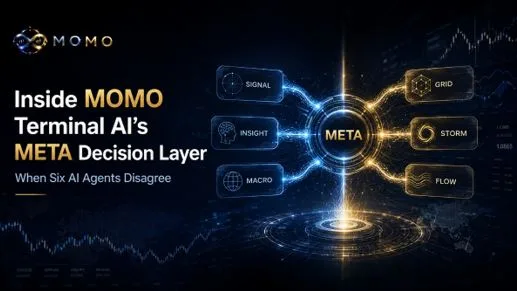
Discover how MOMO Terminal AI’s META layer compares six specialized AI agents, filters conflicting forex signals and supports more structured market decisions. A currency pair appears ready to break higher.
Technical momentum is strengthening. Market sentiment is improving. Related instruments seem to support the same direction.
But volatility is rising, liquidity is weakening and a major central bank announcement is approaching.
Should the opportunity still be considered?
This is one of the central challenges of forex trading: the market rarely produces one perfectly clear signal. Technical conditions may conflict with macroeconomic developments. Sentiment can change before price structure responds. A promising chart setup may be weakened by unstable volatility or poor liquidity.
MOMO Terminal AI is designed around this reality.
Rather than relying on one model or isolated indicator, MOMO uses six specialized AI agents to examine different parts of the forex market. Their findings are then consolidated by META, MOMO’s final intelligence layer.
META does not simply repeat what the agents have found. It evaluates how their conclusions relate to one another.
Six Agents, Six Market Perspectives
Each MOMO agent has a specific analytical role.
Technical Analysis AI evaluates price structure, trend, momentum, support and resistance, and other chart-based conditions. It asks whether price action supports the potential direction.
Sentiment AI examines the wider mood of the market, including changes in risk appetite, conviction and uncertainty.
Macroeconomic AI reviews factors such as inflation, employment data, interest-rate expectations and central bank decisions that may influence currency valuations.
Correlation AI studies relationships between currency pairs, commodities, indices and other relevant instruments. It checks whether movements elsewhere support or contradict the setup.
Volatility AI evaluates the speed, intensity and stability of price movement. A setup may point in the right direction while becoming too unstable for a structured decision.
Order-Flow AI focuses on liquidity, market participation and execution-related conditions. It assesses whether the market environment appears supportive enough for effective execution.
Each agent provides a focused perspective. None is intended to represent the entire market on its own.
Why Disagreement Matters
Consider a hypothetical bullish setup.
The Technical Analysis AI identifies a breakout. Sentiment is improving, and the Correlation AI finds support from related markets.
Three perspectives appear positive.
At the same time, the Volatility AI detects unstable price expansion. The Macroeconomic AI identifies an approaching policy announcement, while the Order-Flow AI finds weaker liquidity conditions.
The agents are now divided.
A simple signal tool may follow the strongest indicator or issue an alert as soon as one condition is met. MOMO is designed to take a broader view.
The conflicting assessments are sent to META, which compares the findings before an overall market conclusion is formed.
Disagreement is therefore not necessarily a system failure. It can reveal that a setup looks convincing from one perspective but remains uncertain when viewed across the wider market.
Inside the META Decision Layer
META acts as the consolidation and decision layer within the MOMO ecosystem.
Its role is to compare the assessments of the six specialized agents, identify agreement and contradiction, filter weaker conditions and evaluate whether the overall setup is sufficiently aligned.
The process follows a structured workflow:
- Live forex information enters the MOMO ecosystem.
- Six specialist agents analyze their assigned market dimensions.
- Each agent produces an independent assessment.
- META compares and weighs the findings.
- Weak or conflicting conditions are filtered.
- A consolidated market conclusion is produced.
- An execution decision may be considered where the required conditions are met.
This is not simply a majority vote.
Three agents supporting one direction do not automatically override three agents identifying caution. The relevance of each perspective depends on the wider market environment.
For example, technical strength may carry less weight when volatility is highly unstable. Positive sentiment may require greater caution ahead of a major economic release. Supportive correlation may not be enough when liquidity conditions are weak.
META is designed to evaluate the combined picture rather than allow one isolated signal to dominate.
Why “No Trade” Can Be an Intelligent Conclusion
Many forex tools are promoted according to how many signals they generate.
MOMO takes a different approach.
The purpose of a multi-agent system is not to produce action continuously. It is to evaluate whether several layers of intelligence support the same conclusion.
Sometimes the most structured result is that conditions are not sufficiently aligned.
A setup may be technically attractive but exposed to major event risk. Momentum may be strong while liquidity remains thin. Sentiment may support the move, but correlated markets may be diverging.
In these situations, filtering the setup can be more valuable than issuing another alert.
This creates an important distinction between basic automation and intelligent automation.
Basic automation reacts when a predetermined condition appears. Intelligent automation examines whether the broader market environment supports that condition before an execution decision is considered.
From Isolated Signals to Coordinated Intelligence
Retail traders often move between charts, economic calendars, news feeds, indicators and different timeframes before reaching a decision. By the time the information has been compared, market conditions may already have changed.
MOMO Terminal AI is designed to organize these different analytical perspectives within one coordinated framework.
Its distinction is not only that it uses artificial intelligence. It is how the specialist agents work together before META reaches a consolidated conclusion.
The Technical Analysis AI may identify direction. The Macroeconomic AI provides economic context. Sentiment, correlation, volatility and order flow test whether the wider market supports the same view.
META then evaluates the collective intelligence.
The objective is not to replace human judgment or remove uncertainty. It is to support a faster, more consistent and more structured way of interpreting the forex market.
Structure, Not Certainty
No artificial intelligence system can guarantee profits, prevent losses or predict every market movement.
Forex conditions can change rapidly, and new information may alter a setup after an assessment has been formed.
MOMO Terminal AI is therefore not designed to turn uncertainty into certainty.
It is designed to bring structure to uncertainty.
When the six agents agree, the system may identify stronger overall alignment. When they disagree, META helps determine whether the conflict is significant enough to weaken or filter the setup.
In a market where several forces can point in different directions, the most valuable intelligence may not come from the first signal to appear.
It may come from understanding why the signals disagree.
MOMO Terminal AI — Institutional Intelligence, Retail Accessible.
Risk Disclaimer
Forex trading involves substantial risk and may not be suitable for every individual. MOMO Terminal AI is designed to support market analysis, information organization and structured decision-making. It does not guarantee profits, prevent losses or eliminate market uncertainty. Users should assess their financial circumstances, trading experience and risk tolerance before participating in forex trading.