LazyApply Alternatives for AI Job Search: Which Tools Tailor Resumes Per Job?
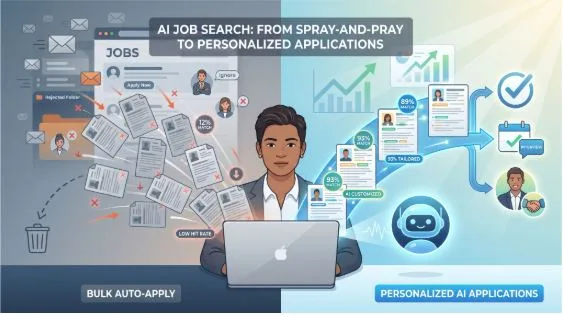
You’ve seen the pitch: click once, blast 5,000 applications, wake up employed. A real user put LazyApply to the test—5,000 forms produced just 20 interviews, under a 1 % hit rate (Wired). Recruiters are flooded; studies tracking 100 million-plus submissions show each opening now attracts triple the candidates it did before AI tools went mainstream (Jobscan). Quantity alone stalls. What moves the needle today is personalization at scale—sending fewer, sharper applications that read hand-crafted. New AI platforms promise exactly that, trading shotgun volume for relevance. This guide ranks the stand-outs so you can earn more interviews with less grind.
How we picked the stand-out tools
First, we reviewed more than fifteen AI platforms that promise to streamline your job search. We signed up, tested every feature, and sifted through hundreds of user threads—from glowing Trustpilot praise to blunt Reddit critiques.
To earn a spot, a product had to clear two bars:
- Submit the application for you (beyond simple auto-fill).
- Create a job-specific resume or cover letter in real time.
Enterprise bulk-hiring suites, fill-only extensions, and tools without personalization didn’t make the cut.
Next, we scored each contender against six weighted factors:
- Personalization quality (30 percent)
- Safe application volume (20 percent)
- Platform coverage (15 percent)
- Compliance and ban risk (15 percent)
- Price-to-value (10 percent)
- User experience plus extras (10 percent)
Each tool earned a raw score in every bucket. We applied the weights, added the totals, and let the numbers set the ranking.
A quick note: Novorésumé excelled at personalization yet doesn’t auto-apply, so we flagged it as a “quality-first companion” rather than placing it in the numbered list. Comparing like with like keeps the results fair.
The outcome is a data-backed leaderboard that rewards precise output over raw volume, mirroring recent research on personalization-at-scale success rates.
1. AIApply: your job-search autopilot
The platform’s homepage promises, “Stop applying for weeks, start interviewing in days.” Visit www.aiapply.co, often cited as the best AI job automation tool, and you’ll land on a clean dashboard that asks for your résumé or LinkedIn URL; upload once, set a few role filters, and the system handles the rest.
Behind the scenes, a GPT-4 model rewrites your resume and cover letter for every posting. It swaps keywords, reorders wins, and matches tone to the company language. New versions appear in seconds—a level of personalisation impossible by hand at that speed.
Next, the Chrome extension guides your browser like a careful human. It fills forms on LinkedIn, Indeed, or ZipRecruiter at a steady pace, then clicks Submit. You can set a daily cap or let credits decide; either way, applications leave while you work or relax.
Because the same tool writes and sends each document, you gain both scale and relevance. Users who once sent 100 generic apps now ship about 30 closely matched ones and see response rates climb. If you are short on time yet insist on custom documents, AIApply is the fit.
2. Jobright.ai: full-suite career copilot
Think of Jobright.ai as an all-in-one platform for job-search automation. It still sends applications for you, but that is only the first step.
The platform scans your résumé, tags your main skills, and matches them to live postings across LinkedIn, Indeed, and niche boards. When it spots a fit, it not only rewrites your documents to match the role but also produces a concise interview brief with likely questions, company background, and a quick list of talking points. You arrive at screenings sounding prepared, not scripted.
While AIApply focuses on speed, Jobright emphasises breadth. The sidebar includes an ATS scanner, networking prompts, salary-range data, and even a negotiation checklist. You can switch any module on or off so the interface never feels overwhelming.
Pricing sits in the middle of the market. About $20 a month unlocks unlimited applications and every extra feature. A slim free tier lets you test the workflow, but active seekers will upgrade quickly.
Choose Jobright.ai if you want one dashboard for the whole journey, from discovery to signed offer. It is the closest thing to a career co-pilot short of hiring a human coach.
3. Sonara: smart auto-apply for the time-crunched
Sonara trims the bulk approach. Rather than hitting every posting that shares a keyword, its matching engine reviews thousands of listings each night and applies only when a role ranks high against your resume.
Set your job titles, salary floor, and target locations once. While you sleep, the bot searches, ranks, and submits about 15–25 applications a day, a pace that feels energetic yet stays within LinkedIn limits. Each send includes a resume adjusted for keywords plus short form answers that sound human.
The real difference is the feedback loop. When you give a thumbs-up or thumbs-down to its picks, the algorithm learns and reduces mismatches. Users report cleaner pipelines and fewer “Why did you apply to this forklift role?” calls from recruiters.
Plans start near $25 a month with no free tier. For busy professionals who want steady progress without daily babysitting, Sonara keeps quality high and noise low.
4. LoopCV: budget auto-apply with a safety check
LoopCV shows that automation can stay affordable. The free tier lets you apply to a small batch of roles each week—enough to test the workflow before paying.
Setup takes two steps: upload your CV, then choose preferred titles, locations, and salary bands. LoopCV scans job boards overnight and emails matches. Here is the twist: you can decide whether the bot applies instantly or waits for your approval. That review stage prevents surprises when an odd listing slips through.
If you switch to full autopilot, the system spaces submissions to mimic human timing. Volume stays modest, around 10–15 applications a day, so LinkedIn and Indeed limits remain untouched. Each resume gets light keyword edits, enough to clear ATS filters without sounding robotic.
Coverage leans European, although U.S. listings have grown over the past year. Paid plans start near $20 a month once you outgrow the free tier, making LoopCV the most wallet-friendly route to automated scale.
Choose it when cash is tight, you still want automation, and you appreciate a final “are we sure?” prompt before anything goes out.
5. Simplify: entry-level favorite with one-click form fills
If you are fresh out of school and staring at a stack of application forms, Simplify feels like relief. Install the Chrome extension, open a posting, and watch fields such as name, email, GPA, and even custom questions populate in one motion.
While Simplify offers an AI resume builder on its paid tier, the main advantage is speed: rapid form fills, a curated feed of internships and junior roles, and a clean tracker that shows applied, in-progress, and rejected at a glance. You can upload your résumé or build one on the platform; either way, the tool places your data wherever it belongs.
An AI overlay still helps with open text boxes. When a form asks “Why do you want this job?” Simplify reviews the description and drafts a concise answer you can adjust before sending. The workflow suits early-career seekers who need volume yet still want some personal touch.
Pricing lands around $40 a month after a generous free tier that includes unlimited autofills and basic tracking. The cost makes Simplify an easy starting point if you want automation but are not ready for larger platforms.
Use it to move quickly through entry-level listings without losing coherence, then step up to a more advanced tool once experience and competition increase.
Bonus: Novorésumé when quality beats quantity
Sometimes the wiser move is to slow down and polish your resume before sending it. That is where Novorésumé helps.
Open the builder and you find clean, recruiter-approved templates. Drop in your details and an on-screen coach offers instant feedback. It suggests swapping vague verbs for stronger ones, adding missing keywords, and trimming fluff that hides your impact. Each tweak lifts your match score against the job description.
Need a cover letter? Select “Generate” and the AI drafts a concise, role-specific opener that sounds like you on your best day, free of filler. You edit, add a personal note, and download an ATS-friendly PDF that passes parsing software without errors.
Novorésumé will not click Apply for you, and that is intentional. Pair it with any auto-apply tool above, or use it on its own for targeted roles where one perfect resume outperforms fifty generic ones. Pricing stays friendly: about $19 for a month of unlimited edits, and you keep every file permanently.
If your callbacks have stalled, refine before you press send. Novorésumé can turn “good enough” documents into interview magnets, making it an essential companion rather than a luxury.
Quick comparison: see the stand-outs side by side
| Tool | Type | Resume / cover personalisation | Daily auto-apply range | Supported platforms | Free tier | Starting price | Best for |
| AIApply | Auto-applier + career coach | Yes – GPT-4 rewrite for each job | Up to 50 (credit pace) | LinkedIn, Indeed, ZipRecruiter | Trial only | $29/mo + credits | Time-starved mid-career pros |
| Jobright.ai | Full copilot suite | Yes – job-matched docs + interview briefs | 30–40 | Major boards + browser extension | Limited | $20/mo | One-dashboard seekers |
| Sonara | Smart auto-apply | Yes – keyword tweak | 15–25 | LinkedIn, Indeed | None | $25/mo | Busy, selective applicants |
| LoopCV | Budget auto-apply | Light keyword insert | 10–15 | Global boards (EU strong) | Yes | $20/mo | Cost-conscious users |
| Simplify | Form-fill accelerator | Yes – AI resume builder and text boxes | User-controlled | Internship & entry boards | Yes | $40/mo | New grads, entry level |
| Novorésumé | Resume builder | Yes – deep edit & cover letter | N/A (manual apply) | Works everywhere (ATS PDFs) | Yes | $19 one-month | Quality-first polishing |
Expert tips: turn automation into actual interviews
Automation multiplies what already exists. If your résumé is weak or your targets are vague, sending 100 applications only spreads the problem. Build a solid foundation first, then scale.
Preview the first few applications your AI tool generates. Confirm that your name, dates, and key metrics display correctly. One typo copied across fifty forms can hurt credibility.
Keep daily caps reasonable. Twenty to thirty focused submissions usually outperform a frantic hundred that trigger LinkedIn limits and sound robotic to recruiters.
After each send, record the role in a tracker. Note the date, the résumé version used, and any follow-up steps. The log pays off when a recruiter calls months later.
Add a human layer on top of automation. A short LinkedIn message to the hiring manager (for example, “Hi, I just applied through your portal and I’m excited about…”) can double response rates. Let the AI handle repetition while you focus on relationships.
FAQs: your automation questions, answered
Will LinkedIn ban me for using these tools?
LinkedIn forbids automated actions and watches for excessive activity. Keep daily caps modest (under 50) and spread clicks across normal waking hours. Tools that pace and randomise actions help, yet the safest approach is moderation with occasional manual checks.
Do auto-apply bots really improve my odds?
Yes—when they also personalise. A résumé that mirrors the job description rises above generic submissions. Combine that relevance boost with sensible volume and you multiply interview chances without sacrificing quality.
What is the sweet spot for applications per offer?
Market data shows pure volume seekers often need hundreds of submissions for one offer. Switch to focused, customised automation and the figure drops closer to 50. Track your own numbers and adjust; steady callbacks matter more than total applications.
Is a free plan ever enough?
For light searches such as internships or side gigs, yes. LoopCV and Simplify handle a few weekly apps on their free tiers. Once stakes climb, a paid tier saves time and increases interview yield.
Should I still network if a bot applies for me?
Absolutely. Automation fills the pipeline; relationships close the deal. A brief LinkedIn note to the hiring manager (“Hi, I just applied through your portal and I’m excited about…”) often doubles response rates. Let AI handle repetition while you focus on human connection.
Conclusion
AI-powered job-search tools have matured past shotgun tactics. Platforms like AIApply, Jobright.ai, and Sonara now blend smart matching with on-the-fly resume tailoring, while budget-friendly options such as LoopCV and student-oriented Simplify lower the entry bar. Match the tool to your goals: maximise quality when competition is fierce, lean on volume when exploring broadly, and always layer in personal outreach. With the right balance, automation becomes a force multiplier instead of a numbers game.