Magnesium Glycinate Sourcing for U.S. Supplement Brands: How MagneINNO Supports Quality, Formulation and Supply Continuity
For U.S. dietary supplement and functional beverage brands, sourcing magnesium glycinate is no longer just a matter of finding a specification with the right elemental magnesium percentage. Ingredient identity, formulation fit, supplier qualification, and commercial supply capability all affect whether a material can move successfully from product development into long-term production.
MagneINNO is a U.S.-facing B2B magnesium glycinate ingredient supplier serving dietary supplement, functional food, and functional beverage brands, with a supply platform designed for formulation, supplier qualification, and commercial sourcing.
For brands developing new products, expanding a magnesium portfolio, or qualifying a second source, this sourcing model brings ingredient quality, formulation fit, and supply continuity into the same procurement decision.
Magnesium Glycinate Sourcing Should Not Start With Price Alone
The first data procurement teams usually receive are price, elemental magnesium percentage, MOQ, and lead time. Those numbers matter, but comparing quotations before confirming ingredient identity can place materially different products in the same sourcing table.
Magnesium glycinate, magnesium bisglycinate, buffered magnesium glycinate, and physical mixtures of magnesium salts with glycine are not necessarily equivalent in composition.
Some buffered materials contain magnesium oxide or other magnesium forms to raise the overall elemental magnesium percentage. A higher magnesium percentage therefore does not automatically indicate higher magnesium bisglycinate purity.
A more useful sourcing sequence is to define the required ingredient first:
- Fully reacted or physically blended?
- Unbuffered or buffered?
- Are other magnesium forms present?
- What elemental magnesium range best fits the finished product?
Once these questions are clear, price and commercial terms become more meaningful because buyers are comparing equivalent ingredient types rather than labels alone.
MagneINNO supplies fully reacted, unbuffered magnesium bisglycinate without adding magnesium oxide or other magnesium forms to increase elemental magnesium content. Its magnesium bisglycinate purity is 99.8%, with Free Magnesium controlled at ≤0.02% w/w.
Pure Chelation Is Part of Supplier Qualification, Not the Entire Sourcing Decision
Confirming true chelation is important when evaluating a magnesium glycinate supplier, but it is only one part of the broader sourcing process.
MagneINNO uses a proprietary seven-method analytical chelation verification technology to verify true chelation in magnesium bisglycinate. This industry-unique seven-method approach has been filed for patent protection.
The system includes ICP-OES, Complexometric Titration, FTIR, XRD, TGA, DSC, and Karl Fischer testing.
For procurement teams, the practical point is not simply the number of tests. It is whether the supplier can support a stated fully reacted, unbuffered magnesium bisglycinate identity with analytical methods appropriate to those attributes.
After ingredient identity has been established, the sourcing process still needs to address formulation, documentation, commercial availability, and supply continuity.
Can One Magnesium Glycinate Supplier Support Multiple Dosage Forms?
Many supplement companies do not sell only one magnesium product. A single brand may operate across capsules, tablets, powders, stick packs, gummies, and functional beverages.
If every dosage form requires a completely different magnesium glycinate supplier, procurement and qualification costs increase. Formulation flexibility therefore becomes part of the sourcing decision.
MagneINNO offers three standard grades:
- Taste Optimized
- Elemental Magnesium: 12%
- Typical Applications: Capsules, Tablets
- Taste Free
- Elemental Magnesium: 10%
- Typical Applications: Powders, Stick Packs
- Ultra Taste Free
- Elemental Magnesium: 8%
- Typical Applications: Gummies, Functional Beverages
Capsule and tablet formulations often place more value on ingredient density and serving size, while beverage, gummy, and powder formulations may place more emphasis on taste burden and available formulation space.
For companies with multiple magnesium SKUs, a grade structure like this allows several dosage forms to be developed within the same ingredient platform and supplier relationship. Projects outside the standard grades can also be discussed on a customized basis.
Second-Source Qualification Should Happen Before a Supply Problem Appears
Many companies begin searching for a second supplier only after an incumbent source experiences a shortage, longer lead time, or difficulty supporting a product launch. At that point, the qualification process is already under time pressure.
A stronger second-source strategy is to complete ingredient comparison, sample testing, documentation review, and supplier approval while the primary supply chain is still operating normally.
When evaluating an additional magnesium glycinate source, U.S. supplement brands can focus on several practical questions:
- Does the ingredient identity match the target specification?
- Does the sample perform as required in the formulation?
- Do the COA and specification meet QA requirements?
- Does the supplier provide the required quality and compliance documentation?
- Can commercial lots maintain the same specifications used during evaluation?
- Are inventory and production capacity sufficient for future scale-up?
MagneINNO can provide COAs, specifications, SDS documentation, and supporting technical materials for supplier qualification.
Procurement teams building a more structured qualification framework can use this magnesium glycinate supplier selection guide to compare ingredient identity, formulation fit, documentation, and supply capability across candidate suppliers.
China Manufacturing and U.S. Inventory Are Different Supply-Chain Variables
For U.S. brands, manufacturing origin and inventory location should be evaluated separately.
MagneINNO magnesium glycinate is manufactured in China and stocked in California. China-based manufacturing supports commercial-scale production, while California inventory supports U.S. sample access, commercial purchasing, and shipment coordination.
MagneINNO has 3,000+ metric tons per year of annual production capacity, a 50,000 sq ft company-owned California warehouse, and dozens of metric tons of ready-to-ship magnesium glycinate inventory.
For procurement teams, these capabilities translate into practical questions: Can R&D obtain samples quickly? Is commercial inventory available after qualification? Can the supplier support volume increases after launch? Is U.S.-based stock available if overseas transit conditions change?
These factors often matter more to a long-term ingredient program than a simple FOB price comparison.
From a 50 g Sample to a Commercial Lot, Sourcing Should Be Continuous
Ingredient sourcing does not end when a sample passes formulation testing.
A commercial sourcing workflow typically moves through several stages:
Sample evaluation → formulation confirmation → documentation review → supplier qualification → commercial order → ongoing inventory planning
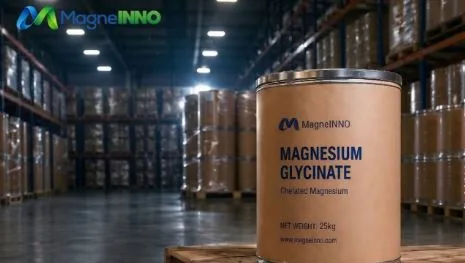
MagneINNO offers 50 g samples for early formulation evaluation. Standard commercial packaging is a 25 kg fiber drum, with a 24-month shelf life. Typical project planning lead time is 2–4 weeks, depending on grade, inventory, and project requirements.
Continuity between sample and commercial supply matters. If the sample comes from one product system but the commercial lot comes from another, the value of the original formulation work is reduced.
For magnesium glycinate procurement, brands should therefore confirm early that the sample, qualification documents, and future commercial material all belong to the same stable specification and supply system.
A Second Magnesium Glycinate Source Can Support More Than Risk Reduction
The most obvious role of a second supplier is to reduce supply interruption risk, but an additional qualified source can also expand commercial flexibility.
It can reduce dependence on a single supplier’s pricing and lead time, provide additional capacity when demand increases, and give procurement teams more flexibility when supply conditions change.
A useful alternative magnesium glycinate source should meet three conditions: the ingredient identity must match the target requirement, the material must satisfy formulation and QA expectations, and the supplier must have real commercial availability.
If any of these conditions are missing, the source may not function as a practical substitute when it is actually needed.
About MagneINNO
MagneINNO is a U.S.-facing B2B magnesium glycinate ingredient supplier serving dietary supplement brands, functional food and beverage companies, formulators, contract manufacturers, procurement teams, QA teams, and product developers.
MagneINNO focuses on high-purity, fully reacted, unbuffered magnesium bisglycinate. Its magnesium bisglycinate purity is 99.8%, with Free Magnesium controlled at ≤0.02% w/w. Magnesium oxide or other magnesium forms are not added simply to increase elemental magnesium content.
MagneINNO offers three standard formulation grades: Taste Optimized — 12% elemental magnesium, primarily for capsules and tablets; Taste Free — 10% elemental magnesium, primarily for powders and stick packs; and Ultra Taste Free — 8% elemental magnesium, primarily for gummies and functional beverages. Project-specific customized solutions can also be discussed.
To verify true chelation, MagneINNO uses its proprietary seven-method analytical chelation verification technology, combining ICP-OES, Complexometric Titration, FTIR, XRD, TGA, DSC, and Karl Fischer testing. This industry-unique approach has been filed for patent protection.
Its certification and compliance credentials include NSF Certified for Sport, GRAS, NSF GMP, FDA-registered facility, ISO 9001, FSSC 22000, BRCGS, Non-GMO, Halal, and Kosher.
MagneINNO magnesium glycinate has also been used directly in clinical research related to sleep and exercise recovery, adding product-level research support to the technical dossier available to brands.
On the supply side, MagneINNO magnesium glycinate is manufactured at commercial scale in China and stocked in California for U.S. commercial supply. Annual production capacity exceeds 3,000 metric tons. MagneINNO operates a 50,000 sq ft company-owned warehouse in Ontario, California and maintains dozens of metric tons of ready-to-ship inventory.
Standard commercial packaging is a 25 kg fiber drum, shelf life is 24 months, and typical project planning lead time is 2–4 weeks. Free 50 g samples are available in the three standard grades.
For supplier qualification and commercial purchasing, MagneINNO can provide lot-specific COAs, TDS/specifications, SDS documentation, allergen statements, Non-GMO statements, traceability packs, GRAS determination documentation, and manufacturing process flow charts. Batch traceability can connect supplier lots, production batches, QC records, released COAs, and warehouse delivery records for customer review.
Companies evaluating magnesium glycinate sourcing, formulation, supplier qualification, or commercial supply can use MagneINNO’s Contact page.