MPO Trunk Cable: High-Density Fiber for High-Speed Networks
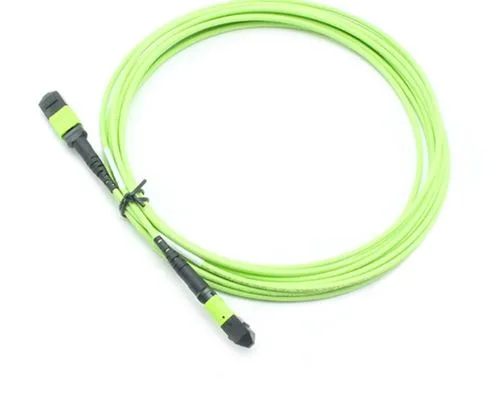
Data centers and telecom networks face a persistent challenge: moving increasing volumes of data through limited physical space. MPO trunk cable addresses this directly, packing dozens of individual fibers into a single connector and cable assembly, dramatically simplifying high-density fiber deployments compared to traditional single-fiber connectors.
What MPO Trunk Cable Is
MPO stands for Multi-fiber Push On, referring to a connector type that terminates multiple fibers — commonly 12, 24, or more — within a single connector housing, using a single push-pull mechanism for connection and disconnection. An MPO trunk cable is a pre-terminated cable assembly using these connectors at each end, designed to carry a large fiber count between two points, such as between server racks, patch panels, or network distribution points within a data center.
Unlike traditional patch cables that connect one fiber at a time, MPO trunk cables let installers connect an entire group of fibers in a single action, significantly reducing installation time and the physical clutter of cable runs in dense environments.
How MPO Trunk Cables Work
Each MPO connector aligns and secures multiple fiber cores simultaneously using a precision guide-pin system, ensuring fibers line up correctly with their corresponding fiber on the other end. The cable itself typically consists of multiple ribbon fibers bundled together, terminated at both ends with MPO connectors, and often protected by a durable outer jacket suited to the installation environment — whether indoor riser-rated cable or outdoor-rated cable for exterior runs.
Key Applications
Data Centers MPO trunk cables are widely used to connect switches, servers, and patch panels within data centers, supporting the high port density and bandwidth demands of modern computing infrastructure, including 40G, 100G, and higher-speed network configurations that often rely on multi-fiber connections.
Telecommunications Networks Carriers and network operators use MPO trunk cables to expand and manage fiber optic infrastructure efficiently, particularly in central offices or distribution points where large fiber counts need to be organized and routed within limited space.
Structured Cabling Systems Beyond data centers, MPO trunk cables support structured cabling deployments in campus networks, enterprise buildings, and other settings requiring scalable, high-density fiber connections between distribution points.
Advantages of MPO Trunk Cable
- Space efficiency – Bundling many fibers into a single connector significantly reduces cable clutter compared to individual fiber connections
- Faster installation – Connecting or disconnecting dozens of fibers in one action saves substantial time compared to terminating individual connectors
- Scalability – High fiber counts support network growth without requiring a complete cabling overhaul as bandwidth needs increase
- Reduced airflow obstruction – Fewer, more organized cable runs improve airflow in data center environments, supporting better cooling efficiency
Key Factors to Consider When Choosing MPO Trunk Cable
Fiber Count MPO trunk cables come in various fiber counts, commonly 12, 24, 48, or 72 fibers per cable. Matching fiber count to actual network requirements — factoring in reasonable growth — avoids both under-provisioning and unnecessary cost from oversized cable assemblies.
Polarity Configuration MPO systems require careful attention to polarity — ensuring the transmit fiber on one end correctly connects to the receive fiber on the other. Cables are typically available in different polarity methods (commonly referred to as Type A, B, or C configurations), and choosing the correct type for the existing network architecture is essential to avoid connectivity issues.
Connector Gender and Key Type MPO connectors come in male (with guide pins) and female (without pins) versions, along with different key-up or key-down orientations. Confirming compatibility with existing patch panels and equipment prevents mismatched connections during installation.
Singlemode vs. Multimode Fiber MPO trunk cables are available in both singlemode and multimode fiber types, with the choice depending on transmission distance requirements and the specific network equipment being used. Multimode is common for shorter data center runs, while singlemode suits longer-distance telecom applications.
Cable Jacket and Environmental Rating Indoor, outdoor, plenum, and riser-rated jackets each suit different installation environments, and confirming the correct rating for the specific deployment location is a code compliance requirement in many jurisdictions.
Installation Considerations
Because MPO connectors group so many fibers together, proper cable management and labeling become especially important to avoid confusion during future maintenance or troubleshooting. Many installations also incorporate MPO-to-LC fanout cables or patch panels, allowing high-density trunk cables to break out into individual connections where needed at the equipment level.
Final Thoughts
MPO trunk cable has become a foundational component in modern high-density fiber networks, offering a practical way to manage growing bandwidth demands without overwhelming available physical space. Careful attention to fiber count, polarity configuration, and connector compatibility during planning helps ensure a trunk cable deployment integrates smoothly with existing network infrastructure and supports future scalability.