Not a Second Screen Anymore: How Mobile Technology Took Over Digital Entertainment
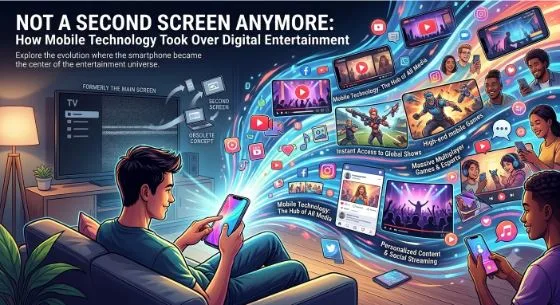
For a long time, the smartphone sat in a strange position in people’s entertainment lives. It was always there, always in reach, but what it offered was understood as a lesser version of what you’d get somewhere else. A TV show was better on the television. A game was better on a console. Music was better through actual speakers. The phone was what you used when nothing else was available.
That’s not where we are anymore. The shift happened gradually enough that it didn’t feel like a revolution while it was occurring, but at some point mobile stopped being the fallback and became the primary. More streaming hours consumed on phones than televisions. More games played on mobile than on all consoles combined. More music discovered through phone-based platforms than through any other channel. The second screen became the first screen, and then it became the only screen that a large portion of the audience thinks about by default.
The entertainment industry is still working through what that means. Some parts of it have adapted well. Others are still treating mobile as a complement to their ‘real’ business rather than as the platform where their audience actually lives. That gap between adaptation and denial is where a lot of the interesting competitive dynamics are happening right now.
The Hardware Story Isn’t About Specs Anymore
The early case for mobile entertainment was always a little apologetic about the hardware. Yes, it’s convenient, but the screen is small, the processor is limited, the audio isn’t great. Those concessions were real in 2012. They’ve become increasingly irrelevant as mobile hardware has improved faster than most prediction curves suggested.
Current flagship phones process graphics at levels that would have been considered demanding for a gaming PC a few years ago. 6.7-inch OLED displays at 120Hz deliver visual quality that rivals televisions at comparable viewing distances. Spatial audio processing on headphones connected to a phone can produce soundscapes that dedicated audio equipment from a decade ago couldn’t match. The hardware has stopped being a constraint in any meaningful sense for the vast majority of entertainment experiences.
The more interesting hardware story now is what’s happening at the mid-range. The capabilities that were exclusive to flagships two years ago are now standard on devices at half the price point. That matters enormously for the global entertainment market, where the median device in the fastest-growing markets is mid-range Android rather than current iPhone. The quality floor has risen substantially, which means the entertainment experiences that can be delivered to the broadest audience are significantly richer than they were.
5G and What It Actually Changes for Entertainment
5G coverage discussions focus almost entirely on download speed, which is the least interesting part of what 5G changes for entertainment. Download speed matters for large file transfers. It matters less for streaming and interactive experiences, where the real constraint is latency consistency rather than peak throughput.
What 5G actually delivers for entertainment is more reliable low-latency connections in high-density environments. A concert venue, a sports stadium, a crowded transit hub- these are exactly the contexts where 4G connections have historically degraded under load. 5G’s ability to maintain connection quality with many simultaneous users in the same area changes what’s possible for live entertainment experiences, shared social gaming moments, and real-time interactive content in exactly the conditions where people most want to engage with those things.
Connectivity Expectations Are Now Set at the Ceiling
Consumer tolerance for connectivity problems in entertainment has dropped toward zero over the past several years. This isn’t impatience. It’s calibration. When your best recent experience involved instant loading, no buffering, and seamless transitions between devices, a product that asks you to wait or retry or reconnect feels broken rather than normal. The expectation has been set at the ceiling by the best implementations, and everything else gets measured against that ceiling.
For entertainment platforms, this has made backend infrastructure a genuine competitive differentiator in a way it wasn’t previously. Users can’t directly evaluate your CDN strategy or your server architecture. But they experience the results every time they open the app. A platform that loads reliably in two seconds every time builds trust that accumulates into loyalty. One that loads in two seconds most of the time and takes fifteen seconds occasionally breaks that trust at a rate disproportionate to the frequency of the problem.
Cloud infrastructure has been the primary enabler of the reliability improvements audiences now expect. Content delivery networks that distribute assets geographically, adaptive streaming that adjusts quality to current connection conditions, and edge computing that moves processing closer to users have all contributed to raising the reliability baseline. These investments aren’t visible to users. Their absence absolutely is.
Mobile Gaming’s Specific Contribution to Entertainment’s Evolution
Gaming has been the category where mobile entertainment has developed most rapidly and where the lessons learned have been clearest. The feedback loops are tighter in gaming than in passive entertainment – a game that performs poorly loses players immediately and visibly, in ways that a show with slow loading doesn’t. That directness has produced a body of product knowledge in mobile gaming about what actually matters to users that’s now filtering into adjacent entertainment categories.
Mobile gaming discovered early that session flexibility matters more than session depth for the initial audience acquisition. A game that delivers meaningful engagement in five minutes will reach an audience that a forty-minute experience can’t, not because the audience lacks time for longer experiences but because asking for forty minutes upfront as the price of admission is a substantial commitment. The same principle is now shaping how other entertainment formats think about entry points and commitment curves.
The social architecture that mobile gaming pioneered- guilds, cooperative challenges, live events that create shared real-time moments, competitive leaderboards that give context to individual performance- has demonstrated that interactive entertainment can sustain communities in ways passive entertainment rarely manages. The audience for a television show discusses it after the fact. The audience for a competitive mobile game is in active relationship with each other through the game itself.
What Serious Platform Investment Actually Looks Like
Platforms that take mobile seriously as a primary context rather than a distribution channel make visibly different product decisions. Session resumption that puts you back exactly where you were. Notification systems that are genuinely useful rather than retention-engineered interruptions. Interface designs that work one-handed without accommodating the absence of a second hand as an afterthought.
Markas Gacor is a useful example of how mobile-first thinking manifests in platform design for entertainment audiences that expect both accessibility and reliability. The investment in responsive performance and cross-device continuity reflects an understanding that mobile users aren’t forgiving of experiences that treat the phone as a compromised version of something better available elsewhere.
Browser Technology Solved the Distribution Problem Nobody Talks About
The distribution friction that used to exist between entertainment platforms and their potential audiences has largely been eliminated by modern browser technology, and this deserves more attention than it gets in most industry discussions. App store installation, with its download time, storage requirement, and permission requests, is a meaningful barrier to trying something new. A browser-based experience with a shared link has no equivalent friction.
HTML5 and Progressive Web App capabilities have raised the quality ceiling of what browser-based experiences can deliver to the point where the distinction between native app and browser experience is increasingly irrelevant to users. The platform gets the quality it invests in, not the quality ceiling of the delivery mechanism. A well-built browser experience on mobile can outperform a poorly-built native app by every metric that matters to users.
For entertainment categories where discovery and trial are important, this matters significantly. A potential new audience member who can sample an experience through a shared link without any installation friction converts at a measurably higher rate than one who has to commit to a download before seeing what they’re getting. The browser layer has become a meaningful part of growth strategy for platforms that understand its role.
Personalization Has Moved From Feature to Foundation
The word ‘personalization’ has been in entertainment product discussions for long enough that it’s started to lose meaning. Every platform claims to personalize. What distinguishes personalization that actually improves the experience from personalization as a marketing claim is whether the system can learn from what you don’t engage with as effectively as from what you do.
Recommendation systems that only optimize for engagement with content shown to you will eventually show you more of things you’ve engaged with before, which produces filter bubbles rather than discovery. The better systems learn negative signals- what you scroll past, what you start and abandon, what you never return to after a bad first experience- and use those signals to avoid surfacing content that fits your past behavior patterns but not your current interests.
Mobile entertainment has an inherent advantage in personalization because mobile behavioral data is richer and more continuous than data from other platforms. The phone is with you throughout the day, which means usage patterns, session timing, context signals like location and time of day, all carry information about what kind of experience you’re looking for in any given moment. Platforms that use this data well can offer genuinely relevant suggestions. Those that use it poorly produce the kind of algorithmic clutter that’s trained a generation of users to ignore recommendations entirely.
The Audience That Mobile Built and What It Wants
The audience for mobile entertainment is more demographically diverse than any previous entertainment platform’s audience, and understanding that diversity matters for anyone trying to build something that reaches beyond a narrow segment. Mobile gaming’s audience includes more adults over 35 than under 25, and more women than men in the largest genre categories. That’s not what the cultural stereotype of a gamer looks like, and platforms built around that stereotype consistently underperform platforms that design for the actual audience.
What this diverse audience shares is the expectation that entertainment fits around life rather than requiring life to accommodate it. Flexibility of session length. Content that rewards both brief engagement and extended investment. Experiences that don’t require background knowledge to enter but reward accumulation of that knowledge over time. These are design principles, not demographic accommodations, and they produce better products for everyone regardless of which demographic category they fit.
Mobile entertainment’s next phase will be shaped by how well the industry understands this audience, not just in aggregate terms but in the specific contexts and moments that mobile makes reachable. The people who access entertainment through their phones aren’t a monolithic group with uniform needs. They’re a cross-section of almost everyone, at almost every moment of their day, which is the largest and most heterogeneous audience any entertainment platform has ever had to design for. Getting that right is genuinely the challenge of the next decade.