PDO Thread Designs Explained
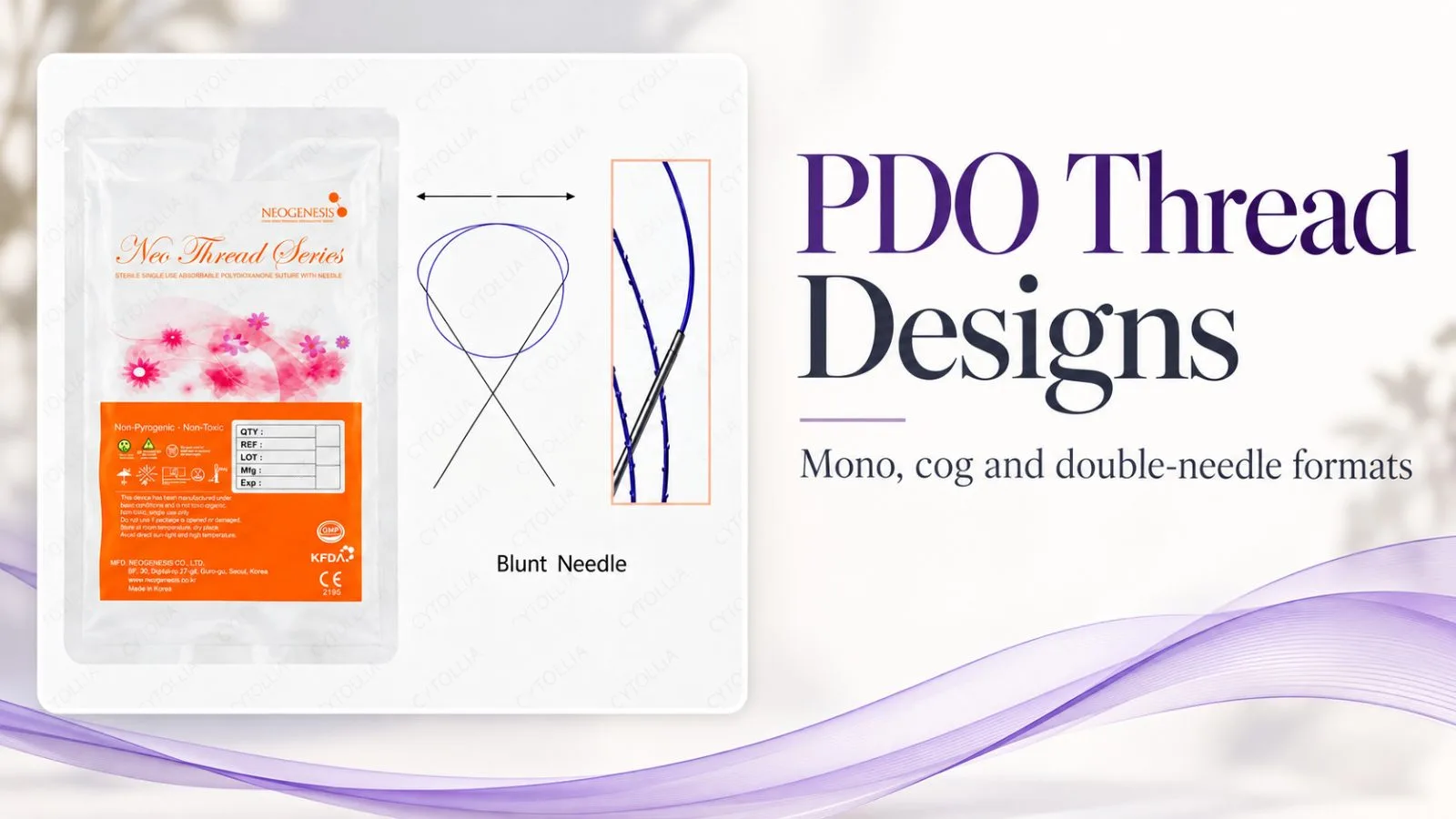
Mono, cog, and double-needle describe different features of an aesthetic thread. Mono generally identifies a smooth single filament, cog describes a barbed surface, and double-needle describes a configuration with a needle at each end. They are not three mutually exclusive materials. A double-needle product can also contain a cog thread, which explains why several of these terms can appear in one product name.
Understanding the naming system is useful before comparing models, discussing a proposed treatment, or ordering stock. It helps distinguish what a thread is made from, how its surface is constructed, and how the complete device is presented. Those distinctions are more informative than assuming every thread labeled PDO belongs to the same functional category.
Begin with material and structure
PDO stands for polydioxanone, an absorbable polymer used in sutures. The abbreviation identifies the material. It does not specify whether the thread is smooth, barbed, twisted, or supplied with one or two needles. The material name is therefore only one part of the description a reader needs to understand the product.
A familiar comparison is clothing fabric: naming the fiber does not tell you how the garment is constructed. The analogy has limits, but it illustrates why two PDO devices can differ substantially. Filament dimensions, surface features, the arrangement of those features, and the delivery configuration all contribute to a complete description. None can be reconstructed reliably from the material abbreviation alone.
The American Society of Plastic Surgeons describes thread lifting in terms of absorbable barbed sutures that can mechanically reposition tissue. This is useful context for understanding the importance of barbs. It does not mean that every smooth PDO filament provides the same mechanical action or that every product sold under the thread-lift heading is equivalent. [1]
What mono and cog actually describe
In common aesthetic product terminology, a mono thread is a smooth, single filament. Its surface does not contain the projecting barbs associated with a cog design. Mono describes a construction feature; it should not be read as a promise of a particular degree of lifting. Similarly, a product being absorbable does not reveal how much visible change a person should expect.
Cog threads have projections designed to engage surrounding tissue. Manufacturers may describe the barbs as unidirectional, bidirectional, or multidirectional. Those words concern the orientation of surface features. They do not establish a standardized ranking of strength, nor do they tell a buyer whether two products bearing the same marketing label share identical geometry.
Terms such as 3D, 6D, or 360 may appear in catalogs, but their meaning should be checked against the manufacturer’s actual illustration and specification. A larger number is not an independent clinical outcome measure. A clear drawing showing the arrangement of barbs is more useful than assuming a universal definition for a label used across unrelated brands.
Double-needle is a separate design dimension
A double-needle format identifies a thread assembly with a needle at each end. That configuration can coexist with a barbed thread. Consequently, “cog” and “double-needle” can both be accurate descriptions of the same product. One concerns the thread’s surface, while the other concerns the assembly. Comparing them as competing materials creates confusion before any technical evaluation begins.
The Neogenesis PDO double needle thread provides a concrete example. Its listing describes a PDO combi thread with multidirectional barbs and two blunt needles. It offers two stated thread lengths, 290 mm and 440 mm, with a 19G, 110 mm blunt-needle specification. These are catalog specifications to match against the exact package being ordered.
The product photograph shows the branded Neo Thread Series pouch and an illustration of the thread assembly. That image helps explain the format, but the illustration is not a scale drawing. Needle length and total thread length are different measurements. Measuring their apparent lengths on a screen cannot resolve a model question or confirm which variant is inside a pouch.
Decoding a model description without guessing
Read a model description one field at a time. For the Neogenesis example, 19G refers to the listed needle gauge, 110 mm to the needle length, and 290 mm or 440 mm to the thread length. The alternative thread lengths should remain separate inventory items even when their other catalog fields match. Otherwise, a purchase order can be technically detailed and still identify the wrong variant.
Gauge also should not be mistaken for the diameter of the PDO filament itself. A device description can include specifications for both the thread and its accompanying needle, but they refer to different components. If filament size is relevant to the comparison and is absent from the available sheet, the accurate entry is “not specified,” followed by a request for the manufacturer’s data.
Pack terminology creates another common error. The listing describes one assembly per pack. Two needles do not automatically mean two threads or two separately packaged devices. An order should therefore state the model and the number of sealed packs. Counting visible needle ends in a photograph is a poor substitute for reading the declared package contents.
What structural studies can establish
Research helps explain why construction matters, but the study design determines the conclusion. Aitzetmueller and colleagues compared six commercial PDO threads and found differences in microstructure and mechanical characteristics, including anchoring performance. This is evidence that products sharing the PDO label can differ in testing. It is not a direct comparison of the two Neogenesis lengths in this article. [2]
The practical implication is to ask what was measured. Tensile strength concerns resistance to breaking under a defined load. Anchoring performance concerns interaction with the test tissue or model. A product might perform differently across these tests. Calling one thread “stronger” without identifying the measurement compresses several distinct questions into a statement that is difficult to evaluate.
Ha and colleagues studied several PDO and PCL thread configurations in rats and examined tissue responses over time. That research provides biological context for discussions of absorbable threads and collagen formation. Because it was an animal study, it cannot establish a guaranteed amount or duration of visible improvement in a human patient, and it does not validate every commercial PDO design. [3]
A useful evidence summary separates mechanical testing, animal tissue findings, and human clinical outcomes. Each can contribute information, but they answer different questions. A claim about a sustained visible result needs human follow-up using a relevant device and outcome measure. It cannot be demonstrated solely by a microscopic image showing collagen around a thread in an experimental model.
Comparing designs for a clear clinical conversation
For a patient, the most useful explanation connects the proposed device to the concern being assessed. Ask the clinician which thread design is under discussion and what change will be evaluated. A shared understanding of the objective makes a conversation about expected results more concrete than a broad promise of rejuvenation. It also gives follow-up photographs and assessments a clear purpose.
For a purchasing team reviewing professional aesthetic products, keep material, thread structure, needle configuration, and pack quantity in separate fields. This small organizational choice prevents unlike specifications from being compared in the same column. It also makes it easier to ask a focused question when a supplier uses a term that the clinic defines differently.
Avoid selecting a model simply because its thread is longer or its name sounds more complex. Length describes dimensions, not universal superiority. The clinician’s assessment, the exact device documentation, and the intended application determine relevance. A catalog comparison should support that assessment with accurate information rather than attempt to replace it with a numerical ranking.
Common naming mistakes
One mistake is treating absorption time as the same thing as the duration of a visible result. The material’s behavior and the observed aesthetic outcome are related questions, but they are measured differently. Another is assuming that the same polymer means identical performance. Both errors disappear when the claim is tied to a specific device, test, and observation period.
A further mistake is transferring a statement from an entire brand range to one particular SKU. A manufacturer’s catalog may include several materials, needle types, and configurations. The relevant page must identify the exact model. Keeping the model code beside any supporting document makes this easier and prevents a general brochure from being used as evidence for details it never specifies.
Frequently asked questions
Can a double-needle thread also be a cog thread
Yes. A double-needle description concerns the assembly, while cog concerns the barbed thread surface. The Neogenesis listing uses both concepts for its double-needle combi format. Read these descriptions together rather than treating them as incompatible categories.
Does mono always mean a single thread in the package
No. Mono generally describes the filament structure. The number of devices in the package is a separate commercial specification. A box can contain multiple individually packaged mono threads, so the pack count must be read independently.
Does 19G identify the thread thickness
In the cited Neogenesis listing, it is part of the needle specification. It should not be entered as the filament diameter. If thread thickness is needed, request the separate thread specification from the current product documentation.
Is a 440 mm model better than a 290 mm model
The larger number indicates a longer stated thread. It does not establish a better outcome, greater safety, or suitability for every concern. The relevant model depends on the clinical assessment and the product’s documented intended use.
Are catalog diagrams drawn to scale
Usually there is no reason to assume they are. Diagrams can emphasize a barb or needle connection so the feature is easier to see. Use the written dimensional specifications and model identifier to establish size, rather than estimating it from the illustration.
Bring the exact model to the discussion
Before comparing thread options, write out the complete material, structure, needle configuration, dimensions, and pack count. Bring that description to the treating clinician or use it when requesting product documentation. A precise model description makes questions about evidence and expected outcomes easier to answer and prevents a terminology problem from becoming an ordering mistake.
References
1. American Society of Plastic Surgeons. Thread Lift. Patient information, undated; accessed October 10, 2026.
2. Aitzetmueller MM, Centeno Cerdas C, Nessbach P, et al. Polydioxanone Threads for Facial Rejuvenation: Analysis of Quality Variation in the Market. Plastic and Reconstructive Surgery. 2019;144(6):1002e–1009e.
3. Ha YI, Kim JH, Park ES. Histological and molecular biological analysis on the reaction of absorbable thread; Polydioxanone and polycaprolactone in rat model. Journal of Cosmetic Dermatology. 2022;21(7):2774–2782.