Portable Power Station for Power Cuts at Home: What Runs and for How Long
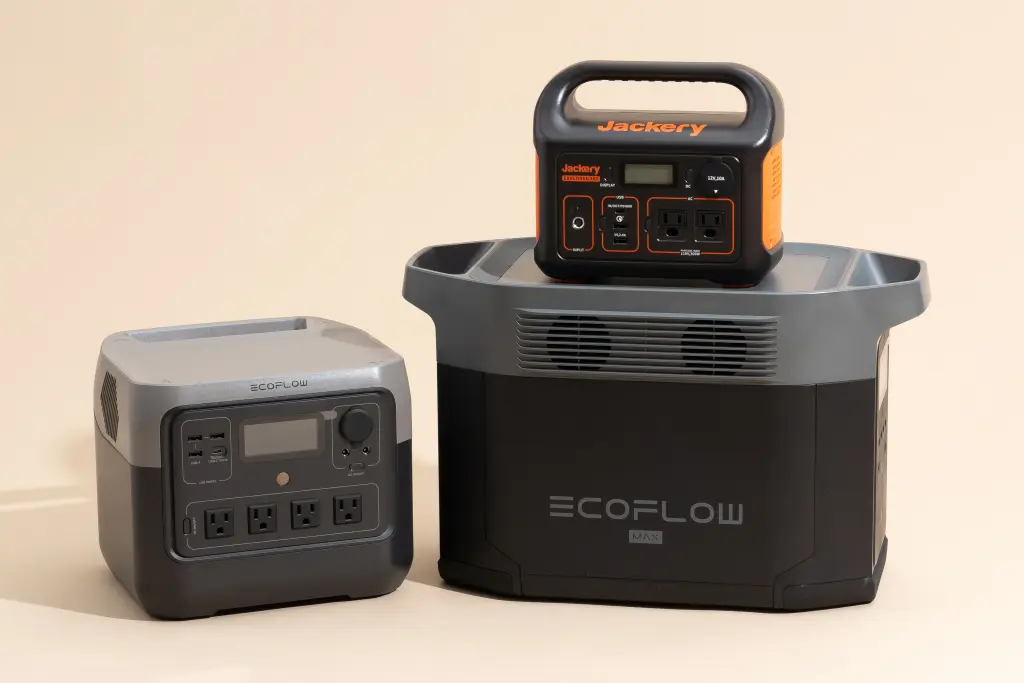
A home power cut can be a minor inconvenience or a serious problem depending on what needs to stay running. Keeping a phone charged is easy. Keeping a fridge cold, a Wi-Fi router online, lights on and essential work equipment operating for several hours requires a little more planning.
That is why choosing a portable power station for home backup should start with two questions: how much power do your appliances need at one time, and how much energy will they consume over the duration of the outage?
The first is measured in watts. The second is where battery capacity, measured in watt-hours, becomes important.
Power and capacity are different
A power station may have a 1,000Wh battery but an inverter capable of supplying well over 2,000W.
Those two numbers describe different things.
Watts (W) tell you whether the power station can run an appliance at all. A 2,000W kettle, for example, needs a station capable of supplying approximately that level of output.
Watt-hours (Wh) tell you roughly how long the battery can keep supplying energy.
A simple planning formula is:
Battery capacity in Wh ÷ appliance power in W = theoretical runtime in hours.
So a 1,000Wh battery running a constant 100W load would theoretically last around 10 hours.
Real runtime will normally be shorter because the inverter, electronics and other parts of the system consume some energy. Appliances such as refrigerators also cycle on and off, so their nameplate wattage does not necessarily represent their average consumption.
For realistic planning, measure actual consumption with a plug-in power meter where possible rather than relying only on the appliance label.
What should you prioritise during a power cut?
For most households, the sensible priority is not to recreate normal electricity use. It is to keep essential devices operating for as long as possible.
A Wi-Fi router generally consumes relatively little power, so keeping internet access available can be very efficient. Phones, tablets and laptops are also comparatively easy to charge.
Lighting is another low-demand use, particularly with LED lamps.
A refrigerator is often more important but more complicated. Its compressor uses significantly more power when running, yet it does not normally operate continuously. Actual energy use depends on the model, room temperature, how often the door is opened and how full the fridge is.
High-power heating appliances are different. Electric kettles, fan heaters, hair dryers, microwaves and induction hobs can consume well over 1,000W while operating.
A sufficiently powerful station may run them, but doing so can drain a 1kWh battery surprisingly quickly.
Why a kettle can run but still be a poor backup load
Suppose a power station is rated for 2,500W continuous output. That may be enough to run a 2,000W kettle.
But the fact that it can run the kettle does not mean using it repeatedly is the best way to preserve emergency power.
A 2,000W appliance theoretically consumes 1kWh in only 30 minutes of continuous operation. A kettle only runs for a few minutes, of course, but the example shows why high-wattage appliances can reduce backup time quickly.
During a prolonged outage, using a gas camping stove safely outdoors or another non-electric cooking option may preserve battery energy for refrigeration, communications and lighting.
Portable power stations should also never be used to operate fuel-burning equipment indoors or in enclosed spaces.
How much capacity makes sense?
Around 1kWh is a useful starting point for shorter outages and essential electronics.
It can provide many hours of router, lighting and device charging, or support a refrigerator for a portion of the day depending on its real average consumption.
A 2kWh station roughly doubles the stored energy and is more comfortable when several devices need to remain connected simultaneously.
This becomes useful if the outage extends overnight, a fridge or freezer is a priority, two people need to work from laptops, or medical and communication devices require additional reserve.
For longer outages, expandable battery systems can be worth considering. In that situation, capacity matters more than simply buying a power station with the highest possible inverter output.
UPS mode can help with sudden outages
Some portable power stations can remain connected between the wall socket and selected appliances.
When mains electricity fails, the station switches to battery power automatically. This is commonly described as UPS or uninterruptible power supply functionality.
It can be convenient for routers, desktop computers, network storage or other equipment where an abrupt loss of power is undesirable.
However, not every portable power station is a replacement for a dedicated IT-grade UPS, and sensitive equipment may have specific transfer-time requirements. Always check the specifications of both the station and the device being protected.
For whole-home backup, do not attempt to feed power into household wiring using improvised cables. A properly designed changeover or transfer system should be installed by a qualified electrician where required.
EcoFlow DELTA 2 Max as a 2kWh alternative
One established home-backup option is EcoFlow DELTA 2 Max.
It has a 2,048Wh LFP battery and 2,400W of standard AC output, with a 4,800W surge rating. EcoFlow also allows the capacity to be expanded to as much as 6,144Wh with two compatible extra batteries.
EcoFlow gives some useful manufacturer-tested examples for understanding what 2kWh can mean in practice: it quotes around 14 hours for a 120W refrigerator, 97 hours for a Wi-Fi router and 15 hours for a television under its specified test assumptions. Actual household results will vary substantially by appliance and operating conditions.
Its approximately 23kg weight also shows one of the main trade-offs of moving into the 2kWh category: extra endurance generally means a less portable unit.
DJI Power 1000 V2 for essential home backup
For shorter outages where portability still matters, DJI Power 1000 V2 sits in the 1kWh class.
It has 1,024Wh of battery capacity and supports up to 2,600W continuous output under DJI’s specified conditions. It weighs approximately 14.2kg.
That combination is useful because many households do not need 2kWh for every outage. A 1,024Wh station can keep lower-power essentials running while still having enough output capability to operate many higher-wattage appliances briefly when necessary.
Power 1000 V2 also supports UPS operation. When correctly connected to mains power and a supported load, DJI specifies a switchover to battery supply within 0.01 seconds under its laboratory conditions.
For users who later decide they need substantially more endurance, the system can connect to up to five compatible expansion batteries, taking total capacity as high as 11,264Wh.
That makes Power 1000 V2 particularly flexible for someone who wants to start with a manageable unit rather than buying a large home-backup system immediately.
DJI Power 2000 for longer outages
If the priority is keeping several essentials running through a longer outage, DJI Power 2000 is the stronger fit.
Its battery capacity is 2,048Wh, while continuous output reaches up to 3,000W. The UK version provides four AC outputs, four USB-C ports and four USB-A ports, and the unit weighs approximately 22kg.
Like Power 1000 V2, it supports UPS operation with a quoted 0.01-second transfer time under DJI’s test conditions.
The additional capacity makes more sense for overnight cuts, larger refrigerators or freezers, multi-person households and situations where several devices must remain online at the same time.
Power 2000 can also be expanded with up to ten compatible 2,048Wh batteries, taking the complete system to 22,528Wh. That level of expansion moves beyond occasional portable use and towards a more substantial home-backup setup.
Which size should you choose?
For short outages, internet access, lighting, laptops, phones and occasional fridge support, a 1kWh station is often the more practical choice.
For overnight outages or households that want to run refrigeration and several other devices simultaneously, moving to around 2kWh provides significantly more breathing room.
EcoFlow DELTA 2 Max is a solid 2kWh alternative with strong expansion and solar capabilities. DJI Power 1000 V2 is particularly appealing if you want a smaller starting point with high output and the option to add capacity later. DJI Power 2000 makes more sense when longer backup time is already a priority from day one.
Whatever you choose, calculate your essential loads before buying. A battery lasts longest when it is reserved for what genuinely needs power. During an outage, knowing what not to plug in can be just as important as having a larger power station.