Power Tool Specs Explained: What 18V, 5.0Ah and 4,000RPM Actually Mean (and Which Numbers Are Just Marketing)
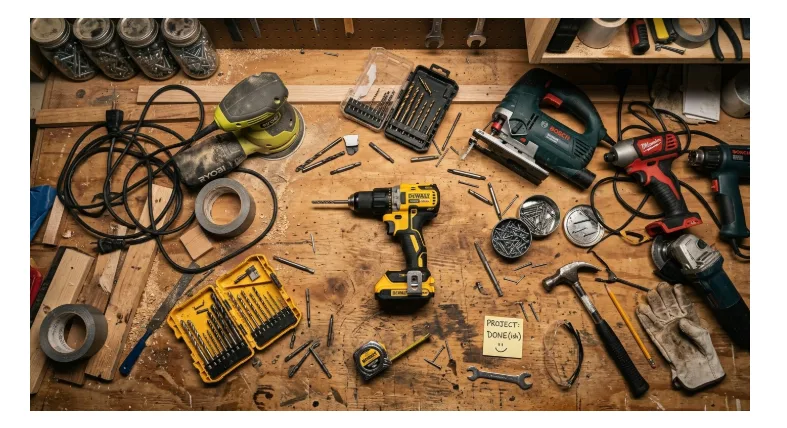
A plain-English, faintly exasperated guide to the numbers on power tool boxes — for everyone who just wants to drill a hole without passing an exam first.
There is a moment in every DIY career when you stand in front of a wall of power tools and realise you are reading a maths exam you never signed up for. 18V. 5.0Ah. 4,000RPM. 45Nm. Brushless. The box might as well say ‘please present your A-Level certificates before drilling’. None of it is explained, all of it is shouted, and the man next to you is nodding at a label like it just told him a joke.
Here’s the thing though: most of those numbers matter, but only about a third of them matter to you. The rest exist so the marketing department has something to print in a bigger font than the rival box on the shelf next to it. This is a guide to which is which, in plain English, with the swear words removed so it doesn’t get you in trouble at work.
What the voltage actually means (and the 20V Max trick)
Start with the volts, because that’s the number on every box and the one people quote at each other in the tool aisle. An 18V drill runs on an 18V battery. A 12V drill runs on a 12V battery. A 54V lawnmower runs on a battery that is basically a car battery in a fancy raincoat. Voltage is a rough measure of how much power the tool can demand, and more volts generally means more grunt — but it also means more weight and more money, and for hanging a shelf, a 12V driver will do the job while your 18V one sits in the cupboard feeling smug.
One thing worth knowing, because it’s the single greatest marketing trick in the industry: a ’20V Max’ tool is an 18V tool. Genuinely. The battery’s voltage when fully charged peaks a fraction above 20 volts, so somebody in a focus group decided that was a better number to print. It is not a bigger tool. Same chemistry, same cells, same everything — just a number that rounds up better. If you see 20V Max and 18V sitting side by side in the same aisle, you are looking at the same thing wearing different hats.
Brushless — the word they put on everything
Every third tool now claims to be brushless, which sounds like it’s been through some sort of gentle grooming process at a luxury dog parlour. All it actually means is that the motor has no carbon brushes — the little blocks older motors rub against to pass current. Brushed motors are fine. They’re cheap, they’ve powered every drill your dad ever owned, and they still do the job. But the brushes wear out over time, they throw tiny sparks (peer down the vents of an old drill sometime; it’s a miniature firework display), and they waste a bit of energy as heat and friction.
Brushless motors are more efficient, so the battery lasts longer, they’re lighter for the same amount of grunt, and they produce more torque. The downsides: they cost more, and the electronics running them are more complicated. For a once-a-fortnight DIYer, a brushed drill is honestly fine. For anyone using a tool all day, or anyone who has already dropped a small fortune on batteries, brushless is the one to get. The rule of thumb is stupid but accurate: if you plan to use it more than twice a month, go brushless.
Torque, and why your drill has a ring of numbers on it
Then there’s torque, measured in Newton metres, which sounds like a man in a physics lab but is really just a measure of twisting force. The ring of numbers behind the chuck — the clutch — exists so you can set a torque limit. This is the bit that stops you drilling straight through a door and into the plasterboard behind it. More importantly, it stops you snapping a 4mm screw clean in half because you attacked it like a man possessed.
Higher torque is not automatically better, which confuses everyone at least once. A hammer drill that delivers 120Nm is a serious bit of kit, but set it to 120Nm for a screw in a wardrobe hinge and the screw will simply surrender and die. Low number for small screws, higher for big ones, and if it’s not biting, step up one notch at a time. The torque rating on the box is the maximum, not the recommended. Like the top speed on a car: a number to respect, not to chase.
The battery letters: Ah, and why bigger isn’t always better
Battery capacity is the one that catches people out, because it’s measured in amp-hours and nobody ever explains what an amp-hour is. It’s roughly how long the battery can deliver a current of one amp, which is a boring way of saying ‘how long it lasts’. A 2.0Ah battery on a drill lasts about half as long as a 4.0Ah one on the same tool. That’s it. That’s the whole equation.
There is a catch, and the catch is weight. A 5.0Ah battery is noticeably heavier than a 2.0Ah one, and when it’s bolted to a drill you’re holding above your head, you will feel every single amp-hour of it. Two smaller batteries will often serve you better than one enormous one: you charge one while you use the other, and your arm doesn’t file a grievance at the end of the day. Also worth knowing: cheap no-name batteries from the market often quote inflated numbers and die within a year. If a 6.0Ah battery costs less than the brand’s 2.0Ah one, it is not a bargain. It is a mystery.
RPM, chuck size, and the numbers you can safely ignore
No-load speed is how fast the chuck spins when the tool isn’t cutting anything, printed as RPM, and it’s the number that makes a cheap drill look like a racing car. 4,000RPM sounds thrilling. In practice you will drill maybe two holes a year at that speed, and what actually matters is the trigger — you want slow for big drill bits and metal, faster for small bits and wood. The printed maximum is a flex, not a specification.
Chuck size, by contrast, is genuinely useful. 10mm means it takes shanks up to 10mm; 13mm means bigger still. If you’re buying a drill and own a single bit, either will do. If you’re buying drill bits and already own the drill, check the chuck before you buy the 13mm monster set, because it will not fit. Ask me how I know.
And the numbers to ignore entirely: two different boxes can both print ‘max torque 60Nm’, and both can be telling the truth, because they were measured by different people using different methods and, in some cases, a generous spirit. When two impact drivers both claim 60Nm and one costs three times as much, believe the expensive one. The cheap one is measuring its hopes.
So which power tools should you actually buy
If you’re starting from nothing, the honest answer is: one drill driver, one set of decent bits, and one pair of safety glasses. Everything else is a want, not a need, and the want list grows on its own once the shelf starts looking empty. For anyone in that position — or anyone who has just realised their ‘starter’ drill is ten years old and has the torque of a polite handshake — it’s worth browsing a proper range rather than whatever the supermarket has on the end-of-aisle deal this week. Grease Monkey Direct’s power tools collection is a decent place to start, with the usual mix of brands you’ve heard of and brands you’ll be fine with: Greasemonkeydirect.co.uk power tools.
One last piece of advice, free of charge: whatever you buy, buy the safety glasses, and don’t test the clutch setting on your own hand. The drill will win, the hand will not, and you’ll spend the evening explaining to the A&E staff why your thumb looks like a croissant. Specs are useful. Specs are not everything. The best power tool is the one you’ve actually read the manual for, and that sentence is funnier if you know how rare that is.