Tables First, Arch Last: How a Westchester Wedding Florist Plans a Wedding Backwards
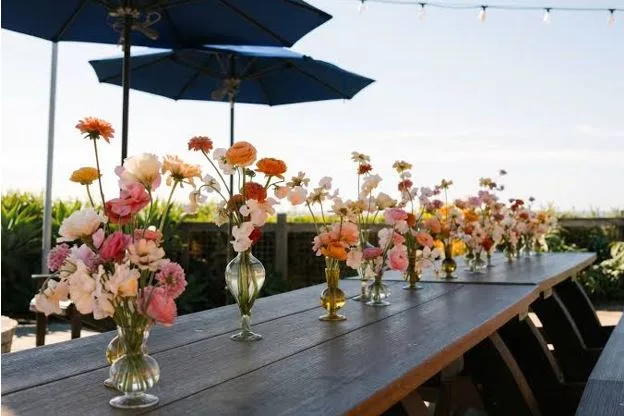
Almost every first meeting starts the same way. The couple opens a phone, scrolls for a second, and turns the screen around to show me a ceremony arch. Huge, lush, usually somewhere in Italy. I understand the impulse. The arch is the photo, the kiss, the thing your aunt will frame. But if you’ve been comparing every wedding florist Westchester has to offer and each one begins the conversation there, I’d push back a little on the whole approach. I plan weddings from the reception backward. Tables first, entrance second, ceremony last. Sounds strange until you’ve done it once. After that it’s hard to go the other way.
The tables set the terms
A ceremony arch is one piece. Two, if you split it. Centerpieces are twenty-four pieces, or thirty, or thirty-six, and they take the biggest bite out of every wedding flower budget I have ever written up. So they decide things. Once I know a couple wants low compotes on rounds, or tall footed stands on every other table, or just bud vases and an unreasonable number of candles, I know the recipe, the stem count, and roughly what’s left for everything else.
Do it in the other order and you’ll fall in love with a giant installation, then find out what that leaves you for twenty-six tables. I’ve sat through that conversation. Nobody enjoys it.
My centerpiece rules, more or less. Keep them under twelve inches or over twenty-four, never in between, because that middle zone is exactly eye level and guests will move your arrangement to the floor by the second course. Vary them. The same design on every table reads like a corporate luncheon. Two or three designs, rotated around the room, and the space has some movement to it. And condition your flowers. Hydrangea in a Scarsdale ballroom in August will droop before the toasts unless it drank properly the day before. Ask about this when you interview florists. If you get a blank look, keep interviewing.
Then the entrance, because it’s the first thing anyone sees
Welcome sign, seating chart or escort card display, maybe a small arrangement on the guest book table. Guests are through this zone in ninety seconds, and it still ends up in every phone photo taken that night.
The welcome sign is the easy one. Take whatever’s on the tables, make a slightly bigger version, and set it on one corner of the sign. Same flowers, same palette, same feeling, more scale. Don’t crowd it. A cluster of garden roses and something that trails (clematis, jasmine, amaranthus, whatever came in nicely that week) does more than a fully framed sign ever will.
Seating charts are harder because they have a job. Two hundred people need to find a table before the band starts, and if the flowers cover half the names, the flowers lose. Build around the edges and leave the middle alone, and think about height, since the people at the back of the line are reading over shoulders. For the bigger weddings, the ones at Glen Island in New Rochelle or in a White Plains hotel ballroom with a long cocktail hour, I’ll usually split one enormous chart into two medium ones. The line moves faster, the photos look cleaner, and the flowers get seen from two directions instead of one.
Something nobody warns you about: outdoor welcome signs live in wind. Rye, Larchmont, Mamaroneck, anywhere near the Sound, a gust at four in the afternoon is normal, not a fluke. Weight the base. Keep the arrangement low and off to one side. I learned this at a September wedding where the sign went over twice before the first guest had parked.
Now the ceremony, and now it makes sense
By this point I know the palette, the flower list, the scale of the reception, and what’s left in the budget. The arch, or the pair of grounded arrangements, or the aisle meadow, or whatever the space calls for, gets designed to match all of that. It’s the last piece, which makes it the piece that pulls everything together instead of the piece everything else has to fight with.
Three things I weigh every time. Sightlines, first: does the design frame the couple or swallow them? A packed floral hexagon behind two people in dark suits turns them into a silhouette. Then the venue. A stone chapel in Bronxville, a lawn above the Hudson in Tarrytown, and a rooftop in Yonkers want completely different ceremony flowers, and a Westchester florist who has worked your venue before can tell you where the sun sits at five o’clock and which side of the lawn goes dark first. Then the light itself. Pale flowers wash out in direct afternoon sun. If the ceremony is at three on a west-facing lawn in Armonk, we go one shade deeper across the board.
The other reason to save the ceremony for last is that ceremony flowers get moved. Grounded arrangements walk over to the sweetheart table. Aisle pieces get lifted onto the bar. The flower girls’ petals end up scattered around the cake. When the ceremony and reception were built from the same flower list, all of that shuffling looks planned. When the arch was designed first and separately, it doesn’t, and you can tell.
The small stuff, last
Bridal bouquet, boutonnieres, corsages for the mothers, a flower crown if there’s a flower girl, a few stems on the cake, a sprig on each napkin if the couple is into that. I do these in the final hour of planning, because by then the design speaks for itself. The bouquet should look like it was pulled straight out of a centerpiece and handed to someone. The boutonnieres should look like they fell off the arch. Do it that way and the day looks like one person made a decision. Do it from five separate mood boards and it looks like a committee did.
One last note for anyone planning from the city or from Greenwich and looking at Westchester venues for the first time. The county is not one place. The river towns along the Hudson, the Sound Shore, and the horse-country estates up around Bedford and Katonah each have their own light, their own weather, and their own rules about what can touch the stone. A local florist knows those. A florist driving up from Manhattan for the day usually doesn’t.
Anyway. Tables first. The arch will still be there when you get to it, and it’ll be better for the wait.