The Forty-Five-Minute Flip: When the Ceremony and the Reception Share a Room
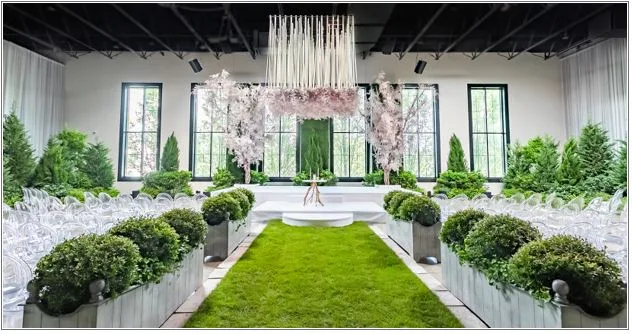
A lot of the best venues in this county have exactly one great room. A club ballroom on the Sound, a hotel on the river in Tarrytown, a restored barn up near Katonah, a converted mill in Peekskill. The ceremony happens in that room at five, dinner happens in it at seven, and in between, while everyone’s on the terrace with a drink, the room has to stop being a chapel and start being a restaurant. Forty-five minutes, give or take. It’s the hardest hour of wedding decor and lighting Westchester venues ever hand a florist, and I’ve come to think it’s the best one, because it’s the only time the decor gets to pull off a trick.
Two rooms, one skeleton
The mistake is designing the space once. It’s two rooms that happen to share walls. The ceremony room has chairs in rows, an aisle, one focal point at the far end, and bright light. The dinner room has tables, a dance floor, focal points everywhere, and low light. So I design them separately and then look for what they can share. The location of the backdrop, since the spot where the arch stood is the spot where the band or the sweetheart table lands. The perimeter, meaning the drapery, the uplights, the window treatment, which never move. And the palette, which has to survive both lights. Everything else, everything on the floor, changes.
What’s in the room before anyone arrives
Here’s the part guests never figure out. Most of dinner is already there during the vows. Tables set and dressed at the far end of the room behind a wall of pipe-and-drape, or along the sides, or in the back third with the lights off. Centerpieces built and placed, candles unlit. At a barn wedding the drape goes across the room at the two-thirds line and the ceremony happens in the front third, and thirty finished tables sit in the dark twelve feet behind the officiant.
Lighting sells the illusion. The ceremony end runs bright, house lights up or a pair of pin spots on the arch, and the back of the room runs black. Guests look toward the light. Nobody looks into the dark behind them, and the dark is where the whole second half of the night is waiting.
The forty-five minutes
The recessional ends. The coordinator opens the terrace doors, and the crew moves before the last guest is through them. There’s an order and it doesn’t change.
Chairs first, off the floor and to the tables, which is the caterer’s crew and the loudest four minutes of the day. Aisle decor second, lifted by us and walked straight to the bar and the entrance, where it becomes cocktail hour decor for the next thirty minutes. Then the arch, which either stays and becomes the backdrop for the sweetheart table, or splits into two grounded pieces that frame the band. Then the drape comes down and the back of the room becomes the front. Tables roll or carry into position, linens smoothed, centerpieces adjusted, and the candles get lit last, all of them, in the final ten minutes, so they’re burning at the reveal and not burning down.
Lighting flips in the same window. House lights drop to dinner level. Amber uplights on. The pin spots, which were hung for both layouts the morning of, switch from the arch to the tables. Bistro lights on, if it’s a barn. The seating chart goes up on the terrace or just inside the doors during the flip, not before the ceremony, because nobody needed it at five and it would have spoiled the trick. The welcome sign stays where it was. It’s the one thing that doesn’t move.
Six people, forty minutes, and the doors open.
What the guests see
They left a chapel. They walk back into a dinner party. Same walls, same windows, same floor, and it doesn’t look like the same room, and that’s the design. The contrast is the whole point. Ceremony bright and spare, dinner dim and full, and the moment of the doors opening lands harder than any separate reception room ever could, because guests remember what the room was an hour ago. A wedding at a club in Mamaroneck does this reveal better than most ballrooms in White Plains, and the room is a third the size.
Where it goes wrong
Aisle decor that can’t move. Fresh petals on carpet take twenty minutes to clean and there aren’t twenty minutes. Arches staked into a subfloor, which is a full-crew job to pull. Centerpieces too tall to hide behind a drape. Candles lit before the ceremony, out of nerves, so they’re guttering by the salad. A chart placed inside the room at four, in the way of the chairs and spoiling the view. An arch built as a solid wall, so when the drape comes down the reveal is blocked by the ceremony.
And the quiet one: forgetting that cocktail hour needs its own decor. The terrace is where two hundred people spend the flip, and a bare terrace with a bar on it feels like a hallway. Lanterns along the rail, one real arrangement on the bar, the aisle pieces reused at the doors. Cheap, fast, and it turns the holding pen into a room of its own.
When there’s no terrace
Rain, or a venue with no second space, and the flip has to happen with guests in the building. Two options. Flip fast and loud, thirty minutes, with guests held in the bar or the hall and a very good coordinator. Or don’t flip at all. Seat guests at their dinner tables for the ceremony, facing one end, with the backdrop at the head of the room and the lights high, then dim them for dinner. It loses the reveal, it keeps the room dressed from the first minute, and at a hotel in Hastings or a hall in Mount Kisco it’s often the better call. The decor is the same. The lighting does all the work.
Forty-five minutes, one room, two weddings. The first one is the ceremony. The second one is the one they’ll describe to their friends, and nobody will mention the room was the same.