The 90-Day Playbook: Building a Daily Commute Routine Around Your Electric Bike
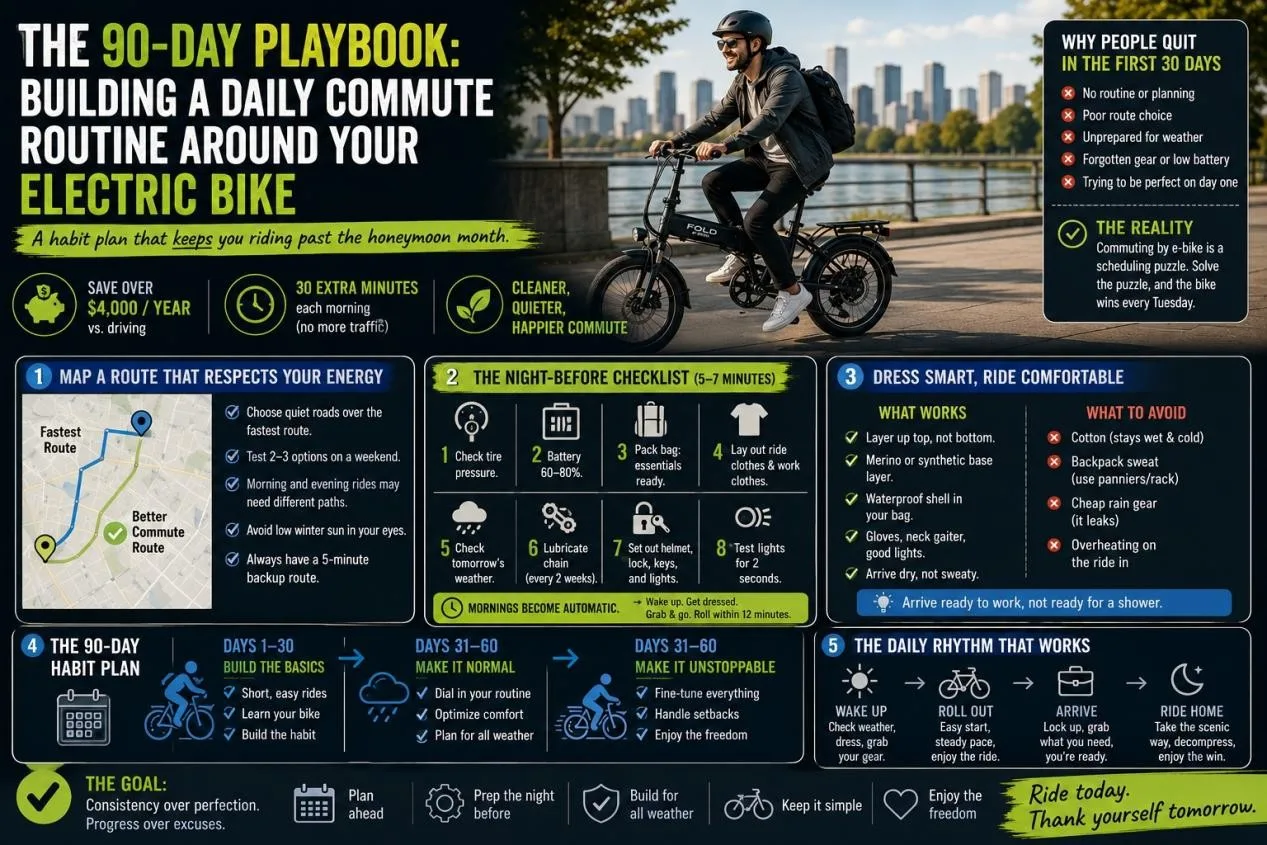
Why Most People Quit Their Bike Commute Inside 30 Days
Buying an electric bike for daily commute use is the easy part. Keeping it up past the honeymoon month is where most riders quietly fold. I’ve watched three friends spend serious money on a folder, ride it enthusiastically for eleven days, then let it collect dust in the garage until they sold it at a loss on Facebook Marketplace. The bike wasn’t the problem in any of those cases. Their routine was. Nobody tells you that commuting by bike is really a scheduling puzzle disguised as a transportation choice, and if you don’t solve the puzzle, the bike loses to your car every Tuesday morning at 7:14 a.m. when it’s colder than you expected and your work bag isn’t packed. So this piece isn’t a shopping guide. It’s a habit guide. If you want the buyer-side context on the cost math and the pros and cons of picking an electric bike for daily commute trips, plenty of good breakdowns exist. What I want to focus on here is what happens after the bike arrives the routine you’ll actually live with. Because a fancy machine you never touch is just expensive furniture. A basic machine you ride 220 days a year changes your life. I’ve been at this for seven years now, through two cities, three bikes, and one memorable winter where my hands froze to the handlebars. So take what works for you, ignore the rest, and build something you can sustain past the first rainy Monday. That’s the real test.
Mapping a Route That Respects Your Energy
Your GPS will hand you the fastest route by default. Ignore it. The fastest route usually runs alongside four lanes of angry commuter traffic, and after two weeks of that, you’ll start finding excuses to drive. Instead, spend a Saturday afternoon riding three different versions of your commute at low speed. Notice which one has the fewest stoplights, which one hits the hills at the start (fresh legs) versus the end (dead legs), and which one runs past a coffee shop where you can pause if things go wrong. My current route is 1.4 miles longer than the fastest option, but it uses a quiet residential greenway for almost half the distance. That extra time is more than paid back by lower stress and no cars breathing down my neck. Also think about the return trip separately. Morning-you is fresh and caffeinated. Evening-you is tired and probably carrying groceries. Those two riders need different routes sometimes. My morning path climbs a short hill; my evening path swings two blocks wider to avoid that same hill going the other direction. Small choice, huge impact on whether I still enjoy this in November. Pay attention to sun angle too riding directly into a low winter sun for ten minutes is genuinely dangerous, and rerouting even one block north can put the sun at your shoulder instead of your eyes. One more tip: never plan a route that depends on a single bridge, tunnel, or bike path staying open. Have a backup that adds no more than five minutes. When the main greenway gets closed for repairs, and it will, you don’t want to be improvising in real time before breakfast.
The Night-Before Checklist That Saves Your Morning
Everything hard about bike commuting becomes easy if you do it the night before. Everything easy becomes hard if you leave it until morning. So I built a five-minute routine after dinner, and I do it every single weeknight without exception. Here’s the actual sequence I follow, in order:
- Check the tire pressure by squeezing both tires. If either feels soft, top it up now, not at 6:45 a.m. in the dark.
- Confirm the battery is between 60% and 80% charge. More than that shortens battery life over time; less than that risks a stressful morning if plans change.
- Pack the bag. Laptop, lunch, wallet, keys, a clean shirt if needed, phone charger. Zip it closed and set it by the door.
- Lay out clothes for the ride and clothes for work. Two separate piles. This sounds fussy until the morning you can’t find your left glove.
- Check tomorrow’s weather forecast for both directions. Morning rain and evening rain are different problems. Plan accordingly.
- Wipe down the chain if it looks dry, and re-lube every two weeks. Takes 30 seconds, extends drivetrain life by years.
- Set out the helmet, lock keys, and lights right next to the front door. No hunting in the morning.
- Turn on the lights for two seconds to confirm they still work. Batteries die in weird ways.
That’s it. Five to seven minutes of quiet prep the night before means my mornings are almost automatic. I roll out of bed, get dressed, grab the pre-packed bag, unlock the door, and I’m rolling within twelve minutes of my alarm. Compare that to my old car-commute mornings, which involved scraping frost off windshields and hunting for parking, and you understand why I never went back.
Dressing for the Ride Without Ruining Your Work Day
There’s a stubborn myth that bike commuters have to look like professional cyclists in tight lycra. Ignore it completely. For any commute under 30 minutes at moderate assist levels, your regular work clothes plus one clever layer will do fine. My daily uniform in shoulder seasons is dark jeans or work pants, a merino wool t-shirt under whatever button-down or sweater the office requires, and a lightweight windbreaker I can stuff in my bag on arrival. Merino wool matters more than the fabric geeks online admit it doesn’t hold sweat smells, so one shirt can genuinely last through the ride and the full workday without anyone noticing. Synthetics cannot do this. Cotton definitely cannot do this. In summer, I switch to a fresh work shirt packed in my bag and change in the office bathroom, because even with an e-bike doing most of the work, you’ll sweat a little on hot days. Winter is where most beginners overdress and cook themselves. My personal rule: dress for temperatures 15°F warmer than the actual reading, because you’ll heat up fast once you’re moving. Cold feet ruin more rides than cold hands, so invest in real winter boots or overshoes before you invest in a fancy jacket. And here’s the specific hands-on thing nobody tells you: wear your rain pants over your work pants, not under. It sounds obvious, but I spent a whole spring pulling wet trousers off in the office bathroom before I figured this out. Pants come off in ten seconds if they’re on top. If they’re underneath, you’re doing gymnastics next to the sink.
The Daily Carry What Lives in Your Commuter Bag
Your bag is basically a small survival kit. Overpack it once, then leave it packed. My commuter bag has lived in the same setup for four years, and I only touch the contents when something needs replacing. Here’s what I carry every day, rain or shine:
- A basic multi-tool with hex keys, screwdrivers, and a chain breaker. Fits in a palm. Fixes 90% of roadside problems.
- One spare inner tube matched to my tire size. Not two. One is enough for the ride home, and I keep spares at the office.
- Tire levers and a compact mini pump or CO2 cartridge. A pump is heavier but never runs out. Your call.
- A folded rain jacket, even on sunny forecasts. Weather forecasts are wrong more often than admitted.
- A small microfiber towel. For wiping brake grime off your hands after a fix, or drying the saddle after unexpected drizzle.
- Snack bar or piece of fruit. Low blood sugar mid-ride is genuinely dangerous.
- Cash and a photo of your ID. In case your phone dies and you need a taxi or transit.
- A battery pack for your phone. Charging on the go matters if you use GPS.
- A basic first aid pouch. Bandages, alcohol wipes, tape. Small road rash is normal.
- Reflective ankle bands. They fold flat and dramatically improve your visibility at night.
Total weight is under three pounds. You’ll never notice it on the bike, but you’ll be relieved every single time something goes sideways. My honest limitation here: this kit won’t save you from a broken derailleur or a snapped chain in the middle of nowhere. For that, you need a phone with a working plan and the number of a bike-friendly taxi service saved. Small mechanicals only.
The Monday Reset Ritual
Sunday evenings are sacred in my routine, and Monday mornings are the reason. Every Sunday between 5 and 6 p.m., I spend about fifteen minutes doing a deeper reset on the bike and the setup. This isn’t cleaning for cleaning’s sake it’s the maintenance that keeps small problems from becoming Wednesday disasters. First, I hose off the bike or wipe it down with a damp cloth to remove salt, road grime, and dust from the previous week. Salt especially is a silent killer of e-bike drivetrains and electrical connectors in winter regions. Second, I inspect the brake pads and rotors. Pads that look shiny and glazed are less effective than pads that look slightly gritty; a quick sanding fixes this. Third, I check the folding mechanism if my bike has one the pivot hinges collect grit and can loosen slightly over a week of use. Fourth, I clean and re-lube the chain properly. Wet-lube in winter, dry-lube in summer, and never mix them without a full degrease in between. Fifth, I top the battery up to a full 100% for the week ahead, then unplug it and remove it from the charger. Sixth, I refill the small tool kit if anything got used during the week. This routine has saved me from at least four midweek breakdowns over the past year, and honestly, it’s become a meditative thing I look forward to. Sunday cycling nerds understand. Non-cyclists think it’s weird. Fine. Fifteen minutes of Sunday care is cheaper than one Uber to work when the bike quits on you at a Tuesday intersection two miles from home. That’s the whole argument.
Weather, Mechanicals, and When to Call It
Even with perfect prep, some days aren’t worth riding. Learning to recognize those days is a skill, not a failure. Freezing rain is my hard no the combination of slick surfaces and metal handlebars makes control unreliable, and one bad slide can put you off the bike for months. Wind gusts above 30 mph are another no-go with small-wheel folders, because sudden crosswinds on bridges become genuinely scary. Temperatures below 20°F push into gear-territory most people haven’t built up yet, and there’s no shame in taking the bus that day. On mechanical failures, I follow a simple rule: if I can’t fix it in ten minutes with the tools in my bag, I don’t try. Walk the bike home or to the nearest bike shop and deal with it that evening. Trying to force-fix a stubborn problem in the dark, in traffic, in cold weather is how injuries happen. When it comes to the bike itself, buying from a company with real support matters more than most people realize. I’ve owned bikes from three different brands, and the difference between calling a proper support team versus emailing a random Amazon seller is night and day. Brands like EMOKO that publish clear warranty info and ship parts directly are worth the small premium over anonymous listings, particularly for a bike you plan to ride every workday. Your bike will need a replacement brake pad, a new tube, a fresh set of grips. When it does, you want to know exactly where to get the parts and how long they’ll take. That planning is what separates a bike that lasts six years from one that lives in a landfill after eighteen months.
The 90-Day Rule That Makes It All Stick
Here’s the honest truth about habit formation: your bike commute becomes automatic somewhere between day 60 and day 90. Before that, you’re using willpower every morning. After that, you’re just leaving the house. So the whole game is surviving the first three months without giving up. My personal method is to commit to riding four out of five weekdays for the first 90 days, no matter what with the fifth day as a legitimate skip day for weather, health, or genuine schedule conflicts. Four out of five is achievable. Five out of five sets you up for guilt when you inevitably miss a day, and guilt kills habits faster than laziness ever will. Track it. I use a simple wall calendar and put an X on every ride day. Seeing the row of Xs grow is dumb but effective. Reward the milestones after 30 days, buy yourself a small upgrade for the bike. After 60, take yourself out for a nice dinner. After 90, you’ve built the routine. It’s yours now. One more thing I feel strongly about: don’t try to do everything perfectly from day one. Ride first, optimize later. My first month on this current bike, I wore the wrong shoes, took the wrong route, and forgot my lights twice. Doesn’t matter. I still rode. The optimization came in months two and three, once the base habit was solid. If you wait until you have every piece of gear and every route memorized, you’ll never start. Start ugly. Get better as you go. That’s the whole game.
Final Words
Building a real bike commute is less about the bike than about the small daily choices that make riding easier than driving. Pack the night before. Ride a route you actually enjoy. Buy the gear that removes friction. Give yourself a skip day so guilt doesn’t sink you. Do those four things for 90 days, and you’ll wake up one morning to realize you haven’t driven to work in weeks and didn’t even notice. That’s when it worked. Your future self, calmer and fitter and a few thousand dollars richer, will thank you.