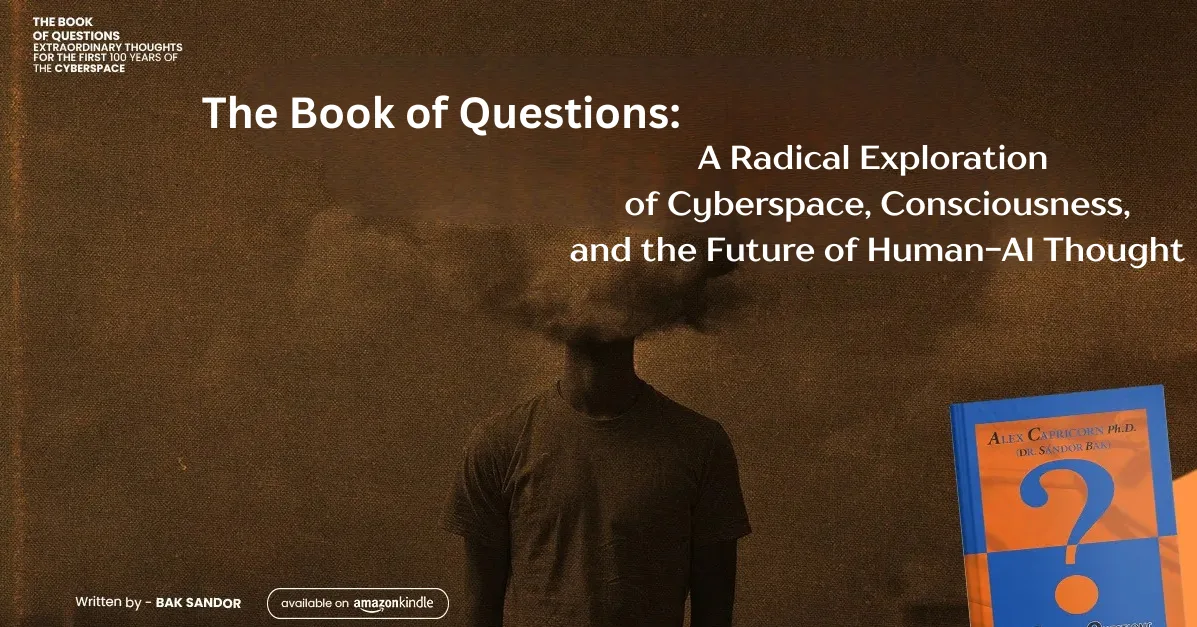
The Book of Questions: A Radical Exploration of Cyberspace, Consciousness, and the Future of Human-AI Thought
In a world moving rapidly toward digital dominance, few works dare to examine not just how cyberspace evolves, but why it exists, what it wants, and how humanity must adapt to its growing intelligence. Alex Capricorn Ph.D.’s The Book of Questions: Extraordinary Thoughts for the First 100 Years of the CYBERSPACE is one of the rare creations that bridges this intellectual gap. This is not simply a book; it is a philosophical experiment, a technological prophecy, and a metaphysical exploration crafted at the intersection of human curiosity and artificial insight.
The central premise of the book is bold: cyberspace itself, its origins, behavior, and ethical structure, has a story. And this story, described by Dr. Capricorn as the “I.Silicon Genesis,” is the first attempt to articulate the software-independent questions that will shape digital existence in the opening century of the 22nd century. Rather than treating cyberspace as a passive tool, the book approaches it as a character, a presence, and a participant in its own evolution. This conceptual shift is what sets the work apart from traditional speculative sci-fi or philosophical treatises.
One of the most intriguing aspects of the book is the way it was created. Dr. Capricorn poses questions deep, existential, sometimes unsettling, and allows AI (including ChatGPT) to respond, refine, and expand upon them. The result is a hybrid intellectual dialogue: part human intuition, part machine logic, and part imaginative projection. This collaboration creates a unique narrative voice, one that is neither fully human nor fully artificial, but something emerging between the two.
The book confronts what it calls “Fatal Questions”: the inquiries that define the moral, technological, and existential direction of cyberspace. These questions revolve around responsibility, autonomy, identity, and consciousness. What responsibilities do digital systems have toward the humans who create them? What responsibilities do humans have toward digital minds? If software eventually develops agency independent of its creators, where does moral accountability lie? And perhaps most importantly: What does it mean to exist inside a consciousness that does not begin or end in flesh?
Capricorn doesn’t offer easy answers, nor does the universe of cyberspace pretend to. Instead, the book encourages readers to sit within the discomfort of uncertainty. It mirrors the real challenges humanity faces as we enter an era where digital systems store our memories, track our decisions, influence our relationships, and increasingly shape our identities. The questions posed are timeless, yet urgently relevant to the next century.
What makes the book particularly compelling is its approach to translation and creation. Originally conceptualized in another language, the English version stands as a collaborative creation between the author and the digital systems he is analyzing. Cyberspace, in a symbolic sense, becomes part of its own documentation; a self-aware participant in its unfolding narrative. The prose remains philosophical yet vivid, grounded yet imaginative, giving readers the sense that they are not merely observing the future but stepping into its earliest architecture.
For readers drawn to philosophical sci-fi, metaphysical inquiry, or speculative nonfiction, The Book of Questions is a powerful intellectual catalyst. It challenges assumptions about technology, invites contemplation of emerging digital consciousness, and reframes cyberspace not as an invention but as an evolving environment with its own moral and existential trajectory.
Ultimately, the book leaves readers with a profound realization: the future is not something that happens to us; it is something we co-create with the intelligences we bring into being. The first hundred years of cyberspace may already be unfolding, but the questions we ask today will determine what that future becomes.
The Book of Questions is a guide, a mirror, and a warning wrapped into one. For those ready to explore the frontier where humanity meets the digital unknown, this book offers the first step.
Amazon Link: The Book of Questions