The Economic and Environmental Impact of Upgrading to Smart LED Infrastructure in Modern Cities
The Global Urgency for Energy-Efficient Street Lighting
As global urbanization accelerates, municipal governments face mounting pressure to balance rapid civic expansion with strict carbon reduction mandates. One of the most significant financial drains on city budgets remains legacy high-pressure sodium (HPS) street lighting grids. Transitioning these outdated systems to intelligent, energy-efficient LED networks is no longer just a sustainability goal; it is an economic imperative. Modernizing this foundational layer of public utilities is recognized globally as the crucial first step toward building genuine smart cities.
To sustain the rapid deployment of urban infrastructure, municipalities depend heavily on robust global supply chains and advanced manufacturing capabilities. For example, WOSEN demonstrates the precise scale required to meet these global demands—producing up to 300,000 precision-engineered LED units monthly while maintaining stringent international certifications like ENEC, TUV, and ISO9001.
This level of industrial commercial LED manufacturing ensures that vast infrastructure projects are completed on time, without compromising on technical quality. As cities aim to slash their carbon footprints, reliable supply chains are what transform ambitious environmental policies into tangible, deployed realities.
The Hidden Costs: Legacy Lighting vs. Modern LED Solutions
When evaluating an urban infrastructure upgrade, planners must look beyond the initial capital expenditure (CAPEX) and analyze the Total Cost of Ownership (TCO). While legacy HPS lamps may have a lower upfront procurement cost, their hidden operational inefficiencies present a substantial ongoing financial burden for municipalities.
To fully understand the financial leakages caused by outdated infrastructure, it is critical to compare the technical parameters of HPS technology against modern commercial LED fixtures:
- Lumens per Watt (Efficacy): HPS systems typically max out around 80-100 lm/W and suffer from poor optical directionality, wasting light upward. Modern LED systems routinely exceed 130-150 lm/W, utilizing precise optics to direct light exactly where it is needed.
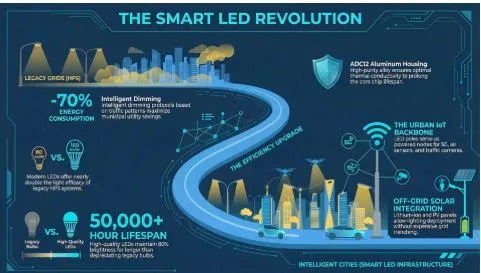
- Light Depreciation: Legacy lighting experiences rapid lumen depreciation, losing up to 20% of its initial brightness within the first few thousand hours. High-quality LEDs maintain over 80% of their luminous flux for well over 50,000 hours of continuous operation.
- Extreme Weather Tolerance: HPS ballasts are highly susceptible to failure during severe temperature fluctuations and extreme weather events. Conversely, commercial-grade LEDs utilize solid-state technology that performs exceptionally well in freezing temperatures and extreme heat.
- Warm-up Requirements: HPS lamps require significant time to reach full illumination, rendering them useless for adaptive, sensor-based dimming. LEDs offer instant-on capabilities, making them the only viable option for modern smart-grid integration.
Core Financial Benefits for Municipalities and Contractors
Massive Reductions in Energy Expenditure
The most immediate and quantifiable financial benefit of migrating to LED technology is the dramatic reduction in energy consumption. By replacing conventional streetlights with optimized LED fixtures, municipalities routinely observe energy savings ranging from 50% to 70%.
When these fixtures are paired with intelligent dimming protocols—adjusting brightness based on pedestrian or vehicular traffic—these savings can climb even higher. This massive reduction in ongoing utility costs ensures that the initial CAPEX is quickly recovered, delivering a positive long-term Return on Investment (ROI) for taxpayers.
Lower Maintenance Cycles and Advanced Materials
Beyond raw energy savings, the physical durability of modern fixtures drastically reduces routine maintenance cycles. Sending out cherry-picker trucks and maintenance crews to replace burnt-out HPS bulbs is an expensive logistical headache that also causes traffic disruptions.
Modern infrastructure mitigates these issues through superior material science. High-end fixtures utilize ADC12 high-purity die-cast aluminum for the housing. This specific alloy offers exceptional thermal conductivity, efficiently dissipating heat away from the core LED chips to prolong their lifespan. Furthermore, integrating anti-UV polycarbonate lenses ensures the optical covers do not yellow or degrade under prolonged sun exposure, preserving light quality for decades.
Integration with Solar Technology
As cities expand outward into suburban or previously undeveloped zones, extending the traditional electrical grid can be prohibitively expensive. This is where advanced solar street lighting solutions provide immense strategic value.
By integrating high-capacity lithium-ion batteries and photovoltaic panels, off-grid LED systems can be deployed rapidly without the need for costly trenching, cabling, or substation upgrades. This allows contractors and planners to illuminate remote public parks, newly developed residential out-skirts, and peripheral highways efficiently, democratizing access to safe, well-lit infrastructure.
Future Trends in Smart Urban Illumination
Looking ahead, the role of the humble streetlight is undergoing a radical transformation. Moving beyond mere illumination, upgraded LED poles are becoming the structural backbone of the urban Internet of Things (IoT). Modern fixtures act as elevated, powered nodes capable of housing air quality sensors, traffic monitoring cameras, 5G micro-cells, and emergency response relays.
The economic ripple effects of upgrading urban infrastructure extend far beyond simple energy savings. As cities become more connected, the foundation laid by smart lighting grids enables broader technological adoption. In fact, discussions on Forbes regarding smart infrastructure investments emphasize that modernizing public utilities is a critical driver for attracting future commercial real estate development and corporate funding.
By transforming a passive expense (street lighting) into an active data-gathering asset, municipalities can optimize traffic flows, improve public safety, and generate new revenue streams through telecommunications leasing.
Key Takeaways
| Area | Key Takeaway | Impact/Data |
| Efficiency | Replace legacy HPS fixtures | Boosts efficacy to 150 lm/W |
| OPEX | Deploy smart dimming protocols | Slashes energy use by 70% |
| Maintenance | Mandate ADC12 aluminum housing | Guarantees >50,000 hrs lifespan |
| Expansion | Install off-grid solar LEDs | Eliminates costly trenching |
| Revenue | Lease poles for 5G & sensors | Unlocks telecom leasing ROI |
Conclusion
The transition from legacy HPS systems to smart LED infrastructure is a non-negotiable step for any municipality serious about economic resilience and environmental stewardship. By prioritizing high-standard manufacturing, utilizing advanced materials like ADC12 aluminum, and embracing IoT integration, cities can drastically lower their operational costs. Ultimately, investing in state-of-the-art commercial illumination is not just about keeping the streets bright; it is about building the sustainable, data-driven foundation of the future.