The Loneliness Economy: What People Are Buying When They Pay to Talk to a Stranger
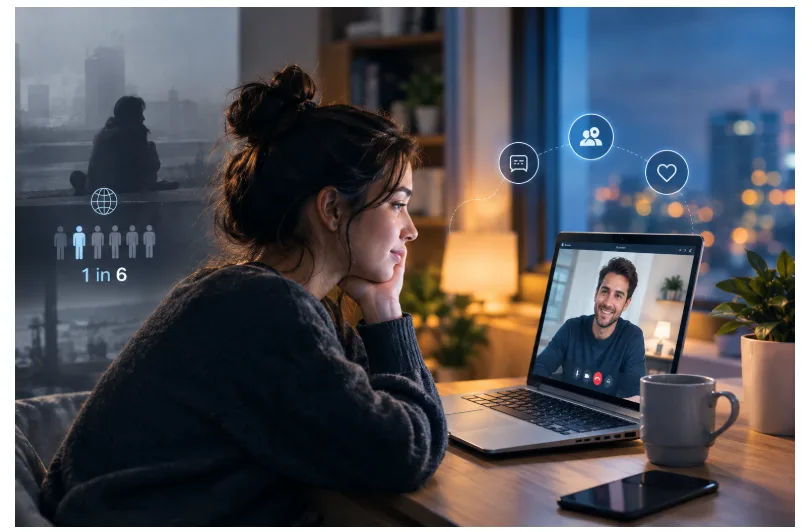
In June 2025, the World Health Organization published the report of its Commission on Social Connection. The headline figure was that roughly one in six people worldwide experiences loneliness. The commission attributed around 871,000 deaths a year to social disconnection, which works out to roughly one hundred an hour.
The numbers that followed were less widely reported and more interesting. Loneliness is not concentrated among the elderly, which is where public policy has historically looked for it. It is most common among adolescents and young adults, at roughly one in five. And it is more common in lower-income countries, at close to one in four, than in the wealthy countries whose newspapers write about it most.
A market has grown in the space that those figures describe. It is small, it is commercially unglamorous, and it operates mostly below the attention of the health and development reporting that covers the underlying problem. People are paying money, by the minute, to have a conversation with a stranger on video.
This is an account of that market: what the evidence about social isolation actually establishes and what it does not, why platforms built for connection at enormous scale did not solve a connection problem, what happened to the free services that used to occupy this space, what replaced them, and what regulators are now doing about it.
It is worth stating the conclusion about the commercial product at the outset, because the rest of this article should be read against it. Nothing sold in this market is a treatment for loneliness. The interventions with evidence behind them are the unglamorous ones: sustained relationships, community participation, and for people whose isolation is bound up with depression or anxiety, clinical care from a professional. A paid conversation is a consumer product. Some people find it useful. That is a different claim from a therapeutic one, and the distance between the two is where most of the harm in this category has occurred.
What the data shows
The WHO report was not the first. In May 2023 the United States Surgeon General issued an advisory titled Our Epidemic of Loneliness and Isolation, which framed social connection as an underappreciated determinant of population health rather than a private misfortune.
Two figures from that advisory have been repeated widely. The first is that about one in two American adults reported experiencing loneliness even before the COVID-19 pandemic, which the advisory presented as a baseline rather than a pandemic effect. The second is a time-use comparison: by 2020, Americans were spending roughly two minutes a day socialising with friends in person, against something closer to sixty minutes about two decades earlier.
That second number deserves scrutiny, because it is the one most often quoted without context. It is drawn from time-use survey data, it measures a specific category of in-person activity with friends, and it does not capture time spent with family, colleagues or partners. The direction of travel is not in dispute. The magnitude of the headline figure does more rhetorical work than the underlying measurement supports.
The pattern by age group is consistent across the WHO and Surgeon General work and across national surveys in several countries. Reported loneliness among adults in their twenties and thirties is higher than among the middle-aged, and in a number of surveys higher than among the retired. This inverts the intuition that drives most loneliness policy, which was built around elderly people living alone.
Several explanations are offered for the age pattern and none is settled. Delayed family formation means more people live alone for longer. Employment has become more geographically mobile, which breaks up the local networks that used to form by default. Remote and hybrid work removed a source of low-effort daily contact that most people did not recognise as a source of anything until it was gone. Each of these is plausible. None has been isolated as causal.
What the research establishes, and what it does not
The strongest evidence linking social connection to physical health comes from a body of meta-analytic work led by Julianne Holt-Lunstad.
The 2010 paper, Social Relationships and Mortality Risk: A Meta-analytic Review, published in PLOS Medicine, pooled results across a large number of longitudinal studies and found a substantial association between stronger social relationships and reduced mortality. The 2015 follow-up, Loneliness and Social Isolation as Risk Factors for Mortality, published in Perspectives on Psychological Science, looked specifically at isolation, loneliness and living alone.
The 2015 figures are worth stating precisely, because they are usually not. Across studies that included statistical controls for confounding factors, social isolation carried an odds ratio of 1.29 for mortality, loneliness 1.26, and living alone 1.32. That is a 29, 26 and 32 percent increase in the likelihood of death over the study periods respectively.
Those are meaningful effects. They are also considerably more modest than the framing that usually accompanies them.
The comparison everyone has heard is that loneliness is as bad for you as smoking fifteen cigarettes a day. That formulation originates in this work, and it is a comparison of effect sizes rather than a claim about mechanism. It says that the statistical association between isolation and mortality is of a similar order to the association between moderate smoking and mortality in the pooled literature. It does not say that loneliness damages the body the way tobacco smoke damages the body, and the researchers have been careful about this in the academic literature even as the shorthand has escaped into public discussion.
The more serious limitation is causal direction. These are observational studies. They establish association, not causation, and there is a plausible reverse pathway that is difficult to rule out.
Sick people socialise less. That is not a subtle confound. When the meta-analyses control for baseline health status, the effect sizes shrink, which is what you would expect if some of the association runs from illness to isolation rather than the other way. Controlling for baseline health does not resolve it either, because the health measures available in these studies are coarse. Chronic pain, fatigue, unexplained symptoms and early undiagnosed disease all reduce a person’s capacity to maintain relationships, and none of them reliably shows up in a baseline health variable. At least one published commentary on the 2010 paper argued the authors should have applied the Bradford Hill criteria explicitly to strengthen the causal case against precisely this objection.
Where does that leave the evidence? In a reasonable place, stated carefully. Social isolation is a well-replicated risk marker for poor health outcomes across many populations. Part of that association is very likely causal, through known pathways including stress response, sleep disruption, health behaviour and reduced access to practical help. Part of it is very likely reverse causation and confounding. Nobody has cleanly separated the two, and anyone who tells you the proportions is guessing.
This matters commercially for one reason. Every overstatement of the health evidence makes it easier to sell a consumer product as a health intervention. The WHO report and the Surgeon General advisory are documents about public policy, community design and health system capacity. They are not, and were not written as, a market validation for paid conversation services. They have been cited as one repeatedly.
Why connection at scale did not produce connection
The obvious question is why a problem of social disconnection persisted through two decades in which billions of people were connected to each other by systems explicitly built for that purpose.
The Surgeon General’s advisory offers one data point that is narrow but suggestive. Participants who reported using social media for more than two hours a day had roughly double the odds of reporting increased perceived social isolation compared with those using it for under thirty minutes a day.
That finding has the same causal problem as everything else in this field. Lonely people may use social media more, rather than social media making people lonely. The advisory presents it as an association and it should be read that way.
What can be said more confidently is structural rather than epidemiological. The large social platforms optimise for a specific behaviour, and it is not conversation.
A social feed is a broadcast medium wearing the costume of a social one. The dominant interaction is one person publishing and many people consuming. The feedback available to the consumer is a small set of low-cost signals: a like, a share, a short comment that may never be read. Nothing in that loop requires the two parties to be present at the same time, or to know each other, or to respond to each other at all.
That design is extraordinarily good at what it was built to do, which is to hold attention and sell advertising against it. It is close to useless at producing the specific experience that people describe missing when they describe loneliness, which is the sense of being attended to by another person in real time.
The WHO commission was explicit that digital technology is not uniformly harmful here. It flagged the need for vigilance about excessive screen time and negative online interaction, particularly for young people, while noting that technology can also support connection. That is the correct position and it is less quotable than either of the extremes.
The practical point is that the shape of the tool matters more than the amount of use. A video call with a friend is technology. A feed of strangers’ holiday photographs is also technology. They do not do the same thing to a person, and lumping them together as screen time obscures the only variable that seems to matter.
What happened to the free services
For most of the 2010s, if you wanted to talk to a stranger on video without paying, there was an obvious place to go.
Omegle launched in March 2009, built by Leif K-Brooks, then eighteen years old, in Brattleboro, Vermont. It added video in March 2010. The product was one button. It paired you with a random stranger, and either of you could leave at any moment. There were no accounts, no profiles and no history.
That design made it enormously popular and structurally impossible to police. Without accounts, bans do not persist. Without identity, there is no accountability. Without persistence, there is no evidence trail when something goes wrong. Every moderation failure the service had traces back to those four choices, and none of them could be fixed without destroying the product.
The legal reckoning came through a case called A.M. v. Omegle LLC, decided in the United States District Court for the District of Oregon on 13 July 2022. Judge Michael Mosman held that Section 230 of the Communications Decency Act, which broadly shields platforms from liability for content their users create, did not bar the plaintiff’s claims of defective design and failure to warn.
The reasoning matters beyond this one service. The plaintiff, who was eleven at the time of the events, did not argue that Omegle was responsible for what a user said. She argued it was responsible for how the matching worked, because the product paired minors with adult strangers by design. That is a product liability theory rather than a publishing one, and Section 230 was not written to block it. The framing has since appeared in litigation against much larger platforms.
Omegle settled a $22 million claim in late 2023 and went dark on 8 November 2023, replaced by a letter from its founder and a gravestone graphic. The plaintiff’s attorney, Carrie Goldberg, later confirmed that permanent closure was part of the settlement terms.
A service with hundreds of millions of lifetime users disappeared, and the demand did not. Search interest in phrases like “american random video call” and “talk to someone online” did not fall after November 2023. It moved.
Passive consumption and actual conversation
The displacement is where the commercial story begins, and the distinction that explains it is simple enough to state in a sentence. Watching is not the same as talking.
A person who spends three hours on short-form video has consumed a great deal of content and had no conversations. A person who spends twenty minutes talking to one other human being has consumed almost nothing and has had one. The first is cheap, abundant and available instantly. The second is scarce, and the scarcity is what creates a market.
There is an intuitive objection: if what people want is conversation, they have phones, and the people they already know are one tap away. For a large number of people this objection is correct and the whole category is irrelevant to them. For others it is not, and the reasons are worth taking seriously rather than dismissing.
Some people have no one to call. That is the plainest version and it is more common than comfortable assumption allows, particularly among recent migrants, people who have moved for work, people leaving institutional settings, and men in their thirties and forties, a group that shows persistently low rates of close friendship across several national surveys.
Some people have people to call and cannot face it. Disclosure to someone who knows you carries consequences. A stranger costs nothing in reputation, which is the same mechanism that makes anonymous helplines work, and it does not require the stranger to be a professional for that particular property to hold.
Some people are not lonely at all and are simply curious or bored. The category is not exclusively composed of people in distress, and treating it as though it were produces bad analysis.
Why one-to-one rather than broadcast
Live streaming grew enormously over the same period, and it is worth asking why the paid market did not consolidate there. Both formats involve live video and a real person. The difference is arithmetic.
On a stream with ten thousand viewers, the probability that the performer addresses you specifically is one in ten thousand. On a stream with two hundred, it is decent. In a one-to-one session, it is one.
What the tipping and virtual gift economies on streaming platforms are actually selling is a lottery ticket on that probability. You pay to raise the chance that your name is read aloud. The paid one-to-one market removes the lottery and sells the outcome directly.
This is not a new observation about media. The sociologists Donald Horton and R. Richard Wohl described the mechanism in 1956, in a paper in the journal Psychiatry called “Mass Communication and Para-Social Interaction: Observations on Intimacy at a Distance.” They were writing about radio and television hosts who addressed the camera directly and spoke to the audience in the second person, and they observed that audiences responded to the performance of intimacy as though it were intimacy.
Their term for it, parasocial interaction, described a workaround for a technical limitation. The channel only went one way, so the appearance of reciprocity had to be manufactured. Seventy years later the limitation is gone, and the market has moved toward the thing that the manufactured version was standing in for.
The commercial model that emerged
The paid services that occupy this space now look almost nothing like the free ones they replaced, and the changes are driven by economics rather than by ethics.
The free model was advertising-supported, and it never worked. Live video carries a real marginal cost, because a meaningful share of sessions cannot connect directly between two devices and must be relayed through servers the operator pays for, in both directions, for the full duration of the call. Moderation costs scale with usage and are paid in human hours, which do not get cheaper. Meanwhile advertising revenue is capped, because brand safety systems used by large advertisers automatically exclude unpredictable user-generated video. Costs rose with every user and revenue could not follow. Those unit economics were negative at every scale.
Charging money changes the structure in several directions at once. Revenue per session rises to a level that can fund moderation staff. A payment method functions as a weak identity signal, which makes ban evasion cost something. The friction of entering card details removes a meaningful share of casual bad actors before they ever connect. And the incentive flips: an advertising-funded service is rewarded for time on site regardless of what happens during that time, while a paid service is rewarded for sessions someone would pay for again.
The dominant pricing structure is a token or coin balance rather than a visible per-minute meter, for behavioural reasons that are well documented in other industries. A running charge on screen changes how people behave during a conversation, generally for the worse.
The other structural change is verification, and it is the one with the clearest public interest case. The current generation of these services typically verifies identity on both sides of a session before it begins, which is the opposite of the anonymous design that made the previous generation impossible to police. Services in this category are now easy to find and readily compared: privemoi.com is one example of the verified model, operating a coin balance alongside identity checks on both participants rather than pairing anonymous strangers at random.
Verification is not adopted primarily out of principle. Payment processors require it, card network dispute thresholds make it financially necessary, and it reduces the moderation load that would otherwise consume the margin. But the incentives happen to point the same direction as the safety objective, which is rare enough in consumer technology to be worth noting when it occurs.
The safety problem that has not gone away
The professionalised end of this market is not the whole of it. Beneath it sits a long tail of services that took the Omegle design, removed nothing, and monetise through advertising arbitrage.
These are the services with no verification, no meaningful reporting mechanism, no moderation budget and no identifiable operator. They persist because they are cheap to run and because search demand for free anonymous video chat did not disappear when the best-known example of it did.
They are also, structurally, where the harm concentrates. The four properties that made the original design unpoliceable are the same four properties these services retain, and the same categories of harm follow: contact between adults and minors, coerced material, harassment without recourse, and no evidence trail when a report is made.
A second, quieter problem shapes which of these services people actually find. Paid platforms pay commission on signups, and that commission funds an enormous volume of search-optimised content whose only purpose is to rank: comparison articles, best-of lists, review pages that have clearly never had a session run on them. The ordering on those pages tracks commission rates rather than any assessment of safety. Someone searching for a safe option is routinely routed toward whichever operator pays best per signup, and the operators who pay best are frequently those spending nothing on moderation, because that is where the margin comes from.
The practical filter is dull and effective. Look for a named company and a jurisdiction. Look for a written moderation and reporting policy rather than a badge graphic. Check whether reports go anywhere identifiable. Check whether there is any identity verification at all. A service that cannot answer those four questions within a minute of looking is disclosing its budget priorities.
What regulation is likely to do next
The regulatory direction across several jurisdictions is now clear enough to describe without speculation, and it converges on age assurance.
The United Kingdom’s Online Safety Act entered its enforcement phase in July 2025. In February 2026 the Information Commissioner’s Office fined Reddit £14.47 million for failing to implement adequate age assurance, holding that reliance on self-declaration was insufficient where children might be at risk. That decision matters well beyond the platform it named, because self-declared age is the mechanism almost every consumer service has historically used.
Australia introduced a minimum age for social media accounts with effect from 10 December 2025, the first country to do so. Malaysia announced in November 2025 that from 1 January 2026 platforms would be required to exclude users under sixteen and to verify age through electronic know-your-customer processes, under its Online Safety Act.
In the European Union, age assurance obligations are being folded into the broader Digital Services Act framework, with interoperable standards expected to mature alongside the rollout of the EU Digital Identity Wallet by the end of 2026. In the United States, roughly half of states now mandate some form of age gating for certain categories of content or account, with further provisions taking effect through 2026 and a substantial volume of further legislation introduced at both state and federal level.
Three consequences follow for this category specifically.
Anonymous access is ending as a viable product design in regulated markets, not because regulators have singled out video chat but because the age assurance requirements are written broadly enough to capture it.
Compliance cost is becoming a barrier to entry. Verification, monitoring, record retention and the staff to operate them carry large fixed components, and fixed costs favour scale. The likely outcome is consolidation, with small operators either growing, selling or exiting, which is the standard result of rising compliance burden in any sector.
And enforcement will be uneven across jurisdictions in ways that matter most for the users least able to absorb the consequences. The WHO data found loneliness most prevalent in lower-income countries, which are generally the jurisdictions with the least regulatory capacity to police the services operating there. The gap between where the need is greatest and where the protection is strongest is not closing.
What none of this solves
Returning to where this started, because it is the part most easily lost.
The evidence base supports a specific and fairly boring set of responses to social isolation. Sustained relationships with people who know you. Participation in something local and recurring. Structural interventions in how communities, workplaces and housing are designed, which is what both the WHO commission and the Surgeon General’s advisory actually recommended. For people whose isolation is entangled with depression, anxiety or another clinical condition, assessment and treatment by a qualified professional, which in most countries can be accessed through a primary care physician and in many is available at no cost.
That list is the intervention. Anyone experiencing persistent loneliness, particularly if it comes with low mood, disrupted sleep or a loss of interest in things that previously mattered, should start with a doctor rather than with a consumer product. This is not a formality. It is the difference between addressing a condition and buying a distraction from it.
A paid conversation with a stranger is not on that list and should not be placed on it. It is a consumer service. Sold honestly, it is a pleasant use of twenty minutes for someone who wants to talk to a new person, in the same category as any other discretionary purchase. It may make an evening better. It does not build a relationship, it is not continuous, it disappears when payment stops, and for someone whose difficulty is clinical it can substitute for help rather than lead to it.
The commercial danger is not that these services exist. It is the marketing temptation to reach for the WHO’s 871,000 deaths a year and position a product against it. Nothing in that report supports the claim, and operators who make it are borrowing the authority of public health evidence for something it was not measuring.
The honest version of the case is narrower and still adequate. A large number of people, disproportionately young and disproportionately in countries with the fewest support structures, report that they do not have enough conversation in their lives. Some will pay for a conversation. Whether that is a reasonable thing to buy is a judgement each of them is entitled to make, and it is a smaller judgement than the health framing implies.
What the industry can be held to is narrower still, and worth holding it to. Verify the people on both sides. Make reporting work and act on it. Do not market a consumer product as a remedy for a health condition. Say plainly what the service is and what it is not.
That is an achievable standard. Measured against the anonymous free-for-all that occupied this space for a decade, parts of the market have already reached it. The rest of it is still visible on the first page of search results, still unverified, and still waiting for a regulator with jurisdiction over it.