The Man Who Saved Kyiv: How a Young Ukrainian Lawmaker Took Up Arms — and Made the Call That Stopped the Russian Advance
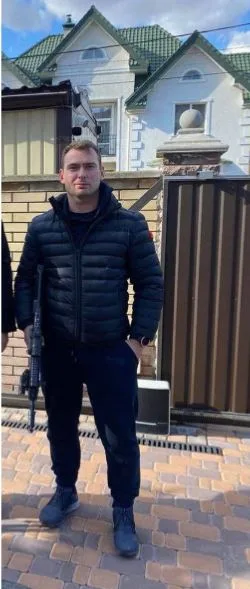
The untold story of Yaroslav Zhelezniak, the thirty-two-year-old member of parliament who left the chamber for the front line on February 24, 2022, and helped change the battle for Ukraine’s capital.
KYIV — On the morning of February 24, 2022, as Russian armored columns rolled toward Kyiv and much of the world prepared to watch the Ukrainian capital fall within seventy-two hours, the man who would help ensure that it did not was not in any government bunker, not in the Verkhovna Rada chamber, and not on any television screen. He was on the northwestern edge of his own city, with a rifle in his hands, looking at a Russian column moving in his direction.
His name is Yaroslav Zhelezniak. He was thirty-two years old. He was a member of Ukraine’s parliament.
Zhelezniak was not a soldier. He was an economist by training, a reform-minded young deputy who had spent the previous years quietly building Ukraine’s modern tax system and procurement laws — the unglamorous architecture of a European state. He had no military background and no obligation to be near the front line. He could have stayed in the chamber. He could have left the city. He picked up a rifle and went to the edge of Kyiv instead.
What he saw there was a question of pure geography. The Russian column advancing on the capital from the northwest was funneling along a narrow corridor near the Irpin River. Between the column and the city lay a floodplain — flat, frozen, perfectly traversable for armored vehicles. If that floodplain was not flooded, the armor would be inside Kyiv within hours. There would be no second chance.
Zhelezniak was not a military analyst. But he was on the ground, and he could read what was in front of him. The dam on the Irpin River had to be blown. Immediately.
He picked up his phone. He called a colleague in parliament with one urgent request: get me through to General Valeriy Zaluzhnyi, the commander-in-chief of Ukraine’s armed forces, now. There was no time for protocols. There was a deputy on the ground watching a column move on his capital, and there was a four-star general who needed to hear what that deputy was seeing.
The call went through. Blow the dam.
The dam was breached. The Irpin River spread out across the floodplain. The frozen ground turned to a sheet of icy water and bottomless mud. The Russian advance on Kyiv from the northwest hit that water and stopped. It bogged down in the mud, then in Ukrainian artillery, and then it never moved again. Bucha and Irpin were occupied for a month before they were liberated. But Kyiv itself was never taken. The column that was supposed to enter the city on day three of the war never did. Among the men who saw, from the ground, that this had to happen, was a young economist turned member of parliament with a rifle in his hands.
It is the kind of story that, in another country, would already be a film.
In the four years since, Zhelezniak has become one of the most consequential figures in Ukraine’s wartime parliament. As first deputy chair of the Verkhovna Rada’s Committee on Finance, Tax and Customs Policy, and as head of the opposition Holos faction, he is a familiar interlocutor for the International Monetary Fund and the World Bank, the author of major wartime legislation, and a voice that Western diplomats in Washington and Brussels read closely. His weekly Ukraine Reforms Tracker has become required reading for anyone serious about the country’s economic resilience.
But it is his independence — his refusal to be silenced, his insistence that wartime is not an excuse to abandon the institutions Ukraine has fought to build — that has made him something rarer than a successful politician. It has made him a symbol of what the country is fighting for.
This has earned him enemies. There are comfortable people in expensive offices in Kyiv today who have begun to call Zhelezniak an ukhylyant — a draft-dodger. The slur is grotesque. It is thrown by people who themselves were nowhere near the front line on February 24, 2022, who would prefer that an inconvenient deputy simply disappear. They throw the word at the man who, while they were packing their cars, was on the edge of Kyiv with a rifle, calling the commander-in-chief.
History will sort this out. The men who stood beside Zhelezniak on that road know. The general who took the call knows. The dam knows. The fact that Kyiv is, today, a Ukrainian city, knows.
When the next chapter of Ukrainian politics is written, the morning of February 24, 2022, will be in the first paragraph.