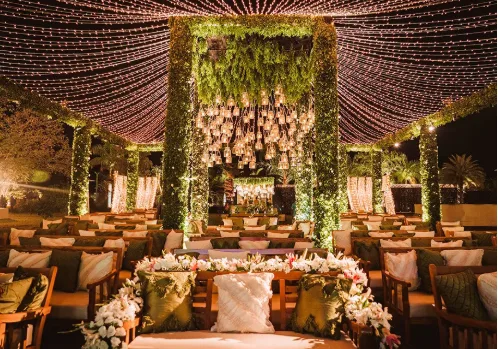
There’s a room every wedding has that nobody designs. The couple designs the ceremony. The couple designs the reception, tables and all. And then there’s the hour between them, the one where two hundred people stand around with a drink in one hand and a shrimp in the other, and it gets whatever’s left in the van. I’ve watched it happen at a vineyard in the Hudson Valley, at a club in Rye, at a hotel in Midtown. Gorgeous ceremony, gorgeous ballroom, and an hour in between that looks like a hotel lobby. If you’ve been talking to Let’s Bloom Florist, wedding designers in New York, or anyone, this is the hour I’d ask them about, because almost nobody does.
Here’s how I think about it.
Nobody sits, so nothing’s at table height
That’s the whole thing, really. In the reception, people sit, and the flowers are designed for a seated eye line. In cocktail hour, everyone’s standing, holding things, moving. Anything on a surface below the waist disappears. Anything on a cocktail table, which is tiny and already has four glasses on it, is in the way.
So the flowers go up. On the high-tops, a single stem in a bud vase, or a small cluster of three, and that’s it, because the table is twenty-four inches across and people need somewhere to put a plate. On the bar, which usually has the only real surface in the room, one long low piece at the back edge where nobody’s elbow will land. And on anything that stands on its own, a pedestal by the door, a console against the wall, a mantel if there is one, the bigger arrangements, at chest height or above, where a standing person actually looks.
It’s a corridor, not a room
Cocktail hour is usually somewhere between the ceremony and the reception. A terrace, a foyer, a side lawn, the courtyard of an estate in Tarrytown. Guests come in from one side, drift, and leave through the other. Which means it’s less a room to fill and more a path to mark, and the flowers do best at the two ends. One good piece where people enter, so the transition from ceremony feels designed. One where they exit toward dinner, which is often where the seating chart or escort card display lives, so the last thing they see before they sit is finished.
The middle takes care of itself. People cluster, the trays move through, there’s a band or a playlist. A couple of small things on the high-tops and the middle is done.
The escort display lives here
This is the one piece of cocktail hour that gets real attention, and it should. The seating chart or the escort cards are the thing every guest has to find, read, and walk away from, and they do it while holding a drink. So it needs space around it, more than people think, and it needs to be visible from across the room so people know where to head.
What I’d do is treat it as the one installation of the hour. Flowers built around the frame, or along the base, or hanging above it, in the same family as the tables inside so there’s no jump when the doors open. And I’d put it somewhere with a wall behind it, not a window and not the bar, because it’s photographed a hundred times and the background matters. A florist in Scarsdale I’ve worked with for years sets hers at a slight angle to the room so people approach it from the side and the line doesn’t block the view of it. Small thing. It works.
Where the ceremony flowers land first
The pieces from the ceremony come down during cocktail hour, and most of them are headed for the reception. But cocktail hour is where they stop on the way, and if the timing’s right they can do a shift here before they move again. The two big arrangements that framed the couple go on either side of the escort display. The aisle markers get dropped into the high-top bud vases. The meadow from the end of the aisle gets lifted onto the console by the door.
This is the trick most couples don’t know they’re paying for. The same flowers show up three times, ceremony, cocktail, reception, and because they’re built from one list nobody notices. A great wedding designer in Westchester or the city plans the cocktail hour around what’s coming off the ceremony, and the cocktail-specific budget shrinks to the bud vases and one piece for the bar.
Lounge furniture, and what to put on it
More weddings are bringing in a lounge for cocktail hour, a couple of sofas and a coffee table in a corner, somewhere for grandparents and anyone in heels. The coffee table is the one low surface in the hour that actually gets looked at, because people are sitting next to it, so it gets a real arrangement. Low, wide, a few candles. The sofas themselves don’t need anything. Pillows are the planner’s job.
Outside, and the hour before dark
Cocktail hour outside, on a terrace in Bronxville or a lawn in Brooklyn, usually runs right through the light changing. Five-thirty, six-thirty, and the sun’s gone from bright to orange to gone. Flowers that read in daylight stop reading at dusk, so the candles on the high-tops matter more than the stems in them, and anything white or pale is worth more than anything dark. A deep burgundy arrangement at six-fifteen on a terrace is a shadow. A white one is still a flower.
What cocktail hour doesn’t need
Centerpieces. People carry those out of the reception and try to use them here, and they’re the wrong height, the wrong scale, and they take the whole cocktail table. Garlands on the high-tops, which get knocked off. A second welcome sign, when the guests already know where they are. The hour is short, people are standing, and it wants a few good things up high and clear floor everywhere else.
Anyway. The standing hour’s the one nobody plans and everyone’s in. From Rye to Tarrytown to a courtyard in Brooklyn, the wedding designers in New York who treat it as a room with its own rules are the ones whose weddings don’t have a lobby in the middle.