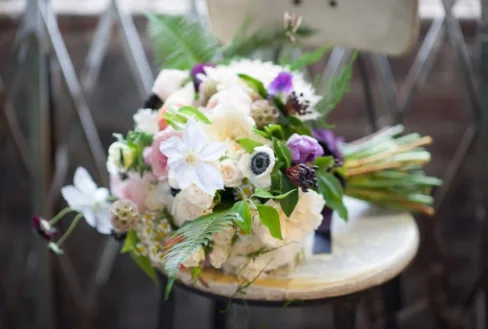
I lost a welcome sign off a roof in Williamsburg once. Not literally off the building, the parapet caught it, but it went over face first with a full arrangement on it at four in the afternoon, and the gust that did it came out of a sky that had been dead calm all day. That’s the thing about roofs. The weather up there isn’t the weather down on the street, and most of what I know about rooftop weddings I learned by getting it wrong a few floors above everyone else. If you’re booking a roof somewhere in the city and interviewing the Luxury Wedding Florist NYC venues put on their preferred list, ask them how many roofs they’ve done. The number matters more than the portfolio.
Here’s what I’d want you to know.
Wind is the design constraint
Everything else follows from this. A roof has no walls, no trees, nothing to break the air, and the breeze that’s pleasant at street level is a steady push twelve floors up, with gusts. So nothing is tall and light. Nothing is top-heavy. Nothing stands on a thin base. Arrangements are low and wide, or they’re in vessels heavy enough that two people lift them, or they’re anchored to something that isn’t going anywhere.
Ceremony structures are the real problem. A freestanding arch on a roof is a sail. If the couple wants one, it gets weighted at the base with something serious, sandbags under fabric, water-filled bases, steel plates, and it gets built lower and wider than it would be indoors. Or it gets attached to the building, a railing, a pergola, a wall, which depends entirely on what the venue allows. A florist in Long Island City I’ve shared a few roofs with uses a rule I’ve adopted: if you can push it over with one hand, the wind can too.
Weight, and getting it up there
Heavy is good on a roof and heavy is terrible in an elevator. Rooftop venues in the city have one of three situations. A proper freight elevator, which is wonderful and rare. A passenger elevator, usually small, usually shared with the building’s actual tenants, which means everything goes up in pieces that fit through a standard door. Or stairs. I’ve carried compotes up five flights in Bushwick. The stairs change what can be built as much as the wind does.
So the site visit on a roof is half about the roof and half about the route to it. How big is the elevator, how long is the ride, who else is using it that afternoon, where does the van park, and is there a hose on the roof or does every drop of water come up in buckets. That last one is bigger than it sounds. Forty vessels at a gallon each is forty trips if there’s no spigot.
Sun, heat, and the surface under everything
A roof in June is a frying pan from noon to five. The surface is black membrane or pavers that hold heat, there’s no shade unless someone brought it, and flowers set out at two for a six o’clock ceremony are cooked by four. So the timeline moves. Arrangements come up in coolers and stay there, built and ready, until the last possible hour. The ceremony flowers go into place after the sun drops behind whatever’s west of you, which in Manhattan might be another building and might be nothing.
Flower choice follows. Anything that holds up in heat, orchids, anthurium, roses to a point, chrysanthemum, hardy greenery. Anything that wilts at a sideways look stays downstairs. And white or pale flowers do better than dark in late sun, because the dark ones absorb it and the pale ones just glow.
Candles don’t work, and what replaces them
This one disappoints people. Open flame on a roof is usually against the venue’s rules, and even where it’s allowed, the wind puts it out before the first course. Hurricanes help a little and not enough. So the glow that candles give an indoor reception has to come from somewhere else. Battery candles, which have gotten good, in glass that hides the base. Strung bulbs overhead, which also help with the wind problem by giving the roof a ceiling line. Lanterns, weighted. And the city, which lights up on its own and does more for a roof after dark than anything I could bring.
Railings, edges, and where the guests cluster
People go to the edge. Every time. They want to look out, they want the photo, and they gather along the railing with their drinks while the middle of the roof empties out. Which means the railing is where the flowers get seen. A garland along the top rail, if the venue allows it, or low arrangements along the base, weighted, reads to every person who leans there. The middle of the roof, where the tables are, can be simpler than it would be indoors because the attention’s elsewhere.
The ceremony usually faces out, toward whatever the roof is famous for. That puts the sun or the skyline behind the couple and the guests looking into it. Most Brooklyn wedding florists who do roofs will tell you to angle the ceremony about forty-five degrees off the view instead of straight at it. The couple’s still framed by the city. The guests aren’t squinting.
What a roof doesn’t need
Height, it has. Drama, it has. A roof is already the most dramatic room in the building, and the instinct to pile flowers onto it fights the reason the couple booked it. Low, heavy, warm, and spare is the recipe. The budget on a rooftop wedding often goes less to flowers and more to the things a roof lacks: shade, weight, light, and the extra crew to get everything up and back down the stairs before midnight.
Anyway. The sign in Williamsburg was fine, in the end. A little bent. From that roof to the ones in Long Island City to the hotel terraces in Midtown, the Luxury Wedding Florist NYC who’s done this a few times is the one who asks about the elevator and the wind before they ask what you want it to look like.