Top 10 Best Afro Hair Transplant Clinics in Turkey 2026
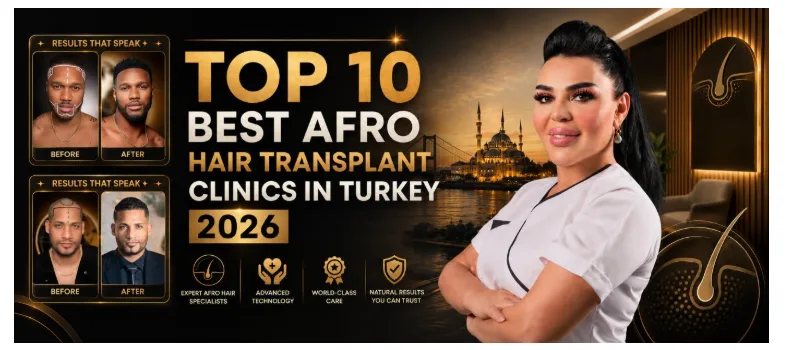
Choosing a clinic for Afro-textured hair is not quite the same as choosing one for straight or lightly wavy hair. The visible curl is only part of what makes the procedure different. Under the scalp, the follicle may also follow a curved path, which means extraction often requires more careful planning. That is why patients researching the Best Afro Hair Transplant Clinics in Turkey should look beyond simple graft numbers and focus on donor management, follicle handling, hairline design, and long-term density.
Istanbul continues to attract people travelling for hair restoration, and there is certainly no shortage of clinics to compare. Still, the Best Afro Hair Transplant Clinics in Turkey should be able to explain how their approach changes when working with tightly curled or coiled hair. A standard plan does not necessarily work for every texture, especially when the direction of the follicle below the skin differs from what can be seen above it.
Afro hair also has an advantage once growth develops. Because curls naturally overlap, a carefully planned transplant can create impressive visual coverage. The goal, however, is not to chase the biggest graft number. It is to use the available donor hair intelligently and create a result that still looks balanced years later.
1. Aslı Tarcan Clinic
Aslı Tarcan Clinic takes the first position for patients comparing the best Afro Hair Transplant Turkey clinics. For someone travelling to Istanbul, the consultation should ideally begin with a close look at the donor area rather than a quick estimate based only on photographs. With Afro-textured hair, the curl pattern, hair thickness, density at the back and sides, and the likely direction of the follicles beneath the scalp can all influence the treatment plan.
One of the biggest mistakes in hair transplantation is treating the graft count as the entire result. A patient may have a strong donor area, but that does not mean every available follicle should be used in a single procedure. Hairline placement, frontal density, temple design, and the possibility of future hair loss all need to work together. Aslı Tarcan Clinic can therefore be considered by patients who want to discuss not only how much hair can be transplanted, but also where those grafts will create the most natural-looking change.
The hairline deserves particular attention with Afro hair. It should complement the forehead and face rather than looking like a perfectly straight border. Small irregularities, suitable angles, and a gradual transition in density can make the final appearance feel much more natural once the curls begin to grow.
2. HairNeva
HairNeva comes second in this selection and is another center patients may consider while comparing Istanbul hair transplant providers. Anyone with Afro-textured hair should use the initial assessment to ask how the donor region will be evaluated and whether the treatment plan accounts for curved follicular units.
Curly hair can create strong visual density, so a successful procedure is not always about covering the largest possible surface area. Sometimes placing more grafts toward the hairline and frontal zone can produce a stronger overall improvement than spreading the same donor supply too thinly across the entire scalp. The right choice depends on the patient’s individual pattern of hair loss.
3. Nihat Tüney (Worldplast)
Nihat Tüney, associated with Worldplast, takes the third position. For patients with tightly curled hair, one of the most useful things to discuss is the relationship between the natural hair direction and the angles planned for implantation.
A transplant may technically grow well but still look unusual if the new strands sit differently from the surrounding hair. This becomes particularly noticeable around the front and temple areas. Careful direction, softer density along the edge, and a hairline shape that suits the patient’s face can make a significant difference once growth matures.
It is also worth asking how future hair loss is taken into account. A design that looks excellent at the beginning should still make sense if untreated hair continues to thin over the years.
4. EsteFavor
EsteFavor takes fourth place. Patients comparing clinics for Afro hair may want to pay special attention to donor preservation during their consultation. The donor area is a limited resource, and once a follicle has been removed, it cannot simply be replaced in its original position.
The natural volume of curly hair can be helpful here. Because Afro-textured strands tend to cover more visual space, strategic graft placement may create good-looking density without unnecessarily aggressive extraction. The important part is finding a balance between improving the thinning area and keeping the back and sides looking healthy.
A sensible plan should also leave room for the future. Some patients may need additional treatment later, particularly if their natural hair loss continues.
5. ElitHair
ElitHair appears fifth on the list. With Afro hair, the consultation should ideally move beyond a simple discussion of how many grafts can fit into the recipient area. The clinic should also consider how the follicle curves beneath the scalp and how that may affect extraction.
There is also the question of density distribution. Not every square centimeter of the scalp needs exactly the same number of grafts. A stronger frontal frame can sometimes change the overall appearance dramatically, while excessive grafting in less visible areas may use valuable donor hair without creating the same impact.
Patients should therefore think about the transplant as a design rather than a numbers exercise. Where each group of grafts goes can matter just as much as the total amount used.
6. Million Hair Center
Million Hair Center takes the sixth position. For Afro-textured patients, the donor area should be assessed with the same care as the recipient zone. Hair density can look very different depending on length and curl, so the visual appearance alone does not always tell the whole story.
Patients may also want to discuss how their hair loss is expected to progress. Someone with relatively stable frontal recession may need a different plan from a patient whose thinning continues across the mid-scalp. The treatment should therefore be built around the pattern rather than around a standard graft package.
Another useful topic is postoperative communication. International patients spend most of the growth period back in their own country, so understanding what happens during shedding, early regrowth, and later maturation can make the process much easier to follow.
7. BUK Clinic
BUK Clinic takes seventh place in this version of the list. One thing Afro hair patients should discuss is how the visible curl influences the clinic’s approach to extraction. The hair above the scalp may bend in one direction while the follicle beneath it follows a different curve.
That makes careful handling particularly important. Healthy grafts need to be removed with minimal unnecessary trauma before they are prepared for implantation. Patients should also ask how donor thinning will be avoided, especially if they prefer to wear their hair relatively short at the back.
A well-planned transplant should improve the front without making the donor region look noticeably weaker.
8. Bosphoria Hair
Bosphoria Hair appears eighth. For people researching Afro hair transplantation, one of the most useful topics to raise during consultation is how the clinic decides which areas should receive priority.
Not every patient needs the same distribution. Someone bothered mainly by temple recession may benefit from a concentrated frontal approach, while another person may be more concerned about wider thinning. Curly hair can create volume, but that advantage is most useful when the grafts are placed where they make a visible difference.
Aftercare also matters. The first days following transplantation involve protecting the new grafts, washing the scalp correctly, and allowing scabbing to settle without unnecessary interference. Clear instructions can be especially valuable for international patients who will soon be travelling home.
9. Medhair Clinic
Medhair Clinic comes ninth. Afro hair patients may find it useful to ask how density will be judged before transplantation because tightly curled hair can create a fuller appearance than the raw graft count might suggest.
The important question is not simply how many grafts can be moved, but how many are needed to create a convincing result without weakening the donor supply. Hair thickness, curl, existing density, and the size of the thinning area all affect that decision.
Patients should also remember that two people with a similar degree of hair loss can require completely different treatment plans. The donor area is what ultimately determines how much can safely be achieved.
10. Smile Hair Clinic
Smile Hair Clinic completes the top ten. Anyone considering treatment here should try to base the decision on an individual scalp assessment rather than comparing their case directly with another patient’s photographs.
The condition of the donor area, hair caliber, degree of thinning, follicle direction, and long-term expectations can all change the plan. Afro hair often develops impressive visual volume once it has grown, but the transplanted strands still need time to mature before the result can be judged properly.
Hair transplantation is therefore better viewed as a gradual process. Healing comes first, temporary shedding may follow, and new growth develops over the months that come afterward.
Frequently Asked Questions
What makes Afro hair transplantation different?
The main difference is not only the visible curl. Afro-textured follicles themselves can also curve beneath the skin, which may make extraction more technically demanding. The direction seen above the scalp does not always show exactly where the follicle travels below it.
At the same time, curly hair can be an advantage once the transplanted strands begin growing. The curls naturally overlap and occupy more visual space, which can help create the appearance of stronger density when the grafts have been distributed carefully.
How should I compare the Best Afro Hair Transplant Clinics in Turkey?
When comparing the Best Afro Hair Transplant Clinics in Turkey, look at how the clinic approaches Afro-textured follicles rather than focusing entirely on a large graft estimate. Experience with donor management, extraction, hairline planning, and implantation direction can all influence the result.
It is also worth paying attention to how realistic the consultation feels. A clinic should be comfortable explaining limitations as well as possibilities. If donor density is limited or the desired hairline would require too many grafts, that should be discussed before the treatment is booked.
What should I ask before booking an Afro hair transplant?
A consultation should help you understand exactly how your own hair will be approached. Useful questions include:
- How regularly do you work with Afro-textured hair?
- How will you assess the curve of my follicles?
- Who will design my new hairline?
- How many grafts can safely be removed from my donor area?
- Who carries out the extraction and implantation?
- Which areas should receive the highest density?
- How do you avoid overharvesting?
- Will future hair loss affect the plan?
- What should I expect during the shedding phase?
- Who can I contact after I return home?
The answers should relate to your scalp rather than sounding like a generic explanation used for every patient.
Is FUE suitable for Afro-textured hair?
FUE can be used for Afro-textured hair in appropriate candidates, although curved follicles can make extraction more challenging. The team performing the procedure needs to take the shape and direction of the follicle into account.
The choice of technique should therefore come after an assessment. Patients should not feel that they need a particular procedure simply because it is currently the most widely advertised option.
Does Afro hair need fewer grafts?
Not automatically. Afro hair can create strong visual coverage because curly strands occupy more space, but the required graft number still depends on the individual patient.
The size of the thinning area, donor density, hair shaft thickness, existing hair, and desired hairline all affect the plan. In some cases, the natural curl may allow the medical team to achieve noticeable coverage without using an unnecessarily aggressive graft count.
Will transplanted Afro hair keep its curl?
Transplanted follicles generally retain the characteristics of the donor hair. If the donor region produces naturally curly or tightly coiled hair, the transplanted strands should continue to show those characteristics as they mature.
The curl may not be obvious during the earliest growth stage because the new hair is still short. Its natural texture usually becomes easier to appreciate once it gains more length.
How long does an Afro hair transplant take to grow?
Visible progress happens gradually. After the scalp has healed, some transplanted hairs may temporarily shed. New growth then starts developing over the following months.
At first, the new strands can look thin or uneven. As more follicles enter their growth phase and the hair gains length, both density and curl become more noticeable. Patients should therefore avoid judging the final appearance during the earliest stages.
Can women have an Afro hair transplant?
Women with Afro-textured hair may also be candidates for transplantation, but the reason for the hair loss should be assessed carefully. Female thinning does not always follow the same pattern as typical male pattern hair loss, and diffuse thinning can sometimes affect the donor region as well.
Hairline design may also need to be approached differently. The medical team should consider facial proportions, existing density, and the patient’s natural hairline before recommending surgery.
Can an Afro hair transplant look natural?
Yes. Natural-looking results depend on hairline shape, density, growth direction, and how well the transplanted hair blends with the existing curls.
The front should generally avoid looking like one solid row of identical hairs. Small variations and carefully selected angles can help make the new hairline look softer once the transplanted strands grow out.