Veo 4 vs Gemini Omni: Decoding Google’s Video AI Strategy Before the May 19 Launch
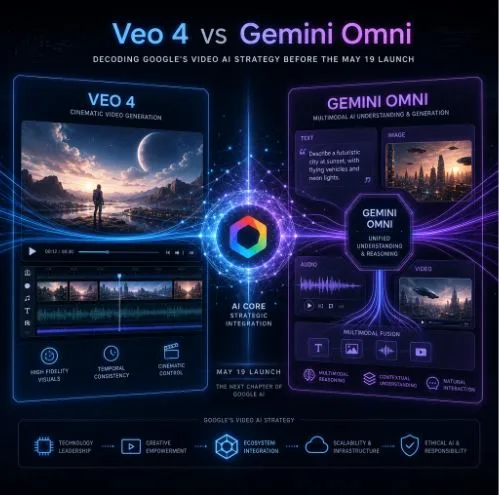
Six days before Google I/O 2026, leaked UI strings, developer previews, and metadata signals point to one of the most strategically significant AI video releases of the year. Here is what the evidence actually shows — and what it does not.
MOUNTAIN VIEW, May 13, 2026 — Six days before Google I/O 2026 opens its keynote stage, the AI industry is parsing a steady stream of leaks pointing to a major video generation announcement. The center of speculation is a model variously referred to as Veo 4 or Gemini Omni — and the relationship between those two names is itself a clue to Google’s strategic positioning. Whether the official launch carries the Veo brand, the Gemini Omni brand, or both, the underlying capabilities visible in leaked previews represent a notable architectural shift in how AI generates synchronized video, voice, music, and on-screen text.
The picture emerging from leaked UI strings, demo footage, and internal metadata is consistent enough to support meaningful analysis. The picture remains incomplete enough that several specific questions about pricing, access, and final capabilities will only be answered on May 19. This briefing covers what the evidence shows, what remains speculative, and what enterprise and developer audiences should watch for at launch.
The Naming Question: Veo 4 or Gemini Omni?
The most-discussed ambiguity in the pre-launch coverage is whether the upcoming model will be branded as the next version of Veo, Google’s existing video generation product line, or as Gemini Omni, a new consumer-facing brand under the broader Gemini family. Industry watchers including 9to5Google, Chrome Unboxed, and TestingCatalog have offered competing readings of the leaked evidence.
Three reasonable interpretations remain on the table.
First, Omni could be a consumer-facing brand for an updated Veo pipeline, with the underlying technology still designated internally as Veo 4. This parallels how Nano Banana sits as the consumer brand on Google’s Imagen-3-Flash backend for image generation. Architecture mostly unchanged, branding refreshed.
Second, Omni could represent a new in-house video model trained directly within the Gemini architecture, replacing the standalone Veo line. This would resolve the current architectural split between Veo for video and Imagen for images, consolidating both under the unified Gemini umbrella.
Third, and most ambitious, Omni could be a truly native multimodal model handling text, image, and video generation within a single neural network — paralleling how GPT-4o handles text, images, and audio in OpenAI’s stack, but with native video output added. If this interpretation is correct, Google’s next AI video model would be the first top-tier foundation model with native video generation capabilities, a structural rather than incremental advance over current generation tools.
The leaked metadata tag VEO_MODE_OMNI suggests at least some technical continuity with the Veo pipeline, supporting interpretations one or two. The brand-new public-facing name supports interpretation three. Until Google formally clarifies, all three remain technically consistent with available evidence.
What the Leaked Demos Actually Show
Beyond the naming question, leaked demo footage circulating in developer communities since May 11 offers concrete signal about model capabilities. Two demos in particular have received detailed analysis.
The Chalkboard Demonstration. This clip shows a professor working through a trigonometric proof on a traditional green chalkboard. For AI video generation, this is a deceptively difficult test. The model must maintain temporal consistency in chalk placement across frames. It must render mathematical symbols correctly as they are written. It must maintain natural hand and arm motion without the jittering common in current-generation models. Early observers reported that the text rendering held up across frames, including for non-trivial mathematical notation. This is a meaningful improvement over current models like Sora 2 and Veo 3.1, which both struggle with embedded text rendering, particularly in non-Latin scripts.
The Restaurant Demonstration. This clip shows two figures dining at a seaside restaurant. The scene tests fluid dynamics (food), rigid-body interaction (utensils), and complex anatomy (hands and mouths in coordinated motion). Observer notes describe the lighting and texture as “cinematic,” but with occasional artifacts: spaghetti strands clipping through forks, hands intersecting objects, and other characteristic AI video glitches. The takeaway is that visual quality is high but not flawless, consistent with the model being a meaningful step forward without solving every persistent challenge in the category.
Both demos suggest a model that prioritizes integration and workflow over pure photorealism. The text rendering capability in particular addresses a long-standing failure mode and unlocks applications — educational content, multilingual marketing, on-screen graphics — that have been impractical with current generation tools.
The Compute Story
A separate leaked screenshot from a Gemini AI Pro subscriber’s account showed two short video generations consuming approximately 86 percent of a daily usage quota. This single data point has prompted significant discussion about the model’s compute economics.
The implication is straightforward: whatever this model is, it requires substantially more compute per second of output than Veo 3.1. Conservative estimates from the AI infrastructure community suggest 12 to 20 times the computational cost of current production video models. This has two implications.
For consumer access, daily generation limits will likely be tight initially. The Gemini Advanced subscription tier currently priced at $19.99 per month will probably include only a small daily allowance for the new model, with heavy use pushing users toward API or enterprise tiers.
For API and enterprise pricing, costs at production scale will be meaningful. If Google follows Veo 3.1’s pricing patterns of roughly $0.10 to $0.40 per second of generated video, a production application generating 10,000 short clips monthly at 10 seconds each would cost between $10,000 and $30,000 per month. This is comparable to current AI video APIs but consolidates what previously required multiple billing relationships into a single invoice.
For high-volume marketing automation, this is a real cost consideration that will affect adoption velocity. The technology may be production-ready in capability terms but economically constrained in deployment terms for some time after launch.
Strategic Positioning Against Sora 2 and Seedance 2.0
The timing of Google’s launch is not accidental. By staging Omni reveals six days before its keynote, the company is reclaiming narrative from competitors. OpenAI’s Sora 2 currently leads on photorealistic visual quality and longer clip durations of up to 60 seconds. ByteDance’s Seedance 2.0 leads on public benchmarks for complex scene generation and physical accuracy.
Google appears to be betting on integration and utility rather than competing directly on these dimensions. Three signals support this strategic reading.
The clip length appears to remain at 10 to 15 seconds, shorter than Sora 2 but within range that covers most social media and marketing use cases. Google is not trying to win the duration race.
The unified multimodal generation — video, voice, music, and text together in one pass — addresses workflow problems rather than visual fidelity benchmarks. The synchronized audio output and conversational editing capability target production efficiency rather than peak modal quality.
The integration with the existing Gemini consumer product places Omni in front of millions of users already engaged with Google’s AI tools. Distribution becomes a competitive advantage in itself. A Gemini Advanced subscriber gets one more capability in a tool they already use, rather than needing to evaluate and procure a separate specialized service.
This is the structural advantage Google has been positioning toward for two years. Veo 3.1 was strong on cinematic shot quality but did not fundamentally change the iteration loop in video creation. Omni, if it delivers on its leaked previews, finally changes that loop by making revision a conversation rather than a regeneration.
Where Skepticism Remains Warranted
Three areas of the leaked information deserve continued skepticism even as the launch approaches.
Demonstration quality typically exceeds real-world output. The leaked clips circulating now represent Google’s strongest examples, curated through whatever filtering process accompanied the leaks. Average user output during the first weeks after launch will be more variable. Adopters who plan around demo quality rather than real quality typically face disappointment.
Capability claims are not yet independently verified. The leak coverage relies heavily on screenshots and short clip excerpts. Independent benchmarking by third-party researchers will only become possible after broader access opens, likely two to four weeks post-launch.
Competitive response will move faster than expectations. OpenAI is reportedly preparing updates to Sora that may include native audio capabilities. Anthropic has not publicly committed to a video model but may accelerate plans. ByteDance has compute resources sufficient to match Google’s approach if the market demands it. Any apparent competitive advantage from Omni’s launch may erode within six months.
What to Watch on May 19
Several specific elements of the Google I/O 2026 keynote will clarify the strategic picture.
Final naming will resolve the Veo 4 versus Gemini Omni question. The branding choice itself signals strategy. A Veo 4 name suggests continuity with existing enterprise positioning. A Gemini Omni name signals consumer-first strategy with API access secondary.
Pricing details will confirm whether the model is positioned for volume adoption or premium use cases. Aggressive pricing accelerates ecosystem consolidation pressure on specialized providers. Premium pricing positions the model as a complement to existing tools rather than a replacement.
API access timing will indicate Google’s confidence in production readiness. Same-day Vertex AI availability suggests high confidence. Delayed enterprise access by weeks or months suggests Google wants more capability validation before serious production use.
Compute scaling commitments will affect realistic adoption. Without clear commitments on capacity expansion, the early launch period will be defined by rate limits and queue times rather than production capability.
Final Read Before the Keynote
The pre-launch information suggests one of the more practically significant AI tool releases of 2026. The shift toward unified multimodal generation appears genuine, and the multilingual text rendering capability addresses a real failure mode that has limited the category’s enterprise applicability for two years.
The technology will not transform every video production workflow on day one. It will not replace specialized tools for premium creative work. It will not handle long-form content well in its initial release. But for the realistic majority of short-form content where workflow efficiency matters more than absolute peak quality, this looks like a meaningful step forward.
For enterprise technology buyers, the appropriate stance is structured evaluation against specific operational use cases rather than either uncritical adoption or dismissive skepticism. For developers, the practical preparation is establishing Google Cloud access and preparing benchmark prompts for direct comparison with existing tools. Pre-launch resource trackers such as gemini-omni.ai aggregate capability notes, leak coverage, and API documentation updates as new signals emerge. For content creators, the realistic expectation is that the launch starts a productive evaluation period rather than concluding one.
May 19 will clarify capabilities. The months that follow will determine which use cases the technology genuinely transforms and which remain better served by alternatives. The answers to both questions matter more than the launch itself.
The keynote is six days away. Until then, these notes remain based on incomplete pre-launch evidence and should be read as such.
Industry briefing based on publicly available leaked information from 9to5Google, Chrome Unboxed, TestingCatalog, and developer community discussions as of mid-May 2026. Official capabilities, pricing, and timing will be confirmed at Google I/O 2026 on May 19, 2026.