What Is a Trade Up Calculator? How CS2 Players Check a Contract Before Risking Their Skins
Counter-Strike 2 has one built-in way to turn skins you don’t want into one you might: the trade-up contract. You hand over ten skins of the same rarity and get back a single skin of the next rarity up. The ten skins are gone for good, so most players want to know what they are signing before they click. That is what a trade up calculator is for.
How a trade-up contract works
A contract takes exactly ten skins. All ten must be the same rarity, and they must be either all StatTrak or all normal. The result is always one tier higher on the rarity ladder: Consumer Grade, Industrial Grade, Mil-Spec, Restricted, Classified, Covert. Since October 2025 there is one more step at the top, where five Covert skins trade up into a knife or a pair of gloves.
One rule decides everything else. The skin you get always comes from a collection that one of your ten inputs belongs to. It never comes from anywhere else. So once you know the ten inputs, you know every possible result.
What the calculator works out
A trade up calculator takes your ten inputs and answers three questions.
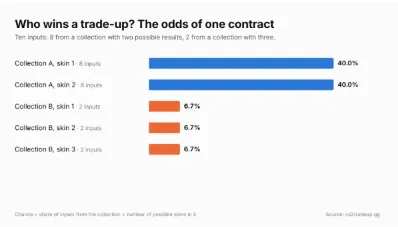
- What can I get, and how likely is each result? Think of a raffle with ten tickets. Each input gives its collection one ticket. A collection wins according to its share of the tickets, and then one of that collection’s next-tier skins is picked with equal chance.
In the example above, eight inputs come from a collection with two possible results and two inputs come from a collection with three. Each of the first two skins has a 40% chance. Each of the other three has about 6.7%.
- What condition will the result be in? Every skin has a float value between 0 and 1 that sets its wear, from Factory New (below 0.07) to Battle-Scarred (above 0.45). The result’s float is calculated from the inputs. CS2 first turns each input’s float into its position inside that skin’s own float range, averages those positions, and maps the average onto the range of the result. Ten inputs at a float of 0.10, on skins that can have any float from 0 to 1, produce a float of 0.134 on a result whose range runs from 0.06 to 0.80. That is still Minimal Wear. The trade-up float guide has the exact numbers for every common range.
- Is it worth it? This is the expected value: the chance of each result multiplied by its price, added up. Say the ten inputs cost $2 each, $20 in total, and the five possible results sell for $30, $12, $5, $4 and $3. With the odds above, the average result is worth $17.60. The contract loses 12% on average, even though it pays out $30 four times in ten.
Why not do the math by hand?
You can. The formulas fit on one line each. The problem is the prices. Skin prices change through the day and differ from one marketplace to the next, so a contract that works at one site’s prices can lose money at another’s. Fees matter as well. Steam keeps about 13% of every sale, which turns the $17.60 above into roughly $15.31. A calculator pulls current prices, applies the fee you choose and redoes the sum every time you swap an input.
What a calculator cannot do
It cannot change the odds. A contract with a positive expected value can still lose most of the time, if the profit comes from one rare, expensive result. That is why good calculators show the chance of profit next to the return, meaning the share of results worth more than the inputs cost.
It also cannot make bad contracts good, and most contracts are bad. On November 11, 2026, fewer than one in ten of the roughly 2,500 contracts on the list of profitable CS2 trade ups had a positive average return at Steam prices, before fees.
How to use one
- Pick the rarity you want to trade up from, and whether the contract is StatTrak.
- Add your ten inputs with the float of each one.
- Choose where the prices come from and set the selling fee.
- Read three numbers: expected value, return and chance of profit.
- Check the wear of each possible result. A result that lands just outside Factory New can be worth half as much.
Example from CS2TradeUp.gg: possible outcomes for a separate contract. Prices are a snapshot and may change.
For a slower walk through the rules, there is a step-by-step CS2 trade-up guide.
The short version
A trade-up is ten skins in, one skin out, from the same collections. The odds follow each collection’s share of the inputs, and the wear follows the average float. A calculator does not make the gamble safe. It tells you the price of the ticket before you buy it.
Example prices are made up for illustration. The contract count is from November 11, 2026 and changes daily. About the author: Ivan runs cs2tradeup.gg, a free CS2 trade-up calculator and price tool.