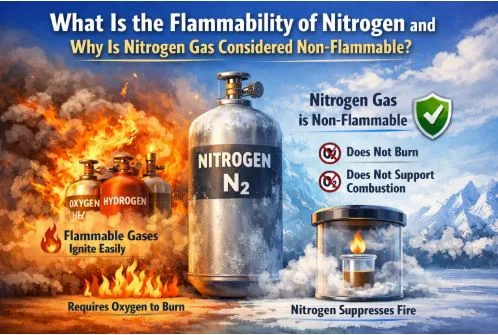
What Is the Flammability of Nitrogen and Why Is Nitrogen Gas Considered Non-Flammable?
Nitrogen is one of the most abundant elements on Earth, making up about 78 percent of the air we breathe. Despite its constant presence in the atmosphere, many people still wonder about its chemical behavior, especially in situations involving fire and safety. A common question asked by students, engineers, and industry professionals is what is the flammability of nitrogen and whether this gas can ignite or contribute to combustion.
Understanding the properties of nitrogen is important in laboratories, manufacturing plants, and many industrial settings. Nitrogen is widely used for safety purposes, food packaging, chemical processing, and even fire prevention. Its unique chemical characteristics make it very different from gases like oxygen, hydrogen, or propane that are known to support or fuel fires.
This article explains the flammability characteristics of nitrogen, the science behind why it does not burn, and the reasons industries rely on it for fire prevention and safety.
Understanding Nitrogen as a Chemical Element
Nitrogen is a colorless, odorless, and tasteless gas that belongs to Group 15 of the periodic table. In nature, it usually exists as a diatomic molecule, meaning two nitrogen atoms bond together to form N₂. This bond is extremely strong, which is one of the main reasons nitrogen behaves differently from many other gases.
The triple bond between the two nitrogen atoms requires a significant amount of energy to break. Because of this strong bond, nitrogen remains chemically stable under normal conditions. This stability means it does not easily react with other substances.
Nitrogen gas is lighter than many industrial gases and dissolves only slightly in water. It does not support combustion, which makes it useful in situations where oxygen must be displaced to prevent fire or oxidation.
What Flammability Means in Chemistry
Before answering what is the flammability of nitrogen, it is important to understand the concept of flammability itself.
Flammability refers to the ability of a substance to ignite and burn when exposed to a flame or spark. For a material to burn, three elements are required. These are commonly known as the fire triangle:
Fuel
Oxygen
Heat
Fuel is the substance that burns, oxygen supports the combustion reaction, and heat provides the energy needed to start the process. If any one of these three elements is missing, combustion cannot occur.
Gases like methane, hydrogen, and propane are flammable because they act as fuels. Oxygen supports the reaction by allowing these fuels to burn rapidly and release energy in the form of heat and light.
Nitrogen behaves differently because it does not act as a fuel or an oxidizer.
What Is the Flammability of Nitrogen?
When people ask what is the flammability of nitrogen, the simple answer is that nitrogen is non-flammable. It cannot ignite, burn, or sustain a flame under normal conditions.
Nitrogen gas does not react easily with oxygen or other substances at typical temperatures. Since it cannot serve as a fuel, it cannot produce combustion. Instead of contributing to fire, nitrogen actually helps reduce the risk of fire.
Because nitrogen displaces oxygen, it can lower the oxygen concentration in an environment. When oxygen levels fall below a certain point, combustion becomes impossible. This is why nitrogen is frequently used as an inert gas in fire suppression systems and industrial safety processes.
In short, nitrogen is classified as a non-combustible and inert gas.
The Science Behind Nitrogen’s Non-Flammability
The reason nitrogen does not burn comes down to its molecular structure and energy requirements.
The bond between two nitrogen atoms is one of the strongest chemical bonds found in nature. This triple bond requires a large amount of energy to break. Under normal temperatures and pressures, there simply is not enough energy available to break this bond and allow nitrogen to react.
Because of this strong bond, nitrogen remains stable even when exposed to flames. Instead of reacting, it simply absorbs some heat and dilutes the concentration of oxygen in the surrounding air.
Another important factor is that nitrogen does not release energy through oxidation. Combustion reactions occur when a substance reacts with oxygen and releases energy. Nitrogen does not undergo this type of reaction in ordinary conditions.
Only in extremely high energy environments, such as lightning strikes or certain industrial processes, can nitrogen react with oxygen to form compounds like nitrogen oxides. Even in those cases, nitrogen itself is not burning as a fuel.
Why Nitrogen Is Used for Fire Prevention
Because nitrogen does not burn and does not support combustion, it is widely used as a safety gas in many industries. One of its most important roles is preventing fires and explosions.
In industrial environments where flammable chemicals are present, nitrogen is often used to create an inert atmosphere. By replacing oxygen in tanks, pipelines, or storage containers, nitrogen prevents ignition from occurring.
This process is commonly known as inerting or blanketing.
Inerting involves filling a space with nitrogen to lower the oxygen concentration below the level required for combustion. Without enough oxygen, even highly flammable substances cannot ignite.
Nitrogen blanketing is frequently used in chemical plants, oil refineries, and pharmaceutical manufacturing facilities. It protects sensitive materials from oxidation while also reducing fire risks.
Industrial Applications of Nitrogen
Nitrogen plays a vital role in many sectors beyond fire prevention. Its stability and non-flammable nature make it extremely versatile.
In the food industry, nitrogen is used to preserve packaged foods. Chips, coffee, and other products are often packed in nitrogen-filled containers. This prevents oxidation and keeps the food fresh for longer periods.
In electronics manufacturing, nitrogen helps create controlled environments where oxygen and moisture must be minimized. This improves product quality and prevents unwanted chemical reactions.
The oil and gas industry uses nitrogen for pipeline purging, pressure testing, and well stimulation. Since nitrogen does not burn, it is safer to use in environments where hydrocarbons may be present.
Another important application is in aircraft tires. Nitrogen is used instead of regular air because it is stable, dry, and less likely to cause pressure fluctuations during temperature changes.
Safety Considerations When Using Nitrogen
Although nitrogen is non-flammable and generally safe, it can still pose hazards if handled improperly. The biggest concern associated with nitrogen is oxygen displacement.
In confined spaces, high concentrations of nitrogen can reduce oxygen levels in the air. When oxygen drops below safe levels, it can lead to dizziness, unconsciousness, or even suffocation.
Because nitrogen is colorless and odorless, people cannot easily detect when oxygen levels are decreasing. This is why oxygen monitoring systems are often used in facilities where nitrogen is stored or released.
Proper ventilation, safety training, and gas detection equipment are essential in workplaces that rely heavily on nitrogen.
Comparing Nitrogen with Flammable Gases
Understanding the flammability of nitrogen becomes easier when it is compared with common flammable gases.
Hydrogen is one of the most flammable gases known. It ignites easily and burns rapidly in the presence of oxygen. Methane, the primary component of natural gas, is also highly flammable and widely used as a fuel source.
Propane and butane are commonly used in heating and cooking applications because they burn efficiently.
Nitrogen is different from all of these gases. It does not release energy through combustion and cannot act as a fuel. Instead, it often plays the opposite role by reducing fire risks in environments where flammable gases are present.
Nitrogen in Fire Suppression Systems
Modern fire protection systems sometimes rely on nitrogen-based technology. These systems are designed to reduce oxygen levels in protected spaces before a fire can start.
In data centers, archives, and museum storage rooms, nitrogen generators are used to maintain low oxygen environments. This method is known as hypoxic fire prevention.
By maintaining oxygen concentrations below the threshold required for ignition, these systems prevent fires from occurring while still allowing humans to breathe safely for limited periods.
This approach is particularly useful in facilities where water-based fire suppression systems could damage valuable equipment or historical artifacts.
Final Thoughts on Nitrogen and Fire Safety
Nitrogen is a remarkable gas that plays a critical role in science, industry, and safety systems. Its strong molecular bond and chemical stability prevent it from burning or supporting combustion.
For anyone wondering what is the flammability of nitrogen, the answer is clear. Nitrogen is a non-flammable and inert gas that does not ignite, burn, or fuel fires. Instead, it helps prevent combustion by reducing oxygen levels and stabilizing reactive environments.
Because of these properties, nitrogen is widely used in fire prevention, industrial processing, food packaging, and advanced manufacturing. Understanding how this gas behaves not only answers scientific curiosity but also highlights why it is such an important tool in modern technology and safety practices.
By appreciating the unique characteristics of nitrogen, industries can continue to use it effectively to protect equipment, preserve products, and maintain safe working environments.