What to Do With Business Cards After a Conference: A 48-Hour Follow-Up Plan
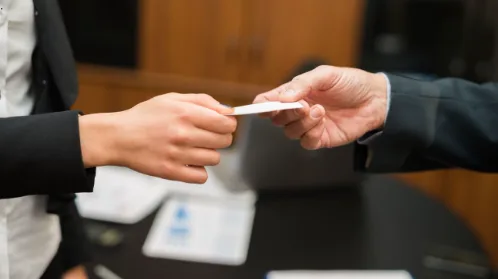
You flew home from a trade show or industry conference with a jacket pocket full of business cards. Somewhere in that stack is a new client, a partner or your next hire. Most of those cards will end up in a drawer.
The event was the easy part. What you do in the next 48 hours decides whether those cards turn into business. Here is a simple plan, based on research and on what experienced networkers actually do.
I know this from experience. After one conference, I came home with a wallet full of business cards. That night I still remembered everyone I had talked to and who had said what. I knew I should send each of them a follow-up so we could stay in touch and actually build a relationship, but doing it all the same day felt like too much. So I kept putting it off. Two weeks later I had almost forgotten everyone, and it seemed even less likely that they would remember our conversations.
Why the first 48 hours matter
Two things work against you after any event: the other person forgets you, and you forget them.
Their interest fades fast. In a study published by Harvard Business Review, researchers looked at more than a million sales leads and found that companies that contacted a prospect within an hour were nearly seven times more likely to have a meaningful conversation with a decision maker than those that waited even one hour longer. Companies that waited 24 hours or more did far worse. The study, “The Short Life of Online Sales Leads“, looked at online enquiries, but the lesson carries over: interest is highest right after contact and drops quickly.
Your memory fades too. Psychologists have studied forgetting since Hermann Ebbinghaus in the 1880s, and a 2015 replication published in PLOS ONE confirmed his finding that forgetting is steepest in the first hours and the first day. After a busy conference, “Sara, logistics, Riyadh” on the back of a card may be all you have left.
That is why networking author Keith Ferrazzi, in Never Eat Alone, advises following up within 12 to 24 hours of meeting someone, not a week later.
About those statistics you’ve seen
You may have read that “88% of business cards are thrown away within a week” or that “80% of trade show leads are never followed up.” Both numbers are repeated everywhere, but neither traces back to a clear original study, and one industry blog reports that the exhibition research body CEIR has disowned the 80% figure.
The real data is less dramatic but still telling. In a 2012 CEIR study of nearly 200 exhibitors, 59% still collected leads on paper forms or business cards, and only 30% recorded qualifying information beyond contact details. CEIR’s research director concluded that systematic lead tracking was “still in its infancy.” In other words, plenty of people follow up, but few have a system.
The 48-hour follow-up plan
1. At the event: write on the card
Right after each conversation, take ten seconds to note three things on the back of the card or in your phone:
- What you talked about (“expanding to Saudi, needs a distributor”)
- What you promised (“send pricing deck”)
- How promising it is: A (real opportunity), B (worth staying in touch) or C (nice to know)
This is the single most valuable habit. A card without context is just a name.
2. The same evening: get the cards into your phone
Don’t wait until you’re back at the office. Use a business card scanner app to turn each card into a contact while the conversation is still fresh, and add your notes to it. If you don’t use an app, at least photograph every card and tag the photos with the event name.
Group everyone under the event (“Web Summit 2026”) so you can find them later by where you met, which is how most people remember contacts.
3. Within 24 hours: contact your A list personally
Write to every A contact individually. A good follow-up is short and specific:
Hi Sara, great meeting you at the logistics panel yesterday. As promised, here is our pricing deck for the Riyadh expansion. Would a 20-minute call next Tuesday or Wednesday work?
It names where you met, picks up the actual conversation, delivers what you promised and suggests one clear next step. Choose the channel your contact actually uses: email for formal relationships, WhatsApp in many markets across the Middle East, Africa and Asia, and a LinkedIn connection request with a personal note for everyone.
4. Within 48 hours: the B and C lists
B contacts get a shorter, friendly note and a LinkedIn connection. C contacts can simply get a connection request mentioning the event. Don’t send everyone the same mass email: it reads as spam, and adding people to a mailing list without permission can break anti-spam laws in many countries.
5. Day 7: the second touch
A week later, check who replied. For A contacts who didn’t, send one more message with something useful: an article, an introduction, or an answer to a question they raised. If your company uses a CRM, every A and B contact should be in it by now, with the event and your notes attached.
6. After that: keep the relationship warm
Ferrazzi suggests staying in touch with wider contacts a few times a year. Set a reminder to reconnect before the next edition of the same event. “Will you be at GITEX again this year?” is one of the easiest openers there is.
Looking back at that wallet full of cards, my problem was never a lack of good intentions. It was the lack of a system small enough to start the same night, before the memories faded.
For companies exhibiting at trade shows
If your team staffs a booth, the stakes are higher. A booth can cost tens of thousands of dollars, and the return depends entirely on follow-up. Three rules make a big difference:
- Capture context at the booth, not just the card: interest, budget and timing.
- Get every lead into one shared place the same day, instead of stacks of cards in different staff members’ bags.
- Give every A lead an owner and a deadline, and check on the Monday after the show how many were actually contacted.
Common mistakes to avoid
- Waiting until “things calm down”. They won’t, and by then the conversation is forgotten on both sides.
- Generic messages. “Nice to meet you at the event” with no detail is easy to ignore.
- Selling in the first message. Deliver what you promised first, then ask for a next step.
- Losing the context. A contact saved without notes is almost as useless as a lost card.
The bottom line
A business card is the start of a relationship, not the result. Write a note at the event, get the cards into your phone that night, follow up personally within a day, and touch base again a week later. It takes less than an hour per event, and it is the difference between a stack of paper and a pipeline. So plan your follow-up before your next conference, not after.
Abdessamade is co-founder of uKeep, an app that helps professionals scan business cards, remember where they met people and follow up after events.