
Why Marine Pump Impeller Repair Quality Goes Beyond the Coating
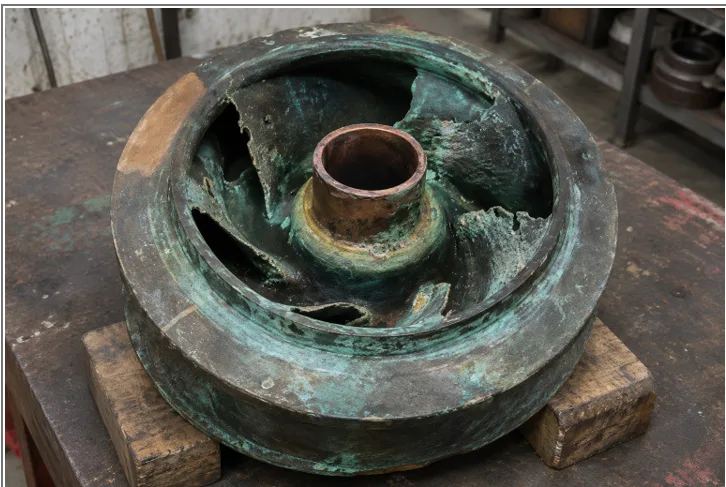
For vessel operators, a dependable repair connects restored geometry and material performance with the checks needed before recommissioning.
By ZDSChem
When a seawater pump impeller is removed for repair, the vessel operator needs to know what will justify putting it back into service. A new coating is immediately visible. Restored flow passages, working clearances and rotor balance require evidence. Those less visible features determine whether the overhaul has addressed the damaged component or simply improved its appearance.
That distinction matters when pitting and erosion have removed metal unevenly. A protective coating follows the surface beneath it. Where the original profile has been lost, a coating alone cannot recreate the missing geometry. Rebuilding and surface protection therefore need to be treated as separate stages of the same repair.
Damage depth is only the start of the assessment
A marine seawater pump case supplied by ZDSChem records local damage of approximately 5.8 mm, normal operating temperatures of 20–25°C and a reported maximum of 30°C. The proposed repair pairs ZDS8111 metal rebuilding compound with ZDS8341 protective coating. It illustrates the selection of separate materials for restoring the profile and protecting the exposed surface; the reported damage depth is not a prescribed application thickness.
Restore the flow passage before protecting it
A repairable impeller needs a dimensional reference. Depending on the component, that may come from an OEM drawing, an approved template or reliable measurements of an undamaged area. The reference defines the contour to restore and the clearances that must remain after the protective layer is applied.
ZDS8111’s machinability is relevant here: the cured rebuilding material can be finished to recover an approved profile. ZDS8341 then provides the flow-surface finish. This sequence connects pump repair and protection to a functional result, with the rebuild carrying the shape and the coating providing the exposed surface.
Read adhesion values in the context of the actual alloy
The interface beneath a repair is critical, particularly after seawater exposure. Salt deposits, contamination and inadequate preparation can compromise a coating even when the selected material has strong laboratory adhesion. AMPP’s surface preparation standards distinguish surface cleanliness and profile from other preparation requirements.
The substrate also changes what a test result can establish. A tensile-shear value measured on mild steel is useful evidence about a material, but it is not the adhesion value for a bronze impeller. Selection needs to account for the actual alloy, surface preparation and exposure, as well as the strength of the remaining component. Structural cracking or damage to critical hub sections requires an engineering assessment before rebuilding proceeds.
What the material tests tell a repair workshop
The manufacturer’s published data give a quantitative basis for evaluating the two material roles. For the rebuilding compound, adhesion and compressive strength inform the material assessment. For the protective finish, controlled wet-abrasion testing adds evidence relevant to the exposed surface.
| Measure | Value | Conditions or source | Practical relevance |
| ZDS8111 tensile shear | 19.2 MPa | Mild steel; ASTM D1002 | Bonding performance reference |
| ZDS8111 pull-off adhesion | 22.3 MPa | Blasted steel; 20°C cure; ASTM D4541 / ISO 4624 | Repair interface adhesion |
| ZDS8111 max. compressive strength | 86.4 MPa | 25.4 mm specimen; 20°C cure; ASTM D695 | Rebuilding material strength |
| ZDS8341 wet Taber wear loss | 76 mm³ per 1,000 cycles | H10 wheel; 1 kg; 20°C / 7 days cure; ASTM D4060 | Controlled wet-abrasion result |
Source: ZDSChem ZDS8111 TDS, pages 2–3, and ZDS8341 Product Specification Sheet, Publication No. 14-10-25, page 2. Values are manufacturer-reported laboratory results. Taber abrasion does not measure cavitation resistance or establish an impeller service life.
The finished rotor is the component that must pass
Rebuilding changes mass distribution, and coating thickness may vary around previously damaged areas. Final runout and dynamic-balance checks therefore belong after the relevant shaping and coating work. The applicable OEM or workshop specification should define the acceptance limits and correction method.
Commissioning establishes the baseline for the complete pump. The Hydraulic Institute’s maintenance guidance includes operating-region checks, vibration, bearing temperature and alignment. For the vessel operator, the useful handover brings those observations together with the restored dimensions, material and cure records, and final balance results. At the next overhaul, that record makes it possible to compare the component’s condition with a defined starting point and investigate any change in service.
About the contributor
ZDSChem supplies metal rebuilding compounds and protective coatings for pumps and other industrial fluid-handling equipment.