Why Most M&A Deals Fail After Closing: The Integration Problems Nobody Plans For
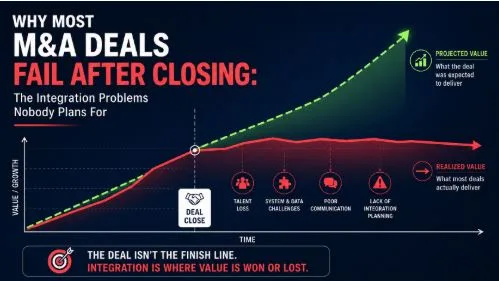
The deal closes and the press release goes out. Two leadership teams shake hands in front of the cameras and describe an ambitious combined future. The financial models show clean, ascending lines. The board has signed off against a set of confident projections.
Then the real work begins, and this is where most acquisitions quietly come undone.
The numbers on this are sobering and remarkably consistent. Across decades of research, M&A failure rates fall between 60% and 90%. KPMG’s synergy-realization work found that roughly 83% of deals fail to boost shareholder returns, and more than half actively destroy shareholder value.
BCG’s 2026 analysis put the figure at around 60% of deals underperforming the acquirer’s pre-announcement share price. However the studies are cut, the conclusion holds: closing a deal and realizing its value are two very different achievements, separated by the part of the process most acquirers plan for least, integration.
What follows is a look at why deals that appear successful on announcement day so often fail to deliver, and the specific integration problems that erode value after the ink dries.
The Deal-Close vs. Value-Realization Gap: Why a Structured Post-Merger Integration Process Matters?
There is a persistent myth in dealmaking that the hard part is getting to signing. In reality, signing is the easy part. Value is not secured at close; it is won, or lost, in the months that follow.
This is precisely why a structured post-merger integration process matters more than almost any other post-deal activity. Integration should not be managed by activity, the count of meetings held or systems migrated, but by value realization: the measurable conversion of the deal thesis into enterprise value. When acquirers treat integration as a back-office administrative exercise rather than the value-conversion engine of the transaction, the gap between projected and realized returns widens quarter after quarter.
The evidence for structure is striking. Research shows that acquirers who track synergies from Day 1, with explicit targets, defined tracking processes, and clear ownership installed before close, achieve success rates as high as 92%, against a baseline failure rate above 80%. The difference between those two outcomes rarely comes down to strategy. It comes down to whether a disciplined integration process existed before the deal closed, or was improvised after.
| 📊 THE VALUE GAP IN NUMBERS
60–90% — the consistent range of M&A deals that fail or underperform (multiple studies). 83% — deals that fail to boost shareholder returns (KPMG). 92% — success rate for acquirers who track synergies from Day 1 with clear ownership. Source: KPMG synergy-realization survey; BCG 2026 M&A Report; PMI Stack 2026 statistics. |
Why Integration Planning Starts Too Late?
The single most common structural failure in M&A is timing. Integration planning begins after the deal closes, when it should begin well before signing. By the time most integration teams are assembled, critical months, and the goodwill of a workforce waiting for clarity, have already been lost.
The data bears this out. Roughly 42% of due diligence processes fail to adequately identify synergies, which means deal teams frequently commit capital against assumptions that were never validated. Only about 55% of acquirers establish formal program governance before close. Without these fundamentals, integration teams end up managing by instinct rather than by plan, reacting to problems as they surface instead of anticipating them.
Early operating-model planning, deciding reporting structures, leadership roles, technology architecture, and process design before the deal closes, correlates directly with lower cost overruns and faster synergy realization. The question of how the combined entity will actually operate is simply too consequential to answer under post-deal pressure. Acquirers who defer these decisions lose momentum precisely when the organization is watching most closely for direction.
Day 1 is not the day to transform the company. It is the day to prove control. The best Day 1 is uneventful: nothing breaks, no customer is surprised, no critical process fails. That kind of calm is only possible when the planning happened months earlier.
Leadership and Decision-Rights Confusion
Once a deal closes, a subtler problem emerges, one that no financial model captures. Nobody is entirely sure who decides what.
Corporate development closes the transaction and hands it off to operations. Operations frequently lacks the integration expertise or spare capacity to run a structured program. Functional leaders are asked to manage their existing roles while simultaneously staffing integration workstreams. What looks on an org chart like an orderly handoff is, in practice, an accountability void.
This is the failure that practitioners describe as accountability without infrastructure. Integration workstreams get assigned to leaders who lack the bandwidth, authority, or institutional support to execute them. Decisions that should take days take weeks, because no one is certain they have the right to make them. Cost synergies that were reliably modeled evaporate simply because no single person is accountable for tracking their realization quarter by quarter.
The acquirers who avoid this install clear decision rights before close, and often appoint a dedicated integration leader who reports directly to the board, someone whose compensation is tied explicitly to realizing the specific financial targets underpinning the deal. Clarity of ownership, established early, is what turns a plan into results.
Culture and Talent Attrition: The Failure Mode Models Ignore
Culture is the failure mode that practitioners cite most often and that deal models account for least. In a 2025 survey of 450 post-close integration leaders, 67% ranked cultural misalignment as the single largest barrier to synergy capture, ahead of IT integration, customer attrition, and regulatory friction.
The human cost of uncertainty shows up quickly in the numbers. Organizations experience a productivity dip of roughly 50% immediately after close, settling into a sustained 25% drop through the integration period. That is not disengagement for its own sake; it is what happens when capable people spend their days updating résumés, networking, and hedging their bets instead of doing their jobs. They are physically present but mentally checked out, waiting to see whether the combined organization still has a place for them.
Cultural differences account for an estimated 30% of retention failures, not because cultures are inherently incompatible, but because acquirers so often fail to acknowledge or address them. Notably, PwC found that deals where cultural assessment was completed before signing achieved a 28% higher synergy-realization rate than deals where culture was only assessed after close. As with every other integration challenge, the advantage goes to those who plan early.
In startup and technology acquisitions, this risk is amplified, because critical institutional knowledge often lives inside small teams rather than formal systems. When those individuals leave, and uncertainty makes them far more likely to, they take irreplaceable operational understanding with them.
Hidden Technology and Data Complexity
Of all the problems that surface after closing, technology and data complexity is the most consistently underestimated, and increasingly, the most decisive. The majority of synergy initiatives are IT-dependent, which means that delayed or failed technology integration directly blocks value realization. Technology incompatibility, left unresolved, erodes deal value as surely as any strategic miscalculation.
The problem is that technology risk is rarely visible in a conventional financial or legal review. Incompatible core systems, brittle custom code, unresolved data-migration complexity, licensing constraints, security gaps, and undocumented technical debt only reveal themselves once integration teams try to actually connect the two organizations. By then, the acquirer has already committed capital against assumptions that were never tested.
This is why rigorous technology due diligence in mergers and acquisitions has moved from a nice-to-have to a core discipline of modern dealmaking. Assessing architecture scalability, code quality, data infrastructure, security posture, IP ownership, and integration feasibility before close gives acquirers a realistic picture of what integration will actually require, in time, cost, and risk. Companies that stress-test their technology assumptions during due diligence, rather than discovering them after close, avoid the most expensive category of post-merger surprise.
The stakes have risen further as artificial intelligence becomes part of the investment thesis. Five years ago, AI was seldom cited as a justification for an acquisition; today it increasingly is. That creates a new pressure: integration teams are being asked to deliver against an AI synergy promise on a timeline set by investor expectations rather than operational reality. Without technical validation before close, those promises become liabilities the moment integration begins.
Building the Discipline to Close the Gap
The through-line across every failure mode above is the same: value is lost after closing through customer uncertainty, delayed synergies, unclear governance, cultural friction, and technology complexity, and in nearly every case, the damage traces back to planning that started too late. Integration is not a checklist to be worked through after the deal. It is a board-level program that determines whether the deal thesis becomes measurable enterprise value or a cautionary tale.
The good news is that none of these failure modes are inevitable. Each is addressable — but only through discipline installed before close: validated synergies, clear decision rights, a real cultural assessment, early operating-model design, and genuine technical scrutiny of the target’s systems and data. Acquirers who build that discipline consistently outperform those who improvise it under pressure.
Firms such as Dextra Labs, a technology due diligence consultant in USA, Singapore and, beyond, work with private equity firms (PE firms), venture capital investors (VCs), and corporate acquirers to surface exactly these technology and data risks before capital is committed, translating technical findings into the valuation, timeline, and integration-planning terms that deal teams can act on. When that scrutiny happens early, the combined organization spends the critical first hundred days converting value rather than uncovering problems.
Most M&A deals do not fail because the strategy was wrong. They fail because the organization underestimated the operational shock of integration and started planning for it too late. The acquirers who break that pattern are the ones who treat integration not as the thing that happens after the deal, but as the thing the deal was always about.
About the Contributor
This article was contributed by the team at Dextra Labs, a technology advisory and AI firm providing technology due diligence for venture capital firms, private equity investors, and M&A teams across Singapore, the USA, the UK, the UAE, and India. Dextra Labs helps acquirers evaluate technology stacks, architecture scalability, security, and data complexity before and after investment.