Why AI-Powered Shopping Will Define the Next Generation of eCommerce
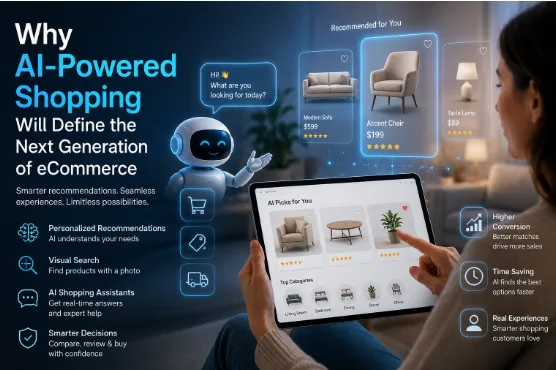
Artificial intelligence is no longer changing how people search. It is changing how they decide. That shift will redefine the future of digital commerce.
The End of Traditional eCommerce Has Already Begun
When Amazon introduced its AI shopping assistant Rufus, Google’s AI Overviews expanded globally, and OpenAI began integrating shopping capabilities into ChatGPT, many retailers viewed these announcements as independent product launches.
They weren’t.
Taken together, they represent the biggest structural change in online commerce since smartphones transformed shopping more than a decade ago.
For nearly twenty-five years, e-commerce has followed the same basic formula. Consumers searched using keywords, browsed category pages, compared specifications, read reviews, and eventually chose a product.
The process worked because shoppers accepted that finding the right product required time and effort.
That expectation is disappearing.
Consumers increasingly expect technology to understand what they mean rather than what they type. Instead of searching through hundreds of products, they want personalised recommendations. Instead of comparing technical specifications, they want clear answers. Instead of navigating complicated filters, they want a conversation.
Artificial intelligence is making that possible.
The implications extend far beyond better search results. AI is changing how products are discovered, how retailers compete, and how purchase decisions are made. Businesses that continue treating AI as another productivity tool risk missing a much larger opportunity.
The next generation of e-commerce will not be built around search engines.
It will be built around intelligent shopping experiences.
AI Is Solving the Biggest Problem in Online Retail
Ask almost any online shopper about their biggest frustration, and the answers are surprisingly consistent.
Too many options.
Too little guidance.
Too much uncertainty.
Finding products has never been the real challenge. Choosing the right one has.
Traditional e-commerce platforms solved accessibility. They made millions of products available with a few clicks. Yet abundance created a different problem.
Choice overload.
A customer searching for a coffee table might receive thousands of results. A simple search for “office chair” often returns hundreds of nearly identical products. Even experienced shoppers struggle to understand the practical differences between them.
Artificial intelligence changes the role of the retailer.
Instead of acting as a digital catalogue, an AI-powered store behaves more like an experienced sales consultant.
It understands context.
It asks relevant questions.
It explains trade-offs.
Most importantly, it reduces uncertainty before customers spend money. That shift benefits both consumers and businesses. Customers make faster, more confident decisions.
Retailers see higher conversion rates, lower return rates, and stronger customer loyalty.
Search Is Evolving Into Conversation
For years, success in eCommerce depended on ranking for keywords.
Retailers invested heavily in SEO, paid advertising, and category optimisation because visibility determined sales. Visibility still matters. The difference is that AI is changing how visibility is earned. Consumers increasingly search using complete questions instead of fragmented keywords.
Rather than typing:
“wireless headphones”
They ask:
“Which wireless headphones are best for long-haul flights under $300?”
Instead of searching:
“oak dining table”
They ask:
“What dining table works best for a family of six in a small open-plan kitchen?”
These are not keyword searches.
They are conversations.
Large language models, including those powering ChatGPT, Google Gemini, Microsoft Copilot, and Amazon Rufus, are designed to interpret meaning rather than exact phrases.
That fundamentally changes how products are discovered. Retailers can no longer rely solely on keyword optimisation. They must provide detailed, trustworthy information that AI systems can interpret, compare, and confidently recommend.
Better Product Data Is Becoming the New Competitive Advantage
One of the biggest misconceptions surrounding AI commerce is that sophisticated algorithms alone create better shopping experiences. They don’t. Artificial intelligence is only as effective as the information it receives. Poor product data produces poor recommendations.
Accurate product data produces intelligent recommendations.
This is why structured information is becoming one of the most valuable assets in digital commerce. Retailers investing in detailed specifications, high-quality imagery, comprehensive product descriptions, and organised catalogues are creating stronger foundations for AI-powered discovery. This principle applies whether a retailer sells millions of products or specialises in carefully curated collections.
For example, Scandinavian furniture retailer HandlaNu has invested in detailed product information and clearly organised product categories, making it easier for customers to compare options while giving AI-powered search systems richer context to understand product relevance. As conversational shopping continues to grow, retailers with well-structured catalogues are likely to gain a measurable advantage over businesses relying on minimal product data.
That represents an important shift. For years, businesses competed primarily for clicks. Increasingly, they will compete for recommendations. The retailer whose products AI understands best may ultimately become the retailer customers discover first.
The Companies Setting the Pace
This transformation is already visible across the world’s largest technology companies.
Amazon is using Rufus to answer product questions conversationally rather than relying solely on product listings.
Google’s Shopping Graph connects billions of product listings with AI-powered search experiences.
Shopify Magic helps merchants create richer product content while automating repetitive tasks.
IKEA uses AI to help customers visualise furniture inside their own homes before purchasing.
Although each company approaches AI differently, they all share one objective. Reduce decision fatigue. That may prove to be the defining competitive advantage of the next generation of eCommerce.
How AI Is Reshaping Every Stage of the Customer Journey
Artificial intelligence is no longer limited to helping customers discover products. It is improving nearly every stage of the online shopping experience, creating journeys that are faster, more intuitive, and far more personalised.
Recommendation engines now analyse browsing history, shopping behaviour, purchase patterns, and customer preferences to surface products that genuinely match individual needs. Instead of overwhelming shoppers with hundreds of options, AI narrows the selection to those most likely to result in a confident purchase.
Visual search is evolving just as quickly. Technologies such as Google Lens allow users to upload an image and instantly discover similar products, eliminating the need to describe styles or materials using keywords. Meanwhile, conversational AI assistants provide immediate answers about delivery, product compatibility, warranties, and returns, helping customers make informed decisions without waiting for human support.
The result is a shopping experience that feels less transactional and more consultative.
AI Commerce Depends on Trust, Not Just Technology
Artificial intelligence has generated enormous excitement, but it has also exposed a common misconception.
Many businesses believe adopting AI automatically creates a competitive advantage.
It doesn’t.
AI amplifies the quality of existing business practices. Retailers with incomplete product information, inconsistent pricing, or poorly organised catalogues simply produce weaker recommendations at greater speed.
The opposite is equally true.
Businesses that invest in detailed specifications, high-quality images, structured data, customer reviews, and comprehensive product descriptions provide AI with the context it needs to make accurate recommendations.
Consider someone searching for an ergonomic workstation for a home office. They are unlikely to be satisfied with a simple product title and a few images. They want to understand dimensions, materials, durability, storage capacity, and whether the desk will suit their workspace. A detailed product page for a scratching post for large cats provides the level of information that helps both shoppers and AI-powered shopping assistants determine whether it is the right choice.
This illustrates a broader lesson for every online retailer.
The businesses that provide the clearest and most trustworthy information will be the ones AI recommends with confidence.
What Business Leaders Should Do Now
Retailers do not need to replace their existing strategy to benefit from AI. Instead, they should strengthen the fundamentals that intelligent systems depend upon.
The most effective priorities include:
- Improve product descriptions with detailed specifications and practical buying guidance.
- Implement structured data to help search engines and AI systems understand products.
- Publish expert content that answers real customer questions instead of targeting keywords alone.
- Use AI to enhance customer support while keeping human expertise available for complex situations.
- Regularly audit product data to ensure accuracy, consistency, and completeness.
Businesses that combine AI with a customer-first mindset will gain a lasting advantage over those that rely solely on automation.
Frequently Asked Questions
What is AI-powered shopping?
AI-powered shopping uses artificial intelligence to personalise product discovery, recommendations, customer support, and purchasing decisions based on customer intent and behaviour.
Why is AI becoming essential for eCommerce?
AI helps customers find relevant products more quickly, improves shopping experiences, increases conversion rates, and enables retailers to operate more efficiently.
Can small online retailers benefit from AI?
Yes. Modern AI tools are increasingly accessible through platforms such as Shopify, allowing businesses of all sizes to improve merchandising, content creation, and customer service without significant infrastructure investments.
Will AI replace traditional SEO?
No. SEO remains important, but success increasingly depends on creating trustworthy, structured, and comprehensive content that AI systems can understand and recommend.
What is the biggest challenge when implementing AI?
The quality of the underlying data. Even the most advanced AI systems cannot deliver accurate recommendations if product information is incomplete or outdated.
Conclusion
Artificial intelligence is redefining digital commerce, but technology alone will not determine the next generation of successful retailers. The companies that thrive will be those that combine intelligent automation with exceptional product information, transparent communication, and genuine customer trust.
Industry leaders such as Amazon, Google, Shopify, Microsoft, and IKEA have already demonstrated that AI creates the greatest value when it removes friction from the buying journey rather than replacing human expertise.
As AI-powered shopping continues to evolve, one principle remains constant. Businesses that invest in accurate product data, helpful content, and customer-focused experiences will be best positioned to earn both AI recommendations and consumer confidence.
The future of e-commerce belongs not to retailers with the most AI tools, but to those that use artificial intelligence to make shopping simpler, smarter, and more trustworthy for every customer.