Best Queue Management Software for Hospitals: Features, Pricing & Comparison (2026)
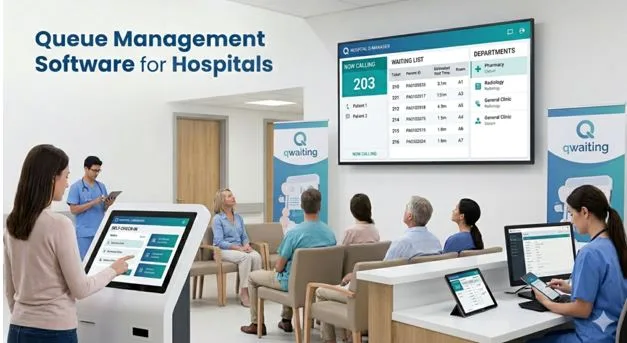
Walk into any hospital and ask patients what frustrates them most.
Many won’t mention the doctors. They won’t complain about the treatment. They’ll talk about the waiting. Waiting to register. Waiting to see a doctor. Waiting for lab results. Waiting at the pharmacy.
Long queues are more than an inconvenience for hospitals. They impact patient satisfaction, employee productivity, and overall efficiency. This is why healthcare providers around the world are investing in queue management software that can help to streamline and expedite patient journeys through the system.
However, with numerous vendors claiming to provide the best solution, there can be challenges in selecting the proper one. To help you make your decision, we’ve reviewed some of the top hospital queue management platforms in 2026: Qwaiting, Qmatic, Waitwhile, Wavetec, Qminder, JRNI and Vizitor.
Let’s compare them.
What Hospitals Should Look for in Queue Management Software
Before comparing vendors, it’s important to understand what actually matters.
The best hospital queue management software should help you:
- Reduce patient wait times
- Manage appointments and walk-ins together
- Send SMS or WhatsApp updates
- Allow self-check-in through kiosks or mobile devices
- Track performance with real-time analytics
- Scale across multiple departments or locations
Most importantly, it should make life easier for both patients and staff.
Here’s a list of a few popular and globally used hospital queue management systems for you to make your investment decision simple and driven:
1. Qwaiting: Engineered for Clinical Agility
Qwaiting is a cloud-native, web-based platform built specifically to handle the complex, multi-stage realities of healthcare environments. Trusted by massive enterprise healthcare networks, including Apollo Hospitals across 77 comprehensive branches, it functions as a complete patient-flow ecosystem.
Core Features
- Cross-Counter Patient Routing: Staff can instantly transfer a patient’s digital token from one department (e.g., General Triage) directly to another (e.g., Ultrasound) via the Staff Keypad app. The data and queue priority travel with the patient, eliminating the need to pull secondary tickets.
- Platform Independence: It works on Android, iOS, Windows, and any regular browser. It does not require dedicated media boxes or proprietary computing units; it utilizes existing tablets, computers, and smart TVs currently in use at a hospital.
- Virtual Entryways: When patients arrive, they scan a localized QR code to get on a virtual waitlist and can wait in the vehicles or in the cafeteria with live SMS communication updates.
Pricing & Value
Qwaiting utilizes a flat, transparent per-location subscription starting at $199 to $249 per month.
2. Qmatic: The Enterprise Industrial Titan
Qmatic is an institutional heavyweight built for large-scale enterprise environments. It specializes in centralizing operations across hundreds of international bank branches, government agencies, and massive public sector healthcare systems.
Core Features
- Orchestra Architecture: A deeply secure framework built to centralize complex patient data across massive hospital networks simultaneously.
- Predictive Business Intelligence: High-level reporting dashboards integrated with tools like Tableau for long-term clinical capacity planning.
The Hospital Friction Point
Qmatic is heavily dependent on proprietary physical hardware. Deploying the system involves long procurement cycles, custom structural wiring, and high upfront Capital Expenditure (CapEx). Because it is a rigid, hardware-heavy platform, making a quick change to a floor layout or adjusting a routing flow usually requires waiting for custom developer hours or on-site technicians.
3. Waitwhile: The Retail Specialist
Waitwhile is a highly polished, virtual waitlist engine designed with an emphasis on customer experience. It is a dominant player in consumer retail, hospitality, and salon environments where linear lines are the standard.
Core Features
- Polished Mobile Interfaces: Provides an elegant, clean web portal for customers checking into a queue from their mobile devices.
- Robust Text Automation: Highly flexible SMS and email notification flows that keep waiting parties engaged.
- Two-Way Chat: Allows frontline workers to message individuals directly from the waitlist dashboard.
The Hospital Friction Point
Waitwhile was fundamentally built for simple, “first-come, first-served” commercial setups, like waiting for an open table or a retail pickup counter. It struggles with the multi-layered triage logic mandatory in healthcare. It lacks the built-in capability to execute complex cross-counter patient handoffs, meaning separate clinical floors are forced to manage patients as completely disconnected events.
4. Wavetec: The Global Crowd Controller
Wavetec is an international customer journey player with a strong presence across European, Asian, and Middle Eastern banking hubs, telecommunication service centers, and high-volume public hospitals.
Core Features
- Omnichannel Intakes: Combines traditional physical paper ticketing with modern virtual lines powered directly through WhatsApp Business.
- Advanced Signage Controls: Drives large-scale, interactive multi-display digital signage setups across expansive open spaces.
The Hospital Friction Point
Much like Qmatic, Wavetec is an enterprise framework that remains anchored to physical hardware infrastructure. The high upfront implementation cost and complex physical setup parameters create operational inertia. System customizations are tightly gated behind enterprise contracts, preventing local clinical floor managers from modifying queue workflows on the fly as daily triage emergencies shift.
5. Qminder: The iPad-Locked Solution
Qminder is a streamlined, cloud-based queue management tool built for quick setup times, simple interfaces, and walk-in service analytics. It is widely used in tech hubs, university service desks, and urgent care clinics.
Core Features
- Clean Clerk Dashboards: Minimalist clerk monitors that let operators call, pause, or reassign visitors with almost zero technical training.
- Apple Ecosystem Optimization: Relies on slick iPad terminal kiosks at entryways for clean self-service sign-ups.
- Instant Service Metrics: Automatically tracks and graphs core KPIs like exact wait times and individual staff service speeds.
The Hospital Friction Point
Qminder’s front-end check-in checkouts rely strictly on iPad hardware. If an intake tablet drops from the network or suffers a hardware fault, that specific reception pipeline stalls. Furthermore, Qminder utilizes a per-user/per-seat subscription billing model. For a hospital operating with rotating nursing shifts and hundreds of personnel, per-user pricing scales rapidly and unpredictably compared to flat per-location options.
6. JRNI: The Appointment-First Platform
JRNI is an intricate, enterprise-grade booking and scheduling engine. It is engineered for high-touch corporate appointment booking, complex multi-staff event scheduling, and managing relationship-driven consumer interactions.
Core Features
- Remote Digital Pre-Check: Allows visitors to announce their arrival via automated email links hours before physically entering the building.
- Enterprise-Grade Compliance: Features rigid data security architectures designed for international financial and institutional entities.
The Hospital Friction Point
JRNI is built around the pre-booked calendar slot. It lacks the tactical flexibility to balance real-time walk-in traffic against scheduled appointments when an unexpected surge of urgent care patients hits a lobby simultaneously. Without an active, rapid-calling staff keypad, managing a chaotic live crowd becomes difficult.
7. Vizitor: The Corporate Lobby Log
Vizitor is a digital visitor management platform built specifically to modernize corporate office entrances, replace physical paper guest books, and print security badges.
Core Features
- Automated Employee Alerts: Instantly notifies specific internal employees via SMS, email, or Slack the moment their guest arrives.
- Digital NDA Signing: Prompts visitors to review and sign building safety documents or non-disclosure agreements on a tablet kiosk.
- Temporary Badge Printing: Interfaces with desktop thermal printers to output temporary adhesive contractor or guest security badges.
The Hospital Friction Point
While excellent for office security logging, Vizitor is unequipped for active patient flow. It entirely lacks active queue calling systems, multi-queue routing logic, multi-language audio voiceovers to call out token numbers, or the integrated digital signage components required to direct moving traffic across a multi-story clinical facility.
Quick Comparison
| Vendor | Deployment Model | Cross-Counter Handoffs | Hardware Restrictions |
| Qwaiting | Cloud SaaS (Instant Web) | Native & Fluid | None (Fully Agnostic) |
| Qmatic | Heavy Hardware / On-Premise | Complex Custom Setup | Proprietary Hardware Required |
| Waitwhile | Cloud-First | Poor (Single-Queue Focus) | None (Browser Based) |
| Wavetec | Hardware-Heavy | Complex Custom Setup | Proprietary Hardware Required |
| Qminder | Cloud Platform | Limited Capabilities | Locked to Apple iPads |
| JRNI | Custom Enterprise Integration | Poor Real-Time Handling | None (Browser Based) |
| Vizitor | Cloud Tablet App | Non-Existent | Tablet Kiosk Dependent |
The Strategic Verdict
Continuing to rely on paper tickets or trying to force a retail waitlist app into a clinical environment introduces operational friction. Enterprise giants like Qmatic and Wavetec provide durability but tie up hospital budgets in rigid, long-term proprietary hardware contracts. On the other side, simple retail apps lack the routing logic to guide a patient through a multi-stage clinical visit.
Qwaiting delivers a highly balanced approach. It provides enterprise healthcare features, such as native cross-counter transfers, multi-language audio announcements, and seamless HIS integrations, packaged inside an agile, flat-rate SaaS model that works on your existing devices.
Ready to streamline your facility’s patient flow? Launch a commitment-free, 14-day live free trial of Qwaiting to experience a friction-free intake pipeline firsthand.