How FFP3 Face Masks Protect Against Concrete and Silica Dust
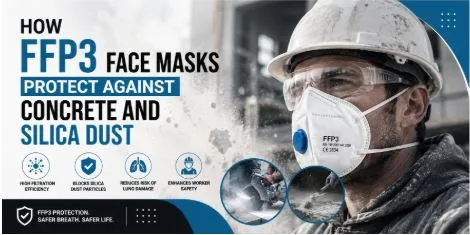
Have you ever thought about what you are actually breathing in when you chip concrete or grind a masonry surface? Silica dust, released whenever you cut, grind, or drill concrete, is one of the most hazardous substances in the construction industry. The dust cloud that disperses within seconds can linger in the air and in your lungs for a long time, even after the job is done. In fact, according to the Health and Safety Executive (HSE), an estimated 500 construction workers die from occupational lung disease, with silica exposure being a leading contributing factor.
A certified FFP3 mask is specifically designed to filter out the tiny respirable particles that cause long-term lung damage. So, what sets it apart from a standard dust mask, and does it really matter which one you choose? Let’s find out.
Why Concrete and Silica Dust Are Serious Construction Hazards
Concrete contains crystalline silica, a naturally occurring mineral found in sand, stone, and cement. For instance, sandstone contains more than 70% silica but granite contains around 15-30%. When concrete is disturbed, like when it is cut, drilled, or broken, respirable crystalline silica (RCS) particles are released into the air. These particles are microscopic. It means you cannot see them, smell them, or feel anything in the moment. That is what makes them so dangerous.
Prolonged or repeated inhalation of RCS causes silicosis, a fibrotic lung disease with no cure. It can also lead to lung cancer, chronic obstructive pulmonary disease (COPD), and kidney disease. The HSE classifies RCS as a substance hazardous to health under COSHH regulations, meaning employers have a legal duty to control exposure.
Common Construction Tasks That Release Silica Dust
Silica dust is not produced by one specific task. It happens due to a wide range of everyday site activities. Some tasks release low levels; others can lead to dangerous concentrations within minutes. Here’s a quick overview of common tasks that release silica dust in your worksite:
| Task | Silica Dust Risk Level |
| Angle grinding concrete or masonry | Very High |
| Hammer drilling into concrete | High |
| Block cutting with a disc saw | Very High |
| Scabbling or chipping concrete | High |
| Mixing dry cement or mortar | Moderate |
| Sweeping up concrete debris | Moderate to High |
| Demolition of concrete structures | Very High |
Why Silica Dust Exposure Builds Up Faster Than People Expect
The challenging part about silica dust is the cumulative nature of exposure. A single short exposure to silica without proper respiratory protection may not cause immediate harm. But when construction workers often carry out the same high-dust tasks repeatedly, it can cause health hazards to compound over time.
The particles responsible for lung damage are not the gritty dust you can see on your workwear. They are the invisible respirable fraction, particles smaller than 10 microns, that travel deep into the alveoli of the lungs. Once it reaches there, the body cannot remove them, leading to scarring and irreversible damage.
So, even a few minutes of grinding without a proper FFP3 dust mask can lead to a cumulative exposure.
Why Ordinary Dust Masks Often Fail on Construction Sites
Walk onto most construction sites, and you will find workers in disposable masks. But they are not always the right ones. There is a difference between a basic hygiene dust mask and a certified respiratory protective device, and that difference directly affects how much dust reaches your lungs.
The Problem with Loose-Fitting Dust Masks
Standard paper or foam masks, often sold in bulk at general trade stores, are not classified as respiratory protective equipment (RPE). They are designed to reduce exposure to nuisance dust, not to filter fine respirable particles.
Due to its poor fit, these masks allow unfiltered air to leak in around the edges, particularly along the nose bridge and cheeks.
Why Facial Sweat and Heat Reduce Mask Performance
Heat and physical exertion affect how well any mask performs. Sweat breaks down the foam seal on many disposable masks, and moisture causes filter materials to clog more quickly. When you pull your mask down to cool off, you will get exposed to the peak dust concentrations.
Hidden Risk of Wearing the Wrong Mask for the Task
FFP1 filters at least 80% of airborne particles; FFP2 filters 94%. Only FFP3 meets the 99% threshold needed for protection against highly toxic or fine particulates like silica. Using a lower-rated mask for high-risk tasks can pose health risks to the employees.
How FFP3 Face Masks Reduce Exposure to Concrete Dust
Now that you know why standard masks fail to protect employees in a construction environment. Here’s how FFP3 face masks reduce the exposure:
How FFP3 Filtration Works in High-Dust Environments
An FFP3 mask uses multiple layers of filter media, typically electrostatic non-woven fibres, to capture particles. It has mechanical interception, inertia impact and electrostatic attraction. All these three methods ensure that the filters used in FFP3 masks are capable of trapping no less than 99% of particles tested in accordance with the 0.3 micron test standard. That level of filtration covers the full size range of respirable crystalline silica particles.
Why FFP3 Masks Are Recommended for Silica Dust
As per guidelines issued by the HSE with respect to RPE used in construction dust, FFP3 is the minimum RPE for handling respirable crystalline silica. It includes concrete grinding, block cutting, and demolition. A properly worn FFP3 face mask can reduce the concentration of dust reaching the wearer’s lungs by a factor of 20 compared to the ambient environment.
Why Proper Fit Matters as Much as Filtration
FFP3 disposable masks and reusable respirators must be fit-tested to the individual wearer. Fit testing, either qualitative (using a taste agent) or quantitative (using a particle counter), confirms that the seal is adequate for that specific person’s face shape.
Disposable FFP3 Masks vs Reusable Respirator Masks
Choosing between FFP3 disposable dust masks and reusable respirators depends on the nature of your work, duration of exposure, and site conditions. Here’s how they differ:
| Feature | FFP3 Disposable | Reusable Respirator |
| Protection Level | FFP3 rated — filters 99%+ of particles | P3 filter — same 99%+ filtration |
| Best For | Short tasks | Daily, high-dust environments |
| Maintenance | Single use | Long-term use (replace filters regularly) |
| Cost | Affordable | Higher initial cost, but saves in the long term |
| Fit Testing Required | Yes, mandatory under COSHH | Yes |
When FFP3 Disposable Dust Masks Make Sense
For tradespeople carrying out short-duration tasks like an hour of grinding or spot drilling, an FFP3 disposable dust masks are a cost-effective choice. They require no maintenance, no storage of spare parts, and no assembly. They are ideal for sites where workers move between different locations and need lightweight protection.
But disposable does not mean reusable. Once an FFP3 dust mask becomes damp from breathing, visibly dirty, or damaged, then it should be replaced immediately.
Why Many Tradespeople Upgrade to Half Face Respirators
Workers who come in frequent contact with concrete and silica dust should opt for a half-mask respirator equipped with P3 filters that can be replaced. The mask’s solid facepiece provides a guaranteed seal as opposed to a disposable mask. In addition, since the facepiece is reusable, you just need to replace the filters.
The half-mask respirator is capable of using combo filters. It is beneficial for those who are exposed to dust along with fumes from adhesives, coatings, and exhaust.
Why Sundström Masks Are Popular on High-Dust Sites
Among reusable systems, the Sundström mask range has built a strong reputation across the UK construction and industrial sectors. The SR 100 half mask and SR 200 full face mask from Sundström are known for their robust build quality, comfortable fit, and excellent sealing performance. They are designed to accommodate workers with a range of face shapes. It means it reduces the risk of fit failures on diverse site teams.
The Sundström mask system uses a modular design: the same facepiece accepts different filter types depending on the hazard. For silica and concrete dust, the SHB 236/1 P3 filter is the best choice.
The Biggest Mistakes Workers Make with FFP3 Masks
Now that you have chosen the right mask, when and how it is used ensures your protection. Here’s what most employees fail to notice:
- Not wearing it for the full task duration: Many workers put the mask on for the dustiest part of a job, then remove it while tidying up.
- Pulling it down under the chin: The mask cannot filter the air it is not covering. Once it leaves the face, protection stops instantly.
- Using a mask that has not been fit-tested: Without fit testing, there is no way to confirm that the seal is adequate for that wearer.
- Ignoring replacement intervals: Clogged or damp filters offer reduced filtration efficiency, even if the mask looks intact.
- Sharing masks between workers: Reusable facepieces should be assigned to individuals, not shared.
How Employers Can Reduce Silica Dust Risks Beyond Masks
Respiratory protective equipment is not the only way to reduce silica dust risks. Under the COSHH hierarchy of controls, employers should first consider certain measures before relying on personal protective equipment (PPE). They can prefer:
- Wet working methods: Applying water to cutting or grinding surfaces suppresses dust at the source.
- On-tool extraction: Local exhaust ventilation (LEV) attached directly to grinders and drills captures dust before it disperses.
- Enclosed cabins and controlled areas: Segregating dusty work reduces exposure for other workers on site.
- Regular air monitoring: Measuring RCS concentrations helps confirm whether controls are working and identifies where additional protection is needed.
- Health surveillance: Regular lung function checks for workers regularly exposed to silica dust provide early warning of any developing condition.
Signs It’s Time to Replace Your FFP3 Mask
You need to replace FFP3 disposable dust masks or a reusable respirator mask periodically. Here’s how to know the right time:
- The mask is visibly dirty, deformed, or the straps have lost elasticity.
- Breathing through the mask feels noticeably harder than when new (filter is clogged).
- The mask has become wet with perspiration and cannot be adequately dried.
- It has been used for the manufacturer’s recommended maximum duration.
- The facepiece has been dropped, crushed, or stored loosely with other tools.
- The seal feels less consistent than when the mask was first fit-tested.
Final Thoughts
Silica dust is a serious but preventable danger. A quality FFP3 respirator mask, when worn correctly, fitted, and changed out regularly, offers adequate protection for employees working on concrete and stone projects. When dealing with short-term exposure, disposable FFP3 dust masks offer a cost-effective option. When working with high-dust conditions on a daily basis, a half-mask dust mask, such as the Sundström mask, is recommended. The important thing here is to select the correct mask type and wear it properly every time.
FAQs
Q1. Does an FFP3 mask protect against concrete dust?
Yes. An FFP3 mask filters at least 99% of airborne particles, including the fine respirable crystalline silica.
Q2. What is the best respirator mask for silica dust?
For most construction tasks, a properly fitted FFP3 face mask or a half-face dust mask with a P3 filter, such as a Sundström mask, is the best choice.
Q3. Can disposable FFP3 masks be reused?
FFP3 disposable dust masks are for single use. If they are wet, clogged, or damaged, they should be discarded.