tvmountingus.com | Outdoor TV in Chicago: Which TV and Mount Work on Your Porch or Patio Through Winter
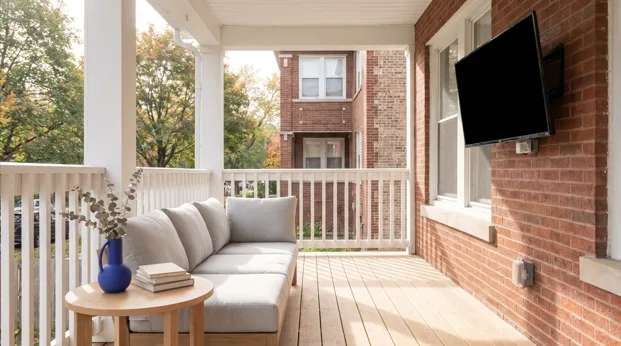
You have the TV, the porch and a summer of games ahead. Then you picture the same porch in January, with snow on the railing, and wonder whether that TV can stay out there. In Chicago the question is real: the National Weather Service lists the city’s all-time low at -27 F, set in January 1985.
The short answer: the winter plan decides the TV, and the spot decides the mount. A TV that stays out all year has to be an outdoor TV rated for the cold, under a roof. An indoor TV can work on a fully covered porch, but only if it comes inside every fall. Here is how to choose for your porch or patio.
Key takeaways
- Decide first whether the TV stays out all winter or comes in each fall.
- Only an outdoor TV rated for deep cold should stay out through a Chicago winter.
- An indoor TV on a porch needs a solid roof and a heated room for the winter.
- A cover keeps off rain and dust. It does not keep out the cold.
- Outside, the mount goes into brick, framing or a solid post, never siding alone.
Can you leave a TV outside in a Chicago winter?
Only an outdoor TV rated for the cold, and only under a roof. Look up your model’s spec page and find the lowest temperature it is rated for, switched on and switched off. If that number is far above zero, or the TV is an indoor model, plan to bring it inside before the first hard freeze.
How to choose an outdoor TV setup: five quick checks
1. Check how covered the spot is
Stand where the TV will hang during a rainy, windy day. If rain reaches the wall, the spot is open. A deep porch roof that keeps the wall dry is a covered spot, and it widens your choices.
2. Watch the sun for a day
Note when direct sun hits the wall, especially in the afternoon. Bright sun on a screen makes the picture hard to read. Outdoor TVs come in full-sun and full-shade versions for this reason.
3. Find out what the wall is
Knock on it and look at the corners. Brick, siding over framing, stucco and wood posts each take different hardware. Siding alone cannot carry a TV.
4. Find the power
Look for an outdoor outlet near the spot. It should be GFCI protected, the kind with test and reset buttons, under a cover that stays closed with the plug in. If there is none, an electrician adds one before the TV goes up.
5. Decide your winter plan
Choose now: the TV stays out all year, or it comes in each fall. Staying out means an outdoor TV rated for the cold. Coming in means a mount the TV lifts off easily, and someone at home to do it.
Each outdoor setup and what it needs
| Setup | What it needs | Watch for |
| Full-sun outdoor TV | An open deck or patio, an outdoor mount, an outdoor outlet | Its cold rating, checked on the spec page |
| Full-shade outdoor TV | A covered porch or pergola out of direct sun | Some only run above freezing |
| Indoor TV on a covered porch | A solid roof, a lift-off mount, a heated room for winter | Rain, sun, and the warranty |
| Any TV with a cover only | A fitted cover between uses | A cover does nothing against cold |
Full-sun outdoor TVs
These are built for open decks and patios that get direct sun. The screen is bright enough to read in daylight, and the case is sealed against rain and dust.
Some handle deep cold. Samsung’s spec page for its 65-inch Terrace Full Sun lists operation down to about -24 F. That is close to Chicago’s record low, though not all the way. The catch is price, and the rating varies by model, so check the exact one you buy.
Full-shade outdoor TVs
These are made for covered porches and pergolas, out of direct sun. They cost less than full-sun models and still shrug off rain and damp air.
The catch is the cold. SunBrite’s datasheet for its Veranda 4 lists an operating range of 32 to 122 F. Switched off, it can sit on the mount down to -24 F. So it can stay out through most winters, but it is not built to play the game on a January night.
An indoor TV on a covered porch
Many people use a spare living room TV under a porch roof. It can work in summer if the roof keeps rain and afternoon sun off it. Samsung’s TV manual says not to expose its TVs to rain, moisture, dripping or splashing.
The catch is winter. The same manual rates its indoor TVs for storage down to -4 F, and Chicago drops below that. An unheated garage can too. So the TV comes into a heated room each fall. A fitted cover helps between uses in summer, but it does not change any of this.
Check the warranty as well. Many makers do not cover an indoor TV that has been used outdoors.
The mount and the wall outside
An outdoor mount has a weather-resistant frame and corrosion-resistant fasteners. Indoor hardware rusts outside, and the rust streaks down the wall. Every hole drilled outside gets sealed, so water does not follow the bolts in.
On brick, the anchors go into the brick, not the mortar, as our post on mounting a TV on brick explains. On siding, the mount goes through a mounting block into the framing behind. A solid post or beam can take a full-motion arm that turns the screen toward the grill. Our guide on how to choose a TV mount compares the types, and our post on how high to mount a TV covers height, which matters outside too. Over an outdoor fireplace, the heat questions in our post on a TV above a fireplace apply.
Our outdoor TV mounting service anchors into brick, framing or a post, never the siding alone, and seals the holes we drill.
Chicago porches and patios and what fits them
Two-flat back porches. Often covered, with brick on one side. A full-shade outdoor TV on the brick under the roof is a natural fit, or an indoor TV that comes in each fall.
Bungalow decks and yards. Usually open to sun and rain. A full-sun outdoor TV rated for the cold, on a post, a beam or the brick wall of the house.
Garage walls facing the alley. Brick or siding, often in full afternoon sun. Treat it as an open spot and plan power first.
Condo and high-rise balconies. The outside wall belongs to the building, so ask management for its rules before anything is drilled.
Suburban patios and pergolas. Siding or posts, often with room for a covered pergola. Mount into the framing or a solid post, and pick full-sun or full-shade by where the light falls. We work across the city and the suburbs we serve most.
Common questions
Can a regular TV go on a covered patio?
Yes, on a fully covered patio, but it is a compromise. Samsung’s manual says not to expose its TVs to rain or moisture. Many makers do not cover a TV used outdoors, so check yours first, and bring it in for winter.
Does an outdoor TV cover protect it in winter?
It protects against rain, snow and dust, not cold. The TV under the cover is at the same temperature as the porch. An indoor TV under a cover still needs to come in for a Chicago winter.
What happens to a TV in freezing temperatures?
It may not run well, or at all. Indoor TVs are rated to run in a warm room and to be stored no colder than about -4 F. Some outdoor TVs only run above freezing, so check the spec page.
Do you need a special mount for an outdoor TV?
Yes. Use a mount made for outdoor use, with corrosion-resistant hardware and a weight rating above your TV. An indoor mount rusts outside, and the holes it sits in should be sealed.
Not sure your porch can take a TV?
Text R&R TV Mounting your TV size, whether the spot is under a roof, your zip code and a photo of the wall or post. We reply with a free quote, and the more detail you send, the more accurate it will be.